Banks worried that Hungarians don't need their credit anymore


Banks fear retail lending will run dry
The National Bank of Hungary (MNB) released loan and deposit statistics for the banking sector on Friday. The most spectacular negative change can be seen in retail lending, including housing lending, which has been booming in recent years: at HUF 59.5 billion, new lending is down 45% compared to October 2021.
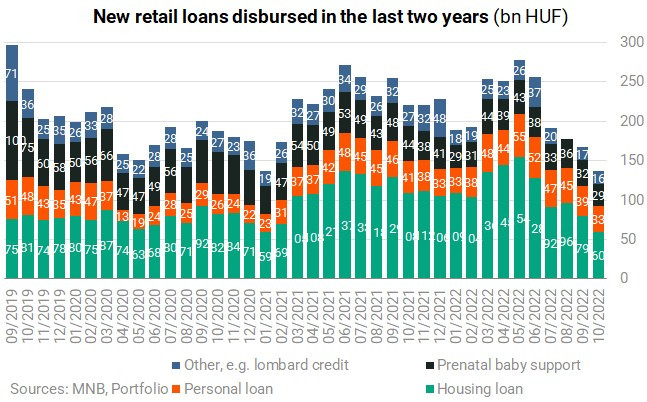
New personal loan originations started to fall year-on-year in August, and showed the largest decline since at 20% in October. Baby loans have been on a downward trend for a long time, so the 36% plunge in new originations in October is less striking. Overall, Hungarians took out 38% less loans in October and 12% less so far this year than this time last year.
| Annual change in newly extended retail loans | |||||
| Housing loan | Personal loan | Prenatal baby loan | Other | Total | |
| Cumulated Jan-Oct 2022 | 1.5% | 9.1% | -24.9% | -28.8% | -11.9% |
| October 2022 | -45.0% | -19.8% | -35.8% | -42.9% | -38.3% |
| Sources: MNB, Portfolio | |||||
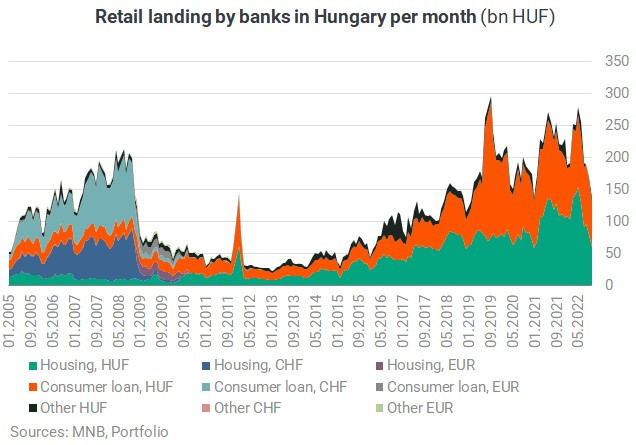
Due to the rising interest rate environment, the income-depleting power of inflation and soaring overheads, as well as economic uncertainty, the growth trend in household lending, which was interrupted during the coronavirus pandemic but has continued since 2013, seems to be coming to an end.
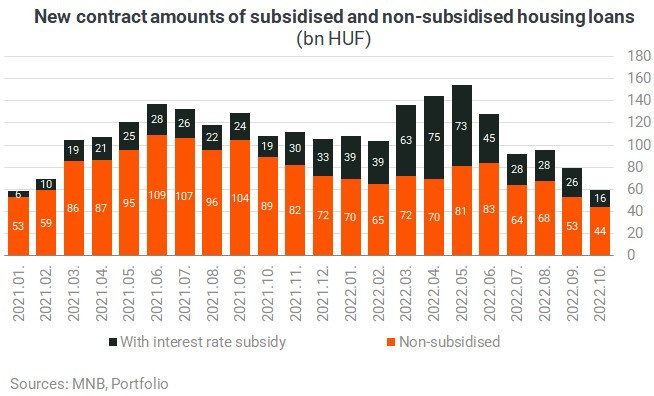
Customers bear the burden of the rising interest rate environment for market-rate loans and the state for subsidised loans. This explains why market-based housing loans fell by 51% in October, while subsidised housing loans fell by "only" 19%.
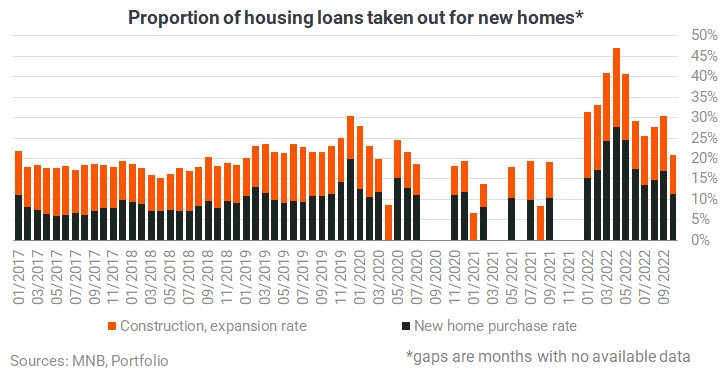
With fewer new housing projects and fewer people daring to build their own home, the share of new housing loans has fallen again to around 20% of total mortgage lending, while the share of renovations rose to over 10%.
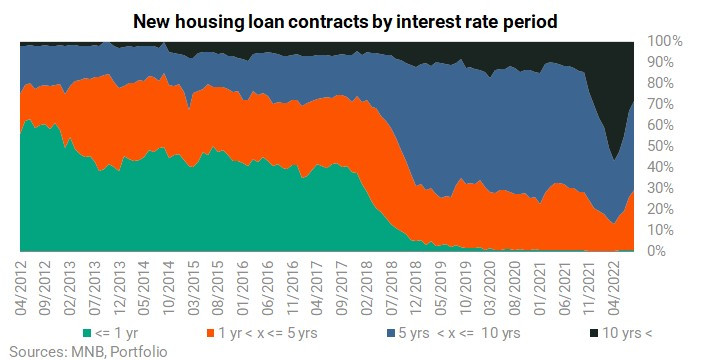
After the expiry of the central bank's Green Home Programme, the housing loan market has also recovered in terms of interest rate period, but not completely: the share of fixed-rate loans and loans with a 5-year interest rate period seems to have stabilised at around 30%, while the 10-year interest rate period is the most popular with a share of around 40% of new lending.
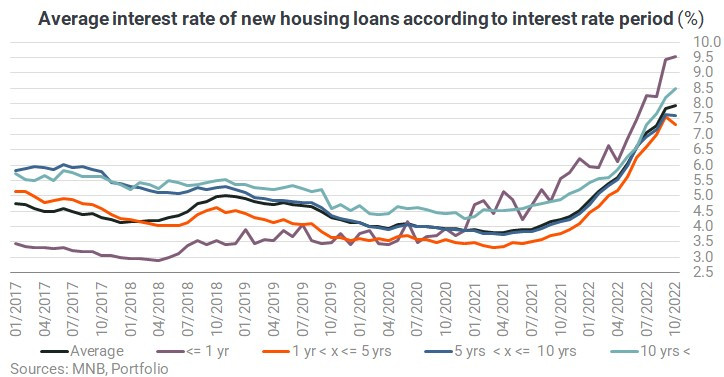
In the first half of autumn, the banks' momentum to raise interest rates seemed to have slowed down: housing loans were offered at an average rate of 7.95% in October, up less than 1 percentage point compared to July. The rise in the yield environment in recent months justifies higher rate rises than this, and this was only partly the case in November. Some banks fear that excessive rate hikes will cause them to lose market share and, as housing loans are the number one product to acquire customers, this could have negative business consequences for them across the board.
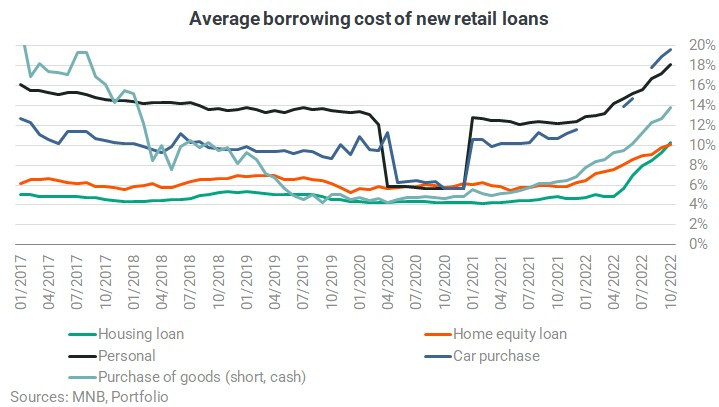
Over the past year, the increase in the average percentage rate (APR) of personal loans has been more pronounced than that of home loans, with the former rising by 5.9 percentage points and the latter by 5.4 percentage points over 12 months. For personal loans, this represents a proportionately smaller increase due to the shorter average maturity. The APR of an average personal loan in October was already 18.2%.
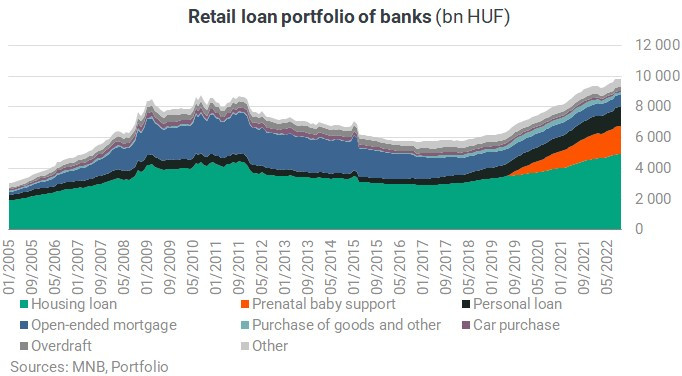
The annual growth rate of retail loans in the Hungarian banking sector slowed to 6.8% in October from 15.7% at this time last year. In addition to the decline in lending, a significant contraction in the number of borrowers in the repayment moratorium and an increase in early repayments in the spring also played a role. At the end of October, the retail loan stock in the banking sector stood at HUF 9,840 billion.
A couple of problems with retail deposits
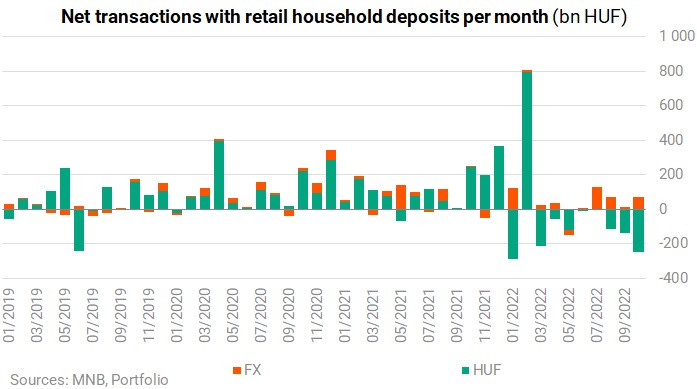
As with household loans, the situation is not so bright when we look at household deposits, either, with more money being withdrawn than deposited with banks. The phenomenon is also linked to speculative exchange rate deals, as the net HUF -251 billion of transactions in HUF deposits was accompanied by a net HUF +72 billion of transactions in foreign currency deposits last month.
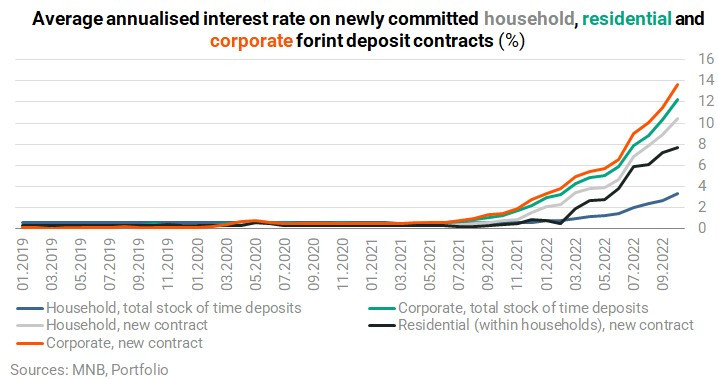
The stock of fixed-term deposits continues to show no significant growth, for a clear reason: even including higher interest rates on private deposits, banks paid an average interest rate of only 3.3% on retail deposits in October. Our graph shows how much better the situation is for new contracts concluded by mainly private bank customers and for corporate deposits, which are constrained by the new deposit rate freeze:
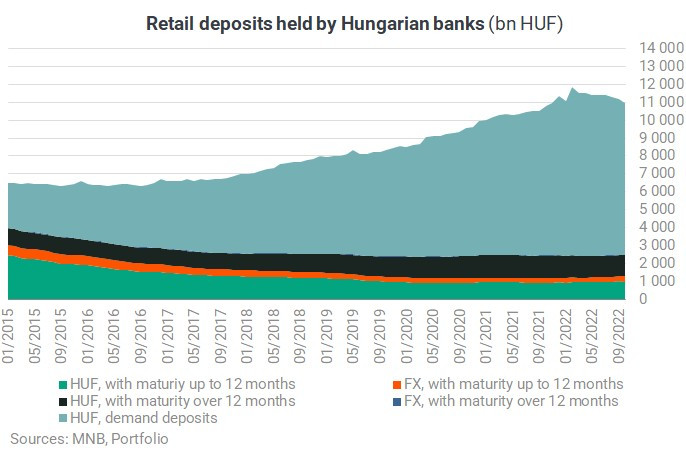
No wonder 81% of household deposits are sitting uncommitted in bank accounts, but despite higher interest rates, the demand rate for companies is still high at 74%. The downward trajectory of retail deposits since February is also striking: although retail savings in bank deposits have risen by 7% in a year, in the eight months since February, they have fallen by 2.9%.
Corporate lending: booming but not how you'd think
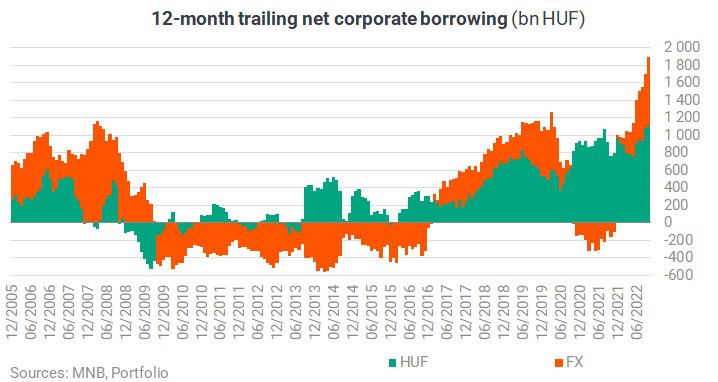
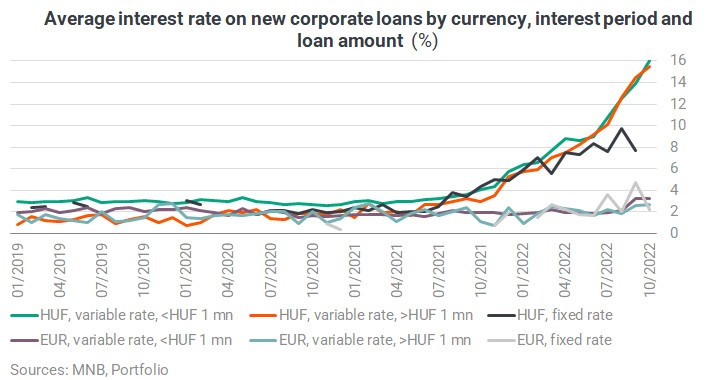
Unlike retail lending, corporate lending continues to boom. However, its structure has changed significantly: forint investment loans at market rates have almost disappeared, replaced partly by subsidised forint loans (especially the Széchenyi Card Programme's working capital and liquidity loans) and partly by foreign currency loans, also at lower rates. In any case, corporate borrowing was HUF 256 billion higher than repayments in October.
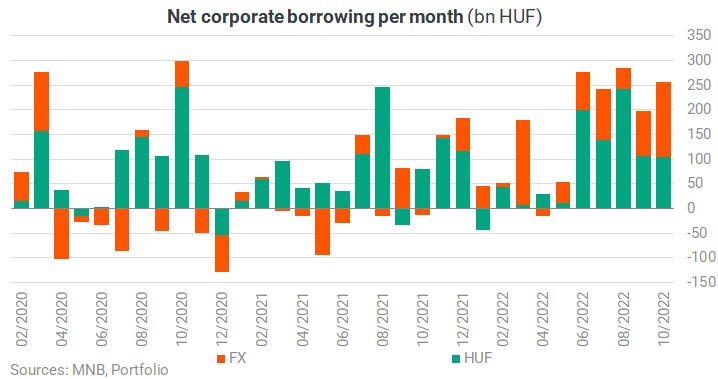
In the past year, businesses borrowed HUF 1,100 billion more in forint loans and HUF 790 billion more in foreign currency loans than they repaid. On a transaction basis, the stock of corporate loans increased by HUF 1,890 billion, or 22% overall.
The chart below explains why companies are not choosing forint loans at market interest rates.
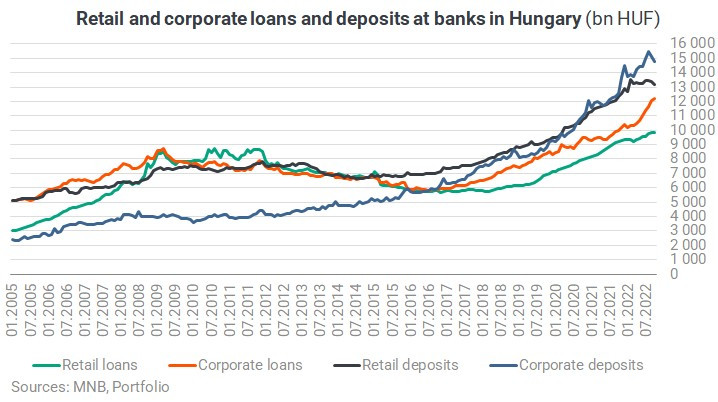
The banking sector is also split into corporate and retail in terms of trends:
WHILE BOTH RETAIL LOANS AND DEPOSITS HAVE GROWN BY 7% IN THE PAST 12 MONTHS ALONE, CORPORATE LOANS HAVE INCREASED BY 22% AND CORPORATE DEPOSITS BY 18% IN THE PAST YEAR.
Cover photo: Getty Images





