Largest Hungarian steel works Dunaferr could shut down for good on Monday


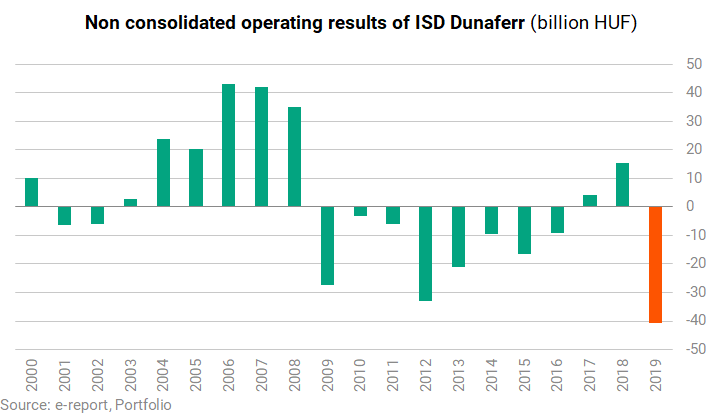
Dunaferr's debt is tens of billions of forints and it has been in a near-bankruptcy situation for two years. For years, the Russian and Ukrainian owners have been unable to agree on the management of the company, the war has worsened the company's situation, and deliveries of raw materials are also disrupted.
On Wednesday, Tamás Pintér, the mayor of Dunaújváros, called a crisis meeting, where Tankhilevich said that without state support, the Dunaújváros steel works' blast furnace could shut down on Monday. If this happens, the cold and hot-rolling mills of the steel works will be left without raw materials, and the liquidation of Dunaferr will become inevitable, the daily says.
Interestingly, in an interview with Portfolio two days ago, Tankhilevich’s deputy spoke of similar problems. According to Mónika Sevcsik, a plan is currently being drawn up to ensure that the shutdown is carried out in such a way that it will be possible to restart the plants at a later date. We are talking about two groups of installations: the two blast furnaces and the coke oven batteries and its other chemical plant equipment. These are basically the bottlenecks. There were temporary shutdowns in the blast furnace before, but we have never had one in the coking batteries. There are technical possibilities to preserve the condition of these units under much better conditions and circumstances than if there had been a forced shutdown with an immediate power cut.
Last week, Portfolio reviewed the situation at the steel works, and we wrote then that the Dunaújváros steel works might not live to see its 70th birthday in its current form. The extremely long series of events of the past few years has taken a tragic turn, and the negative developments have accelerated as the power cut has made the safe shutdown of the plant in Dunaújváros the primary objective.
The importance of the steel works, which has seen better years (in 2001 it was the 13th largest company in Hungary, but still ranked 31st in 2016) for the city and the region remains unquestioned, and many may now ask, as the steel works faces what may be its final hours, whether there is any chance of continuing. This would require an accurate assessment of whether the conditions are right to keep the plant fully or partially operational in the short term. Things that would be necessary:
- Money: it is uncertain for whom the steel works remains attractive in its present state (there was talk earlier of attracting a foreign investor) and what possibilities the state has to put money into the steel works.
- Plant: the current shutdown will be accomplished in a safe way, but it is not known whether, given the money and the will, the technicians would be physically and technologically able to restart production, for example in the blast furnaces or the coker. There are conflicting reports on this inside the factory gates.
- Skills: the recent news of uncertainties has certainly accelerated the exodus of workers from the plant (it is not difficult to imagine how someone who is not being paid a decent salary but is burdened by increasingly heavy winter bills will decide), which could lead to the loss of workers with valuable skills and expertise, with the risk that when the plant or management arrives to that point, there would be no one to plan the restart.
- Energy: this is a very important issue not only in the short term but in the longer run as well. Because although the price of energy has fallen in recent months, it is still much more expensive than it was in the years of peacetime, so it is questionable whether the steel works can produce a competitive product without cheap energy in the long term.
- Raw material: the procurement of raw material is not only financially risky, but also logistically and supplier-wise (due to the war in the neighbourhood).
- Environmental costs: The consequences of buying a carbon dioxide quota.
Cover photo: Getty Images





