Hungarian retail supply on a race to the bottom: painful months ahead


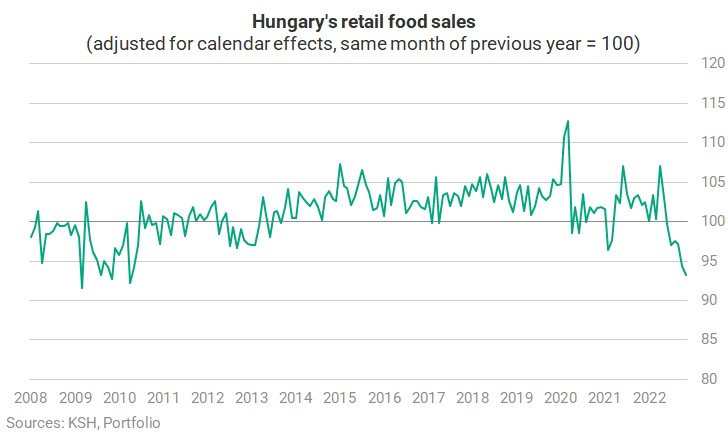
Retail sales have been falling for months even without petrol consumption
György Vámos, Secretary General of the National Commercial Association (OKSZ), told Portfolio. Excluding fuel sales, the decline was already 4.6% in November compared to the same period last year.
"Based on the statistics by commodity group, pure food sales already showed a 5-6% decline in the third quarter," said Vámos. Since then, trends have become even more negative. The OKSZ Secretary General pointed out that
the decline in food consumption is getting worse month by month, meaning that the food price freeze has been less and less able to curb the decline over time.
"In the autumn, people bought more clothes, but furniture and technical goods no longer showed an increase. In other words, people are cutting back on buying higher-value goods because they need to reallocate their money to buy much more expensive food. However, even the reallocation is not enough to keep up the volume of their food purchases," said György Vámos.
Food prices are rising by more than 40% in Hungary, which is not only the highest rate of increase in the European Union, but also one of the top 10 countries in the world with the highest food inflation, according to the World Bank.
The OKSZ Secretary General pointed out that the turnover of online stores has declined, and Black Friday has also been weak. Last year, online sales declined after the web overran during the epidemic, with shoppers returning to traditional stores. On the other hand, online retailers were not able to advertise promotions of the same size and weight as last year's Black Friday. "People are also saving money on the internet because of food and fuel price rises," he added.
According to György Vámos, the first half of 2023 will be very difficult for retailers.
"On the one hand, prices will continue to rise in the coming months, which will push back consumption, and on the other hand, volumes could fall because the base was high in the first half of last year. I expect an improvement only in the second half of this year," he concluded.
Cover photo: Shutterstock





