Hungary net earnings at the bottom of EU rankings


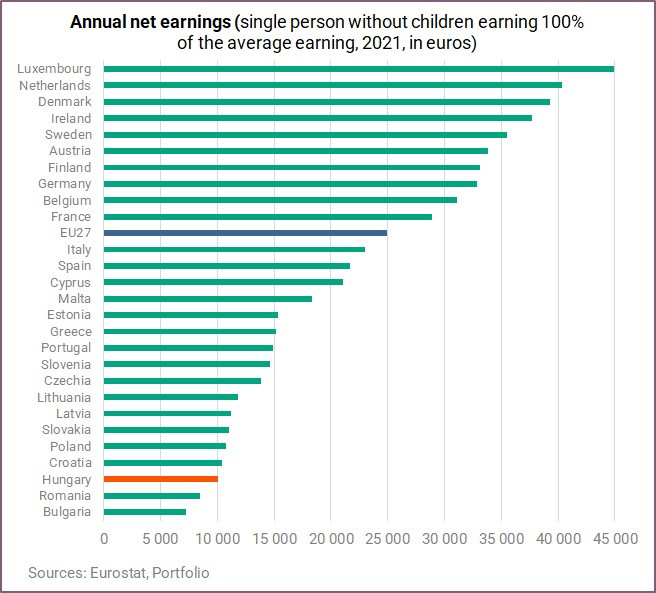
Annual net earnings of a single person without children earning 100% of the average earning was EUR 10,075 in Hungary in 2021, the third-lowest in the EU after Romania (EUR 8,476) and Bulgaria (EUR 7,272). At the top of the ranking we find Luxembourg (EUR 44,935), the Netherlands (EUR 40,312), and Denmark (EUR 39,274).
Eurostat data attest that Hungary's earnings level has been gradually approaching that of more developed EU Member States. The annual net earnings of a full-time single worker without children earning an average wage (PPS) in Hungary reached 24.3% of an Austrian citizen in the same category in 2010, while the ratio has risen to 29.8% by 2021.
In euro terms, the ratio grew even more, to 51.4% from 39.8%.
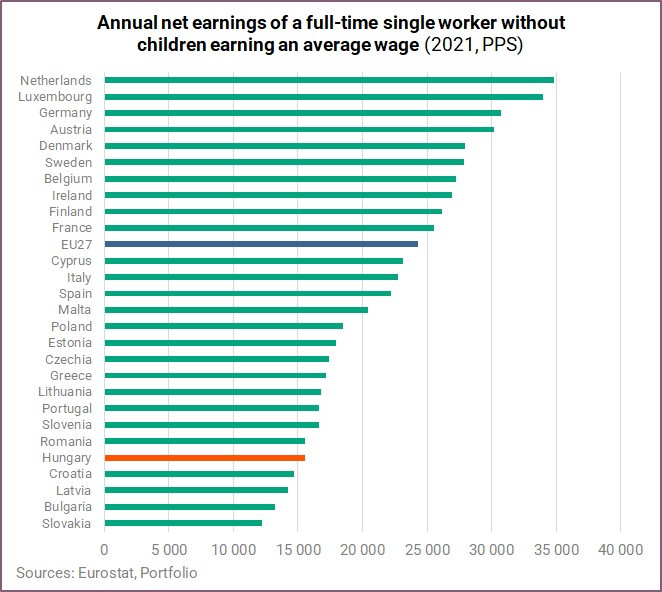
In terms of annual net earnings (of a full-time single worker w/o children earning an average wage) at purchasing power standard, Hungary is fifth from the bottom of the ranking, coming before only Croatia, Latvia, Bulgaria and Slovakia in 2021.
The situation has worsened since 2010: Hungary has fallen from the 21st spot to the 23rd place in terms of earnings in euro among the 25 Member States with the adequate figures, while it remains 22nd in purchasing power parity.
The increase in earnings compared to 2010 is the same for single-earner families with no children and for families with children. It can also be seen that in most of the Eastern European countries surveyed, net earnings have grown faster than in Hungary. The Hungarian growth rate is 60-63% for the different earnings indicators, while e.g. Estonia has seen net earnings grow by 69-96%, Romania by 119-124%, Bulgaria by 118-127%, and also by 27-31% even in Austria.
The two graphs below show the annual changes in euro and PPS terms between 2021 and 2012 (that is as far as Eurostat data go back).


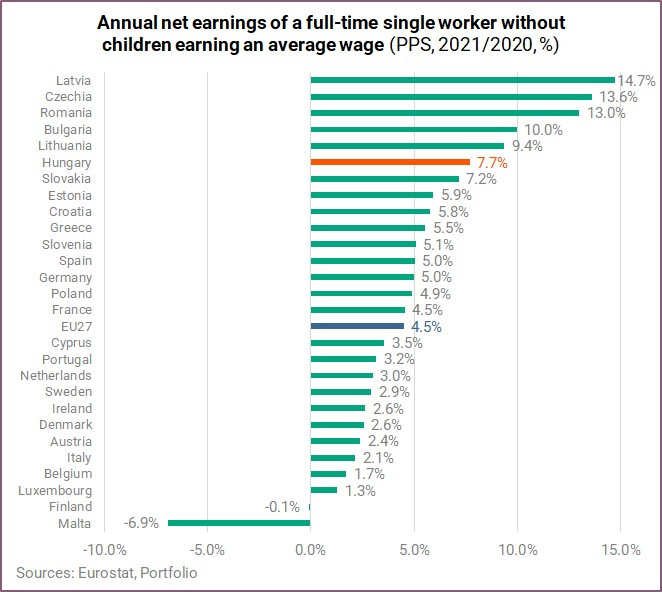
The two graphs below show the same changes but only between 2021 and 2020.

Cover photo: Getty Images





