Already 300,000 Hungarians define themselves as unemployed


Between October and December last year, 284,000 people defined themselves as unemployed, the Central Statistical Office (KSH) said in response to an inquiry by Portfolio. In this period, the number of officially unemployed (ILO unemployed) was 189,000, which means that roughly 100,000 more people considered themselves unemployed (self-classified unemployment) than official data show.
This is because, in order to be officially classified as unemployed, you have to meet a number of criteria according to international methodology. This requires that the respondent must have been actively looking for work during the four weeks preceding the interview and that he/she should have been able to start work within two weeks if he/she could find a suitable job. For self-classified unemployment, however, it is how the interviewee defines himself/herself that matters.
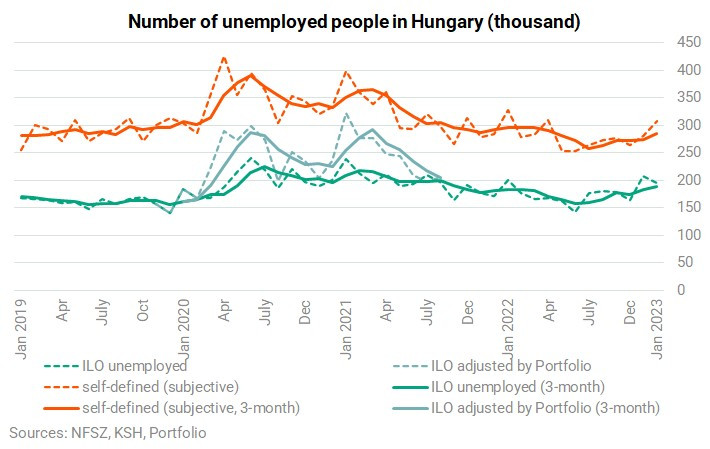
From the data provided by the KSH to Portfolio, it is also possible to calculate how many people considered themselves unemployed in December alone and that number is over 300,000. Compared with the same period last year, we see an increase of 24,000, and if we compare this with the low point seen during the middle of last year, the increase is 50,000.
The three-month average self-classified data show no year-on-year increase in the number of unemployed, but the 284,000 self-classified unemployed are almost 30,000 above the low point of the year, so there is already a noticeable increase. (The 3-month average figures show a slower turnaround, as was the case in the Covid crisis.) Based on the latest data from the KSH, it is worth noting that the self-classified unemployment rate for the last quarter of the year is close to 6%, with a 6.4% unemployment rate in December alone.
Self-classified unemployment, by the way, correlates quite well with the evolution of the labour reserve, i.e. unemployment in the broad sense. This group includes not only those who are officially unemployed, but also those who have no job, but have not been looking for a job continuously in recent weeks, or could not find a job almost immediately.
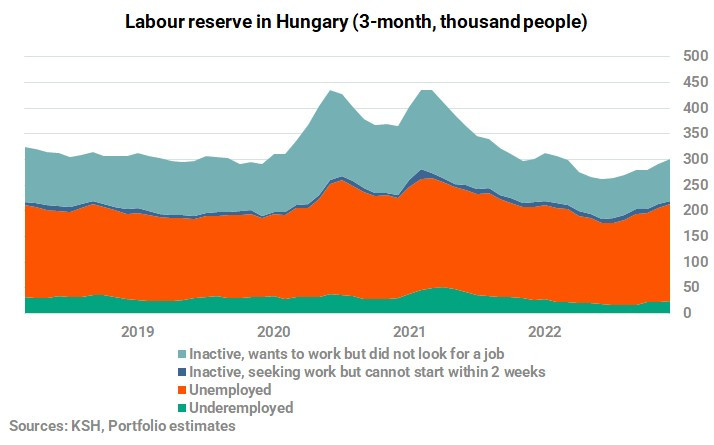
Moreover, labour supply developments and self-defined unemployment moved in tandem during the Covid waves, when official data showed unemployment barely rising. At that time, official unemployment did not go up because, even though people lost their jobs, many were unable to meet the active job search or work entry criteria (and so did not statistically increase the pool of unemployed, but were included in the labour reserve) in the face of the restrictive measures imposed during the pandemic. As in the past, we now see that both self-defined unemployment and the labour reserve are at similar levels.
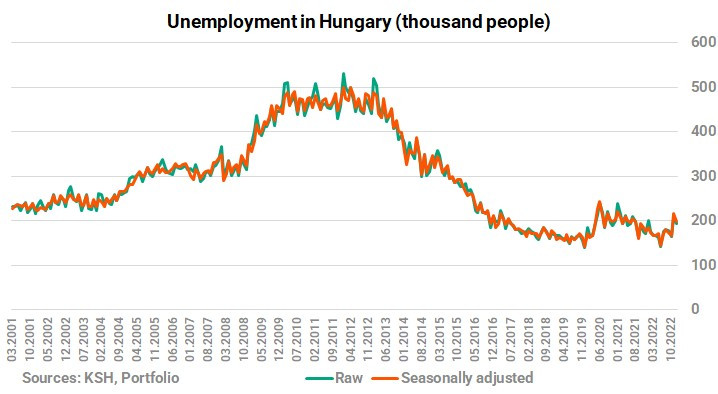
Official data (ILO unemployment) also show a reversal of the trend in the middle of last year. The 189,000 unemployed between October and December, based on official data, represent an unemployment rate of 3.9%. This is 0.2 percentage points higher than the same period of 2021, and exceeds the lows of 3.2-3.3% recorded in the middle of the year, when there were 160,000 unemployed. Unemployment was close to 3%, reflecting full employment, but the rate has risen slightly as the active population has grown, with not all of them finding work, the overall decline in labour shortages and the recession has taken hold, but the domestic labour market is holding up well for the time being, with no mass layoffs.

One might also suspect that seasonal effects have boosted unemployment, as there is less seasonal work in winter than in summer, but in a period of labour shortages (for the time being, only vacancies in many sectors are falling, but remain high) these seasonal effects are very small. That said, we have looked at whether seasonal adjustment produces better or worse numbers than the raw data show. The seasonally adjusted data show that the number of unemployed in November and December was already around 200,000, an increase of 40,000 from the low point in the spring-summer.
The difficulties in energy-intensive industries could therefore easily be reflected in the unemployment figures: a host of small shops have gone belly-up in the retail sector, while tourism and catering could be hit by a substantial drop in the number of accommodation establishments and the temporary closure of some restaurants. Some of the workers in the energy-intensive sector may now find jobs in industry, where vacancies remain. However, there's great uncertainty how the scenery will change in the spring months: the economy will not be picking up yet, but the fall in energy prices could bring some recovery in energy-intensive industries.
Self-classified unemployment is not part of the monthly unemployment data release. The KSH counts the unemployed according to the international methodology in the Labour Force Survey (LFS). However, the LFS also includes the 'self-defined unemployed' (whether or not the respondent considers himself unemployed), which are now known for 2022, courtesy of the KSH. To get a full picture of unemployment, it is worth looking at several different indicators.
Cover photo: Getty Images





