Hungary has never had so huge FX reserves, yet c.bank is most secretive


Foreign exchange reserves have never been this massive
By the end of January, the central bank's international reserves had risen to €40.26 billion, an unprecedented level. The MNB's statistics have been available since 1998, and the reserve has certainly not been higher than the current level since then.

The above amount means that the central bank's reserves have increased by roughly €1.5 billion in one month. This was mainly the result of the $4.25 billion forex bond issue seen in early January. However, the figures also show that without this, the reserve would have fallen significantly.
Of course, the net foreign exchange issuance in January was "only" USD 3.25 billion, as the central bank also bought back USD 1 billion worth of higher-interest forex bonds with the money raised from the latest issuance. There was no FX bond maturity in the first month of the year, and the country will get rid of nearly a billion dollars of debt only this month. This also means that the reserve could fall back below €40 billion in February.
The central bank does not elaborate on the effects that have reduced or increased the amount of the reserve, but some potential factors can be summed up as follows:
- The MNB will continue to provide the foreign currency to settle the energy bill. (We'll get back to this later.)
- There are usually interest payments, but they are limited to a few hundred million euros.
- Earlier, the central bank hinted that the ECB's EUR 4 billion repo facility could be used in the end-of-quarter FX swap tenders. Thus, it is possible that after the end-December tenders, there were also foreign currency repayments to the euro area central bank in January.
- The acquisition of Vodafone is backed by a €750 million loan from state-owned Eximbank and a €425 million loan from the Hungarian Development Bank (MFB). It is not known whether the central bank provided the foreign currency funding or whether the two financial institutions had their own forex resources.
Everything quiet on the energy bill front
Now, let's take a closer look at the issue of energy bills. In October, the MNB announced, at the same time as it raised the benchmark rate by 500 basis points, that it would provide foreign exchange to energy importers so that they would not have to exchange on the market, putting pressure on the forint. In a first step, this was done by the end of the year, and since then it has been mentioned in December and January in the Monetary Council's post-meeting statements that the programme will continue, with the foreign exchange reserve still available for this purpose.
Some sounded the alarm already after the announcement, on concerns that the already not very ample foreign exchange reserves would be further depleted by the settlement of the energy bill. Despite this, the central bank's foreign exchange reserves hardly changed in the fourth quarter. However, if we take into consideration that the Government Debt Management Agency (ÁKK) sold foreign currency bonds worth EUR 1 billion, 2 billion yuan and USD 400,000, which together raised about EUR 1.65 billion in foreign currency, the effect is still visible despite the stagnation.
The amount of foreign currency made available by the MNB under the facility is not public information, the central bank replied to a question from Portfolio when asked how much foreign currency they have had to provide from the reserve to pay the energy bill since October.
When the measure was introduced, the MNB estimated that the amount needed could be as much as €1.0-1.5 billion per month, but since then the world price of natural gas has fallen by half or two thirds, so the required amount is likely to be much lower today. That much was acknowledged by the MNB too, which stressed that
the fall in energy consumption in recent months has led to an adjustment of domestic economic agents on the energy market, which, together with the drop in energy prices, allows foreign exchange market equilibrium to be maintained with less foreign currency liquidity than previously expected.
In other words, not only the decrease in energy prices, but also the adjustment of the Hungarian economy could reduce the required amount of FX sources. The MNB also stresses that they will continue to respect the foreign exchange reserve requirement rules when using the facility, as they clearly believe that they have sufficient foreign exchange available to continue the operation.
No decision has yet been taken on how long the MNB will provide the necessary foreign currency for energy importers, but according to the answer to our question it
constantly monitors developments in relation to reserve adequacy, the foreign exchange market balance and energy imports and, if necessary, decides on an extension based on the current specifics, which [extension] is not automatic.
They have not yet commented on how long the country may need to cover the energy bill from the foreign exchange reserve, and the timing and other implementation parameters of the phasing-out of the instrument will be determined on the basis of the above market developments.
Forex reserves large enough for now
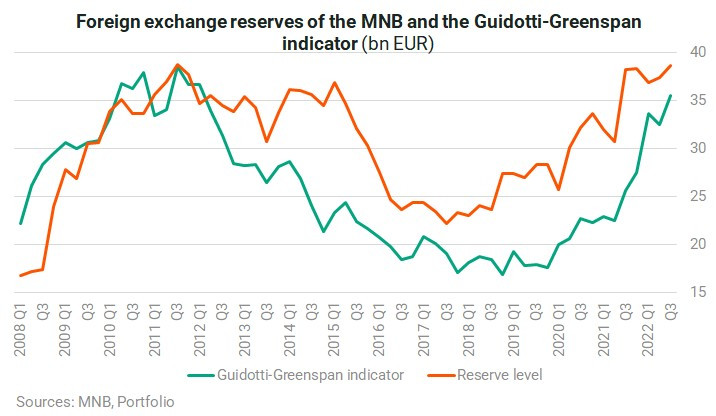
As the MNB has pointed out, there is currently no risk of the central bank's foreign exchange reserves being too low, based on international standards. One important indicator is the so-called Guidotti-Greenspan rule, which relates a country's short-term external debt to its international reserves.
The Guidotti–Greenspanrule is an international economics guideline that states that a country's reserves should equal short-term external debt (one-year or less maturity), implying a ratio of reserves-to-short term debt of 1.
This is updated quarterly in the central bank's balance of payments report, with the Q3 2022 report published in January. It showed that at the end of September, reserves amounted to EUR 38.7 bn, with the required minimum at €35.6 billion. Since then, however, this may have fallen due to the drop in world energy prices, while the reserves have risen to over EUR 40 billion.
The picture becomes less rosy if we look at another indicator, three-month imports, which already exceeded the central bank's foreign exchange reserves at the end of September. The December data will be published on Wednesday morning. In the three months up to end-November, imports amounted to €42.2 billion,
which exceeds even the record large reserves.
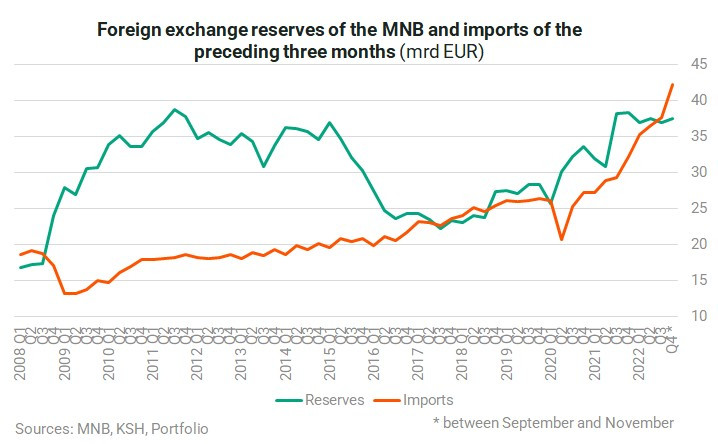
It is important to note that the three-month import indicator is no longer used, as it is considered obsolete. In addition, imports will fall sharply from here at current energy prices, as the €13-14 billion per month mentioned above were imports at gas prices well above €100. In addition, the November imports, due to the two-month delay, included gas prices from September, when they were around €200, and have since fallen by two thirds or three quarters. The big question for the coming months will be how fast Hungary's imports will decline with energy prices dropping sharply, and whether the current favourable world gas prices will be maintained. The possibility of prices starting to rise again looms persistently.
Cover photo: Getty Images





