Hungary in recession, labour market outlook uncertain


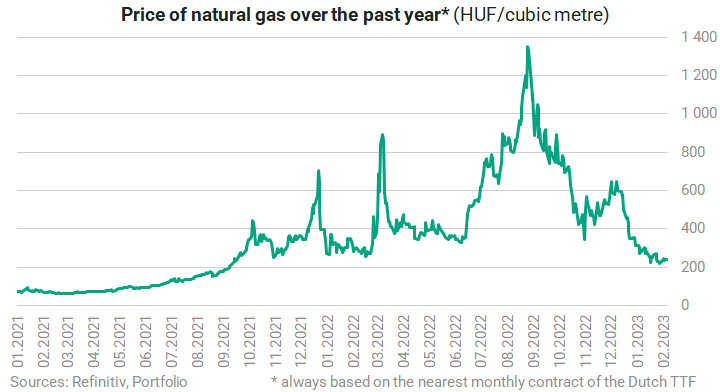
Where are the days when we worried about EUR 200-300 gas prices? Today, gas prices on the Dutch stock exchange are around EUR 50, which is likely to be a great relief to many. Not everyone, of course, as the unfolding energy crisis has left many companies stuck at high energy prices, or some temporarily suspended or closed down. Like the Covid crisis, the energy crisis is taking its toll, but the economic outlook is not nearly as gloomy as it was three or four months ago.
Improving European outlook
Attempts to curb the soaring gas prices and the mild winter in Europe have combined to cause gas prices to plummet on the Dutch stock exchange, which determines European prices. The world market price has now fallen to pre-war levels, still high, but nowhere near as dangerous as when it was at €200-300. In addition, with the significant reduction in gas consumption, storage capacities have reached a reassuringly high level, so there is no question of limiting production in order to provide the population with sufficient energy. This scenario would have led to a drastic downturn in the economy.
Although current price levels remain high, they have now been corrected to pre-war levels. And the economic outlook has started to improve as the energy crisis eases. Europe can avoid recession this year: even if there is some contraction in one or two quarters, it will not be significant. In addition, inflation is turning around on the continent, with most countries already past their peak, so there should not be a drastic fall in demand and consumption and investment could be better than previously expected. The improving outlook in Europe also means that the Hungarian economy's prospects are much brighter than at the time of the gas price peak. The economy may avoid a downturn on an annual average thanks to the stability of the export markets, but a technical recession has not been avoided.
Unemployment slowly rising in Hungary
Improving the outlook is not enough to reverse all negative trends. There are factors that make the domestic situation different from that in most other European countries. We have not yet seen the key moment of falling inflation, the pace of price increases could peak in the coming months, and the rate of monetary depreciation in the country is unprecedented in Europe. This is keeping domestic demand under sustained pressure, and with food prices rising at an astonishingly high rate, we are among the countries with the highest price increases in the world, forcing the population to adapt in a way not seen for decades. In recent months, the purchasing power of wages has fallen, putting pressure on domestic demand, while unemployment has started to rise, which is also holding back consumption. Meanwhile, after the onset of the technical recession, the recovery cannot be helped by the state in any meaningful way on the fiscal side, and the budget deficit has to be cut sharply, which is also pulling the economy back. Against this backdrop, it is not surprising that the unemployment rate is now around 4%, down from the 3.2-3.3% level of full employment in the spring/early summer of last year (Eurostat data show it was already above 4%).

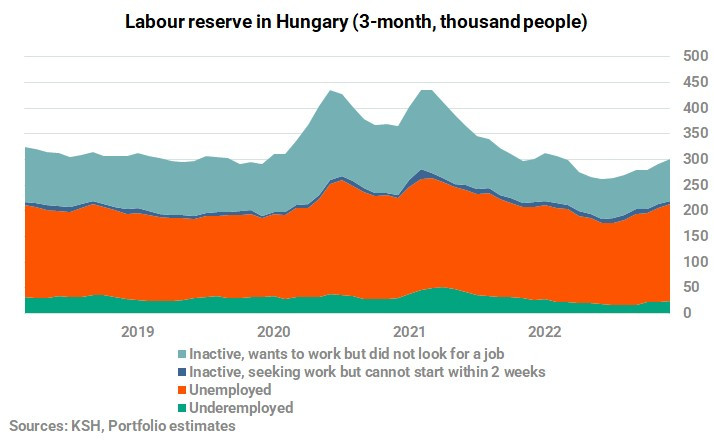
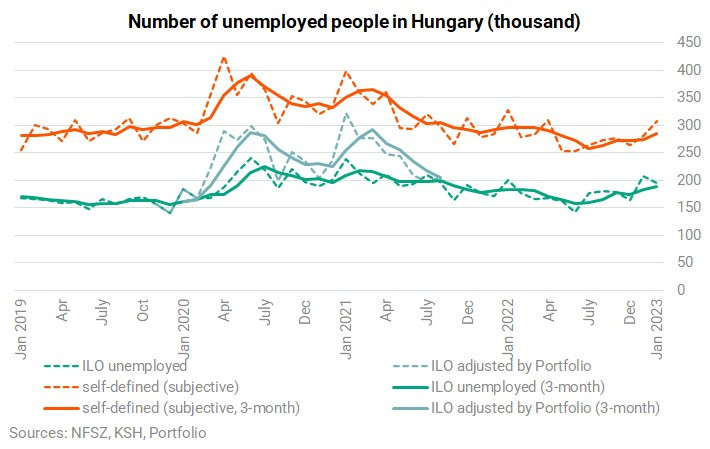
Tens of thousands of people have lost their jobs in recent months, bringing the number of unemployed to around 200,000, according to the Hungarian Central Statistical Office (KSH), and the broad unemployment rate (labour reserve) has reached 300,000, dropping from a low of 260,000. There is no huge deterioration in the labour market, but the change is clear.
In line with this, self-classified unemployment also started to rise, also reaching 300,000, up from 250,000 in the spring. The rise in self-declared unemployment may be an early sign of trouble, as here one does not have to meet various statistical criteria (losing a job, 4 weeks of continuous job search, ability to work within 2 weeks) to add to the ranks of the unemployed, it is enough to declare oneself as such.
According to Portfolio's calculations, the filtered employment figure (net of temporary foreign workers and public sector workers) is already below 5.5 million, down by around 50,000 from the peak seen in the middle of last year. This means that overall unemployment has risen and employment has fallen, but the data do not yet show a drastic deterioration.

Ambivalent overall impact of government measures
This is partly due to the fact that the energy crisis has not become as severe as it seemed a few months ago and the European economy has avoided recession. Meanwhile, the Hungarian government has responded to the crisis in a timely manner - unlike Covid, when help came after the cutbacks - and is helping companies to survive with various general or targeted subsidies and soft loans. Although this has significantly worsened the monetary transmission (the disinflationary effects of interest rate rises), if it were not for the loan programmes, the current extremely high interest rates would be followed by a wave of corporate bankruptcies leading to rapidly rising unemployment. If there were no interest rate freeze, many of the SMEs that would suffer a repricing of their loans would throw in the towel these months because they would not be able to finance themselves.
On the other hand, let's not forget that the government has not only obstructed monetary measures to reduce inflation, but has also contributed to the deterioration of the currency and to the increase in layoffs: the forced budget cuts after the pre-election spending spree, the extra taxes on companies and the maintenance of price freezes have made the business environment much worse. The latter has also contributed to a rise in retail bankruptcies.
What to expect?
Overall, unemployment has risen recently compared to the levels reached during the recovery from the Covid crisis, reflecting full employment, while the number of people in the primary labour market is also falling. The subdued rate of deterioration is partly due to the fact that the energy crisis is not as deep as it appeared two to three months ago, and that for the time being, there is evidence of a reduction in labour shortages in many sectors rather than an increase in unemployment. Energy-intensive sectors in particular have been hit hard by the crisis, as shown by the closure of 10% of accommodation establishments by the end of last year, which may also have contributed to the rise in unemployment. Accommodation services, hotels and restaurants, and retail trade are facing difficult months, not only because of the energy-intensive nature of these sectors, but also because of the fall in real earnings. This may continue the wave of closures of small, domestically-owned stores.
With the Hungarian economy going into a technical recession at the end of last year, the deterioration in labour market trends is not surprising. Economic problems and shrinking domestic demand are expected to continue to dominate the first half of this year, so companies are unlikely to need more workers. Where labour shortages have been the biggest problem in recent years, businesses are clearly making every effort to ensure that the adjustment to the energy crisis does not affect their workforce. The most likely scenario, based on the above, is therefore that labour market developments may improve in the second half of the year, but before then we will certainly not be able to avoid further deterioration due to the continued weakness on the demand side. This could mean a further increase in unemployment of tens of thousands of people, but some comfort can be taken from the fact that we could avoid a wave of layoffs in the hundreds of thousands if energy prices do not rise significantly again.
Cover photo: Getty Images





