Why is Hungary's inflation the highest in Europe? Here's the painful answer


Inflation rampant globally, but Hungary takes the (very expensive) cake
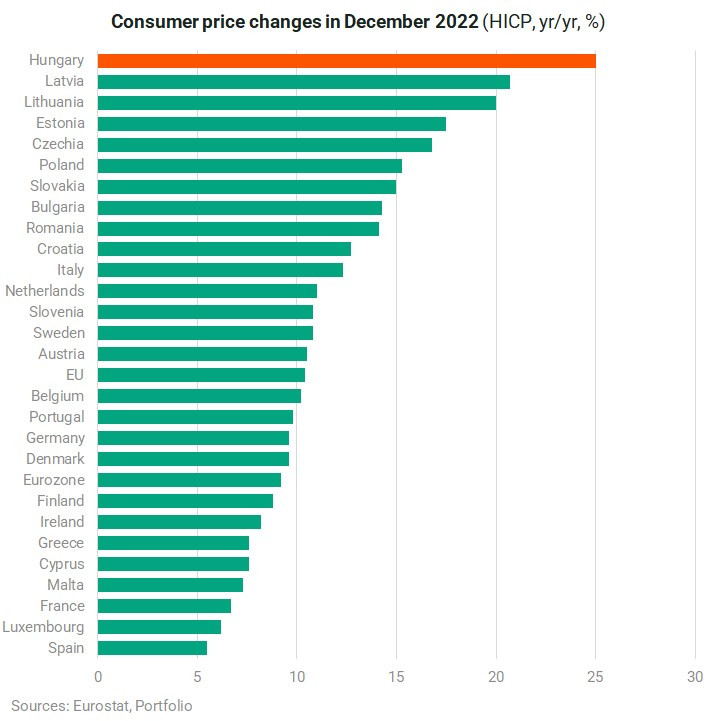
Over the past year, there have been daily reports around the world that inflation has risen to a multi-decade high. In other words, this is not a Hungary-specific problem: the loose monetary policy of recent years and the recovery from the coronavirus pandemic have triggered price rises all over the world. In Hungary, annual inflation rose to 25.7% in January, the highest level in almost exactly 27 years, since 1996.

In recent months, it has become increasingly apparent that Hungarian inflation is in a time lag: while most European countries have seen some deceleration, and the repricing at the beginning of the year has brought only a temporary rise, the rate of price increases in Hungary has been steadily rising for years. This suggests that Hungarian inflation does have some unique characteristics.
Last year, for the first time, the CPI rate rose above 20% in the Baltic countries, where the increased energy prices were passed on to the population in full. By now, however, inflation there has retreated to below 20%, while in Hungary it rose above 25% in January 2023. Inflation in Hungary has risen to notably higher levels than all other European countries, prompting questions over why inflationary pressures have been stronger in Hungary than in its peers. The IMF has now looked into these factors.
Though monetary and fiscal policies are now tightening, inflation expectations are de-anchored and core inflation dynamics remain strong, reflecting a tight labour market and the lag-effect of loose policies that have boosted domestic demand,
the IMF said.

But they did not stop there, and scrutinised the above factors behind Hungary's record-high inflation.
No other country has loosened as much Hungary
Multiple shocks and events have fuelled inflation since 2020. In response to the COVID19 pandemic in 2020, an extraordinary loosening of fiscal and monetary policies, globally and in Hungary, took place to protect against short- and long-term economic and human losses. Central banks lowered rates and expanded their balance sheets, and governments loosened fiscal policy with a range of liquidity and solvency measures to support households and firms and preserve employment.
Of the central banks examined, only that of Turkey expanded its balance sheet more than the MNB between the beginning of 2020 and November 2022, and in terms of GDP, the Hungarian quantitative easing was even larger than that of the ECB. The situation was similar in the budget, where the Hungarian government relaxed the deficit significantly, aided by the epidemic and the 2022 parliamentary elections, but we will come back to this.

This policy support helped foster a stronger-than-expected economic recovery, leading to a tightening of labor markets, rising food and energy prices (exacerbated by Russia’s war in Ukraine), drought, and supply bottlenecks. As a result, inflationary pressures intensified worldwide, including in Hungary.
In Hungary, an additional round of fiscal stimulus ahead of the April 2022 elections further compounded inflationary pressures.
Macroeconomic policies in recent years were among the most expansionary in the EU and persisted to be so even as the unemployment rate became very low. Fiscal policy loosened in 2020 in response to the COVID crisis and then again in late 2021-early 2022 when another round of fiscal stimulus was provided despite a strong-than-expected economic recovery from the COVID crisis was.

Monetary policy also significantly loosened in 2020 and, although the MNB began to increase policy rates in mid-2021, inflation was becoming one of the highest in the region. As a result, over 2020-22, both the fiscal and monetary stances were among the most expansionary across the EU, with cyclically-adjusted fiscal balances and real interest rates below most other countries with similar or more negative output gaps, the IMF analysts added.
And then the HUF started to plummet...
The outbreak of the Russia-Ukraine war, the surge in commodity prices, primarily energy and food, have affected the Hungarian economy not just directly, as rising energy prices also made external financing difficult.
In addition, a widening external deficit led by high energy prices and sustained demand, tightening global financial conditions, and disputes with the European Union (EU) that added to risk perceptions intensified pressure on the exchange rate and imported inflation.
During 2022, the forint depreciated against the US dollar by more than most emerging markets’ currencies globally.

As a benchmark, past estimates of the exchange rate passthrough to inflation in emerging markets ranged from around 6% in the first month after a shock to around 20% after about one year. (A passthrough of 6% indicates that a 1% shock to the exchange rate translates in a 0.06 percentage point increase in inflation - Caselli and Roitman (2019).)
Updating this analysis using longer time series until 2019 and 2022 suggest that the exchange rate pass through to inflation has increased. Estimates for Hungary in the literature are broadly similar—Hajnal 2015 estimated a passthrough of up to 30 percent after two years and Vonnák 2010 estimated a passthrough of 10 to 20% after two years. However, non-linearities (including asymmetries related to depreciation vs. appreciation, and more than proportional impacts on inflation, the larger the depreciation shocks) have been documented in the literature and may have been amplified by the recent multiple shocks that have hit the global economy, emerging markets, and Hungary.

In addition, the depreciation of the forint last year was very pronounced, which in itself increases the impact of the exchange rate on inflation. It is estimated that it could have been as high as 30%, which means that
, applying different methods, found that
a depreciation of 1%let to an increase of inflation by about 0.30% after two years (Hajnal et al. (2015)),
which is in line with earlier studies (e.g., Vonnák, 2010), but that it declined to about 0.10 to 0.20% after the global financial crisis (GFC).
Moreover, this maximum effect is not immediate, but will take about a year and a half to materialise, so the question is how much the "net" inflationary impact will be after the forint has strengthened back in the meantime.
What's wrong with food prices in Hungary?
The IMF highlights that food inflation in Hungary is the highest in the EU. Food prices have risen significantly faster in Hungary than in other EU countries. Domestically, a drought significantly curtailed agriculture production in Hungary in 2022, adding extra pressure of unprocessed food prices (Hungary is a net exporter of food).
Further, a relatively high degree of passthrough from unprocessed to processed foods, driven in part by stronger bargaining power of food producers than retailers and by low productivity in the food processing sector, led to exceptionally high processed food inflation.
In response, the government introduced in February 2022 price caps on six specific food products (granulated sugar, wheat flour, sunflower oil, pork leg, some chicken breast and backs, and 2.8% cow milk) at their October 15, 2021 levels. The cap was extended several times and expanded to two additional food products (eggs and potatoes). It is now set to expire in April 2023.
These caps have been ineffective in slowing food inflation as distributors and retailers raised prices on other products to preserve their margins and food inflation continued to surge.
Hungary's core inflation is also the highest in the EU and is broad-based. Measures of core inflation that exclude unprocessed food or both unprocessed and processed foods are higher in Hungary than all other EU countries. Underlying inflation has been accelerating, with services and nonenergy, non-food goods inflation contributing around 40% of headline CPI inflation through December 2022.
Second round effects of high energy producer prices have led non-energy, non-food goods inflation to rise faster than peers in Emerging Europe. In parallel, services inflation has also surged into double-digit territory, accelerating at a faster pace than peers since mid-2022.
The IMF also found that tight labour markets appear to be adding pressure on wages as core inflation rises. Since the COVID-shock in Q2 2020, core inflation rates have been notably more correlated with the unemployment rate than pre-COVID.

During this time, labour market tightness, measured as the ratio of job vacancies to the unemployment rate, have rapidly increased to historically high levels, suggesting historically low labour market slack. At the same time, private sector wages were growing in double digits (faster than most EU countries but in line with some peers in Emerging Europe at similar or higher positive output gaps), outpacing productivity growth which has also lagged peers in recent years.
Will inflation really peak soon?
Under IMF staff’s baseline, headline and core inflation are expected to peak in early 2023. They then slow as commodity prices retreat, domestic demand cools because the policy mix tightens, and high inflation erodes households purchasing power (Companion Staff Report). However, with persistent core inflation and tight labour market, inflation is expected to remain elevated and above the MNB’s target until end-2025.

IMF staff said labour market developments and increased persistence present the largest risks to theoutlook, as many risks can affect the inflation path, including renewed supply-side shocks notably from higher commodity prices, smaller-than-expected slack, or more entrenched inflation persistence.
Credible, persistent, and consistently tight economic policies are needed to reduce inflation and drive it towards its target,
they underline. The central bank's target range is 2-4%.
"Fiscal and monetary policies need to remain consistently tight and complement each other in dampening demand and reining in inflation. The exchange rate should remain free to adjust as needed while fiscal and monetary policies should remain persistently tight over time. Changes in the policy stance should depend on actual data on underlying inflationary pressures and the nature of any future shocks," the Fund warns.
Price and interest rate caps are costly, ineffective, and undermine monetary and fiscal policy’s efforts to reduce inflation,
they stress in the analysis, and go on to explain how.
In response to rising inflation and costs of living, the government relied on a series of caps on energy and food prices and selected retail interest rates.
These regulatory measures have been counterproductive, working at cross purposes with the fiscal and monetary policy tightening.
- Sustaining artificially low prices prevents the demand adjustment that is needed to cool underlying pressures.
- They have not been effective in fighting inflation. For example, price caps on selected food produces have resulted in higher prices on other products to compensate losses, and energy price caps have prevented demand adjustment and led to wider external deficits and greater exchange rate depreciation which, in turn, increased inflationary pressure.
- Because they are not sustainable, they will eventually need to be removed, as was the case for the motor fuel price cap, which was abruptly terminated on December 6, 2022 after it had led to widespread fuel shortages. By delaying the inevitable inflationary impact, price caps risk ultimately entrenching expectations higher, for longer.
- Moreover, the interest rate caps undermine the effectiveness of monetary policy by disconnecting key channels of transmission, eventually requiring greater tightening to achieve the same outcome.
Cover photo: Getty Images





