Hungarian employees in a perfect storm: living standards declining these months


Real wages down despite fast wage growth
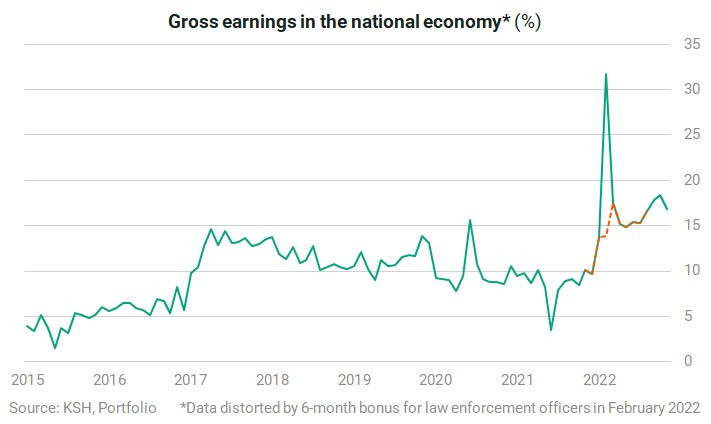
Average gross earnings in Hungary increased by 18.1% year on year in December 2022, reaching HUF 582,000, from the Central Statistical Office (KSH) reported on Thursday. Average net earnings reached HUF 387,00 without tax benefits and HUF 400,000 including tax benefits. Last year kicked off with wage growth of around 12%, then the pace jumped to between 14% and 16%, before finally reaching figures north of 18% at the end of the year. It is extremely rare to see such a marked rise in the pace of wage growth during the year, as companies usually raise wages once. Last year, however, it was different: with inflation rising sky-high, they were forced to raise more than once, creating a price-wage spiral, but inflation still came out victorious in the second half of the year.
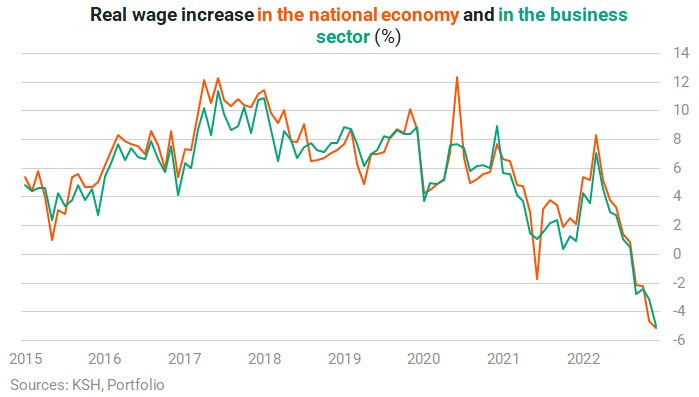
With inflation reaching its highest level for decades by December, making Hungary the EU leader in terms of price increases, real wages for workers continued to fall. With CPI at 24.5% yr/yr, real earnings fell by 5% in the last month of the year, a particularly significant drop. As a result, retail sales are also performing increasingly poorly. With inflation expected to peak only at the beginning of this year, the fall in real wages is unlikely to have stopped this year.
Corporate sector over gross HUF 600,000
Including year-end bonuses, the average gross salary in the corporate sector reached HUF 600,000, while the net average was HUF 402,000.

In the public sector, gross average earnings were close to HUF 500,000, while net earnings were HUF 329,000 in December. As can be seen in the graph below, there was a spike in February last year, but only a narrow group of workers were able to enjoy it: law enforcement officers received six months of "firearms money", which had a big impact on the average wage in the whole economy.

With inflation having risen even higher to nearly 26% in January 2023, real wages are expected to fall further. The rate of wage growth is unlikely to accelerate further as the economic outlook deteriorates and the minimum wage and the wage minimum for skilled workers were raised by less than last year (16% and 14% respectively) . As a result, the first few months of the year are likely to see a decline in the purchasing power of earnings, with only a fall in inflation bringing some respite.
20% minimum wage hike, additional rounds of wage increase
Last year's annual average wage figures should also be treated with a pinch of salt, as the 'firearms money' has an impact on this data too.
- Full-time employees’ average gross earnings (as defined by the Hungarian Central Statistical Office) – at enterprises employing at least five persons, at budgetary institutions as well as at non-profit organisations that are significant in terms of employment – amounted to HUF 515,800, excluding fostered workers to HUF 526,300.
- Average net earnings reached HUF 343,000 excluding tax benefits and HUF 355,300 including them.
- Both average gross earnings and average net earnings without tax benefits went up by 17.5%, and average net earnings including tax benefits grew by 18.2% yr/yr. However, the 'firearms money' could have boosted the national average earnings by as much as a full percentage point.
The outstanding growth is due in the first place to the planned wage raises in certain government branches, as well as the increase carried out in 2022 in the minimum wage and the minimum wage for skilled workers,
the stats office explains. Note that last year the minimum wage and the guaranteed wage minimum increased by 20%, and skyrocketing inflation forced businesses to carry out another round of wage hikes in the second half of the year.
Financial sector on top, catering on the bottom
-
The highest average gross earnings were recorded in the financial and insurance activities section (HUF 859,600) and the lowest ones in accommodation and food service activities (HUF 321,500).
-
Average gross earnings amounted to HUF 565,700 for full-time male employees and to HUF 467,900 for full-time female employees, representing increases of 18.1% for males and 16.5% for females over a year.
-
Estimated regular average gross earnings (without premiums and one-month bonuses) were HUF 469,800, being 16.3% higher than a year earlier.
-
Regular average gross earnings reached HUF 473,800 in the business sector, HUF 449,900 in the budgetary sector, and HUF 499,000 in the non-profit sector, representing growths of 15.0%, 17.3% and 25.4%, compared to the previous year.
The reclassification of several educational institutions from the budgetary into the non-profit sector, following a change in their controlling authority in August 2021, contributed to the above-average increase in regular average earnings in the non-profit sector, as such a significant base effect was still present in the first semester of the year,
the KSH noted.
- Real earnings rose by 2.6%, along with a 14.5% yr/yr increase in consumer prices. Overall, the increase is due to the fact that in the first half of the year, the pace of wage growth was still higher than the much lower inflation rate.
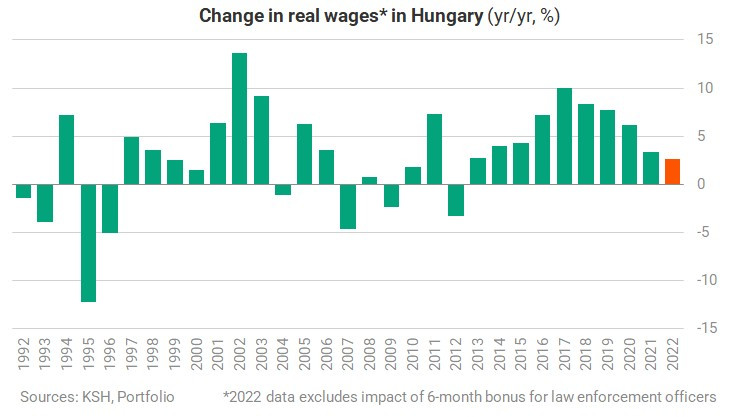
HOWEVER, WAGE GROWTH IS MUCH LOWER EXCLUDING the 'firearms money': PORTFOLIO CALCULATES IT AT AROUND 16% RATHER THAN 17.5%, SO REAL WAGE GROWTH IS ALSO MORE SUBDUED.
- Gross median earnings were HUF 403,100, surpassing the previous year’s value by 15.2%.
- Net median earnings including tax benefits were HUF 280,600, being 17.2% higher than in the previous year.
Cover photo: Getty Images





