The chagrin of change: Number of taxes rises in Hungary


The following article has been contributed by Tamás Fehér, senior tax lawyer at Jalsovszky Law Office.
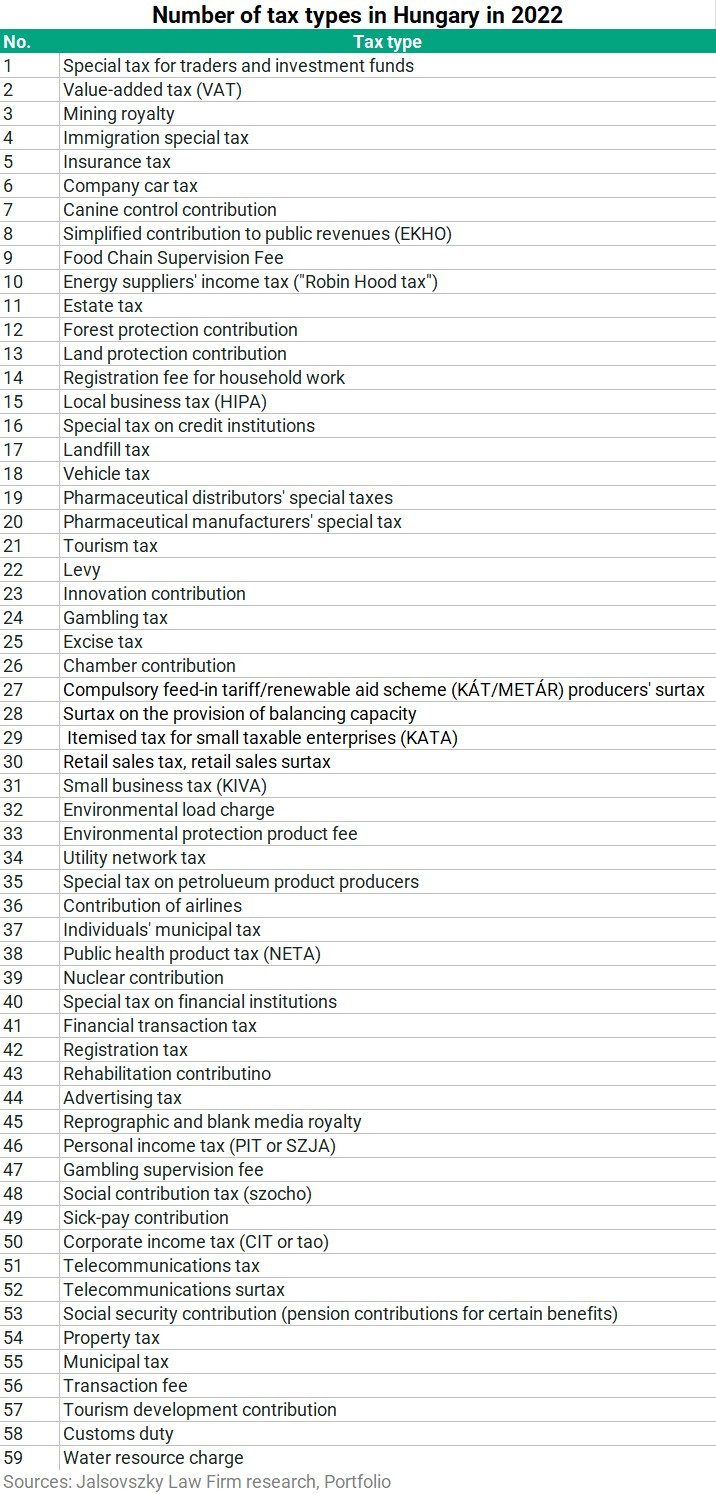
Since 2016, the number of tax categories in Hungary has been steadily decreasing: from 60 at that time, the number of different types of deductions will be reduced to 51 by the end of 2021. Unfortunately, this trend did not continue in 2022, and in fact the opposite was the case: the number of tax types increased again to almost 60. Moreover, the figure of 59 is the result of a conservative and modest calculation - as we will show below. This is not surprising, of course, when seen in the context of broader social and economic developments: the budget deficit has increased, inflation is high and we are also in the midst of a very specific energy market situation, marked by both a shortage of various energy sources and, at the same time, by the truly extra profits of certain energy companies.
And extraordinary situations clearly call for extraordinary measures.
Small business tax KATA - there is none and yet there is
It's been a long time since taxation was so much at the forefront of public debate, as it was when the KATA, the flat tax on small businesses, was (almost) abolished. While it is a matter of opinion whether this tax whitened black incomes or increased grey incomes, the legislator saw it more as a hotbed of trickery and thought it better to severely restrict its applicability. Contrary to popular belief, however, the KATA tax has not been abolished, but has been drastically reformed so that only a very limited group of people can now benefit from it. In other words, although it has ceased to exist for many, it has not reduced the number of taxes.
The special tax on special taxes is not a new tax
In our country, it is also coded to have a relatively high number of taxes because the system of special taxes has become almost a traditional part of our tax policy. And last year we were introduced to a new term, the surtax, which is in fact a special tax on the special tax. Into this not-so-noble circle we have added the retail surtax and the insurance surtax.
These could be considered as completely new taxes, but for technical reasons we did not consider this to be justified. These deductions, although partly under a new name and in new legislation, increased the rate of existing taxes without changing the taxable subject, the taxable person or even the taxable amount. Therefore, in theory, they cannot be considered as separate taxes and do not add to the already greatly increased number of taxes.
The "real" special taxes
However, last year there were also "real" special taxes, those that either did not exist before or that revived old taxes. These include the special tax on credit institutions, the special tax on petroleum product producers, the special tax on producers of the compulsory feed-in tariff/renewable aid scheme (KÁT/METÁR), the special tax on the provision of balancing capacity and the special tax on pharmaceutical producers. But to add to the definitional confusion, the government has also introduced the (securities) transaction tax and the telecommunications surtax as such special taxes. The latter was already considered as separate taxes, as they have a different tax base (and to some extent, a different taxable subject matter too) from their namesake relatives.
An interesting feature of the special taxes is the "airline contribution", introduced last year, which has taken on an importance beyond itself. While the tax has been the focus of a war of words between the airlines and the government, it has also captured the imagination of one of Budapest's municipalities, part of whose territory is occupied by Liszt Ferenc International Airport. It is thought to have drawn inspiration from this special tax when it tried to introduce a municipal tax based on passenger traffic. Although this has not yet been successful, as Curia has suspended its applicability for the time being, it illustrates the conventional wisdom that, with enough creativity, there are very few things that cannot be taxed.
Cover photo: Getty Images





