A host of store closures loom in Hungary in 2023


Store closures a comin'
"The number of stores in Hungary peaked in 1996, when there were 166,000 to 167,000 retail outlets in the country. Since then, the number has been falling steadily from one year to another. Now we are around 100,000. The rate of closures has been relatively low in food retailing, but this is where we have recently witnessed the sharpest price increases. Cautiously, I can only say that in 2023 the rate of store closures will probably be higher than the average of previous years," György Vámos, Secretary General of the National Trade Association (OKSZ) told Növekedés.hu. The curtain went down on more than 2,000 shops in the first half of last year.
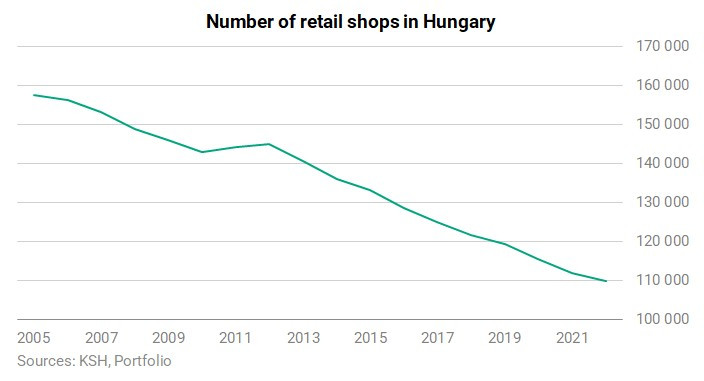
According to previous data from the Central Statistical Office (KSH), of the 2,084 shops that closed, nearly 450 were food and liquor stores, while 180 grocery stores went bankrupt in six months. Nearly 400 clothing shops and almost as many craft shops pulled the plug, while 150 second-hand shops were also shut down. If the trend in the first half of the year held - and did not strengthen further - more than 4,000 retail outlets could have closed in 2022, but official information on this will only be available later.

In Budapest, the number of retail outlets fell by 5.6% in the first half of last year compared to the same period last year, but there was also a significant decline of over 4% in Tolna county. According to KSH's Weekly Monitor, there was no county in Hungary where the number of shops did not fall. The national average was 3.3%, continuing the downward trend of recent years, the agency said. (The shades of grey indicate the number of retail outlets per 10,000 inhabitants.)
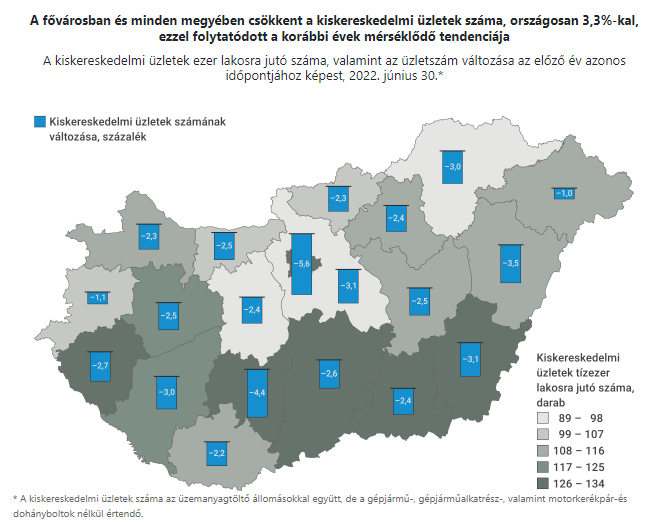
However, the map above also shows that, despite the closures, Budapest has a particularly high number of shops per 10,000 inhabitants. Compared to the rest of the country, there are few shops in Fejér, Pest and Borsod-Abaúj-Zemplén counties.
Retail trade slackening
It is not yet known how the number of shops will develop, but it is known that retail sales continued to fall in January, which is not a good sign. Domestic retail sales continued their spectacular downward trend. With the abolition of the fuel price cap, the downturn has gathered momentum, with sales volumes showing a spectacular decline from their peak in March. All three major groups of goods contributed to the 4.5% year-on-year decline, according to the Hungarian Central Statistical Office (KSH). In January, the calendar-adjusted volume of sales fell by 4.8% in food and grocery retail, 1.5% in non-food retail and 9.7% in fuel retail.

The decline in retail sales is of course linked to high inflation and its effect on purchasing power. Although households are trying to smooth consumption with their savings, the loss of momentum is still spectacular. First, sales in the food segment, which had been experiencing sharp price increases, started to shrink, then the "non-food" segment joined the decline, and finally fuel sales started to drag down the index. Compared to a year ago, families are buying much less furniture, technical goods, pharmaceuticals and industrial goods (in addition to the foodstuffs already mentioned).
György Vámos said in the interview that "the first half of the year will be difficult". After that, however, inflation will continue to moderate and we could be on an improving path in the second half of the year. We could even see a modest increase by the end of the year, he added.
Cover photo: Getty Images





