Battery industry plans become economic Russian roulette, possible project failures alerted


Domestic battery production has not only been playing an increasingly important role in global trade in recent years, but its share of Hungarian exports has also been growing. While in 1995, battery trade accounted for 0.16% of total domestic exports, in 2021 it exceeded 3.04%. And the cabinet led by Viktor Orbán has made cell production a key player in investment policy, with government promises that
by 2030 domestic production capacity will reach 250 gigawatts, while industry sources even estimate at least 217 gigawatts.
If today's known investment plans materialise, by the end of the decade domestic production capacity will be at least five times that of today, if not more.
However, recently announced projects that are still far from being implemented have serious risks on the horizon. Two factors are the main threats not only to Hungarian plans but to all EU plans: the US anti-inflation law, which provides tax breaks and state subsidies for green technology development, and Chinese investment promotion policies, which could lead to a shift of production away from Europe. And battery plant projects that have not yet been delivered could start to stall.
At least, this is the risk warned about in a recent report by the European Transport & Environment Association (T&E), which assessed the main risks associated with cell production projects in Europe.
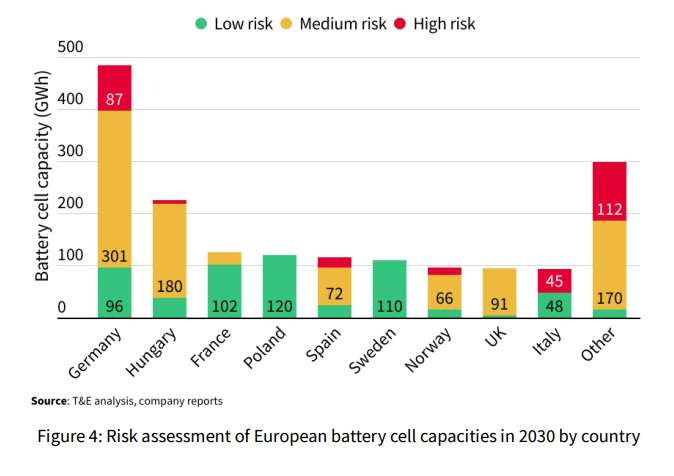
According to the organisation, more than two-thirds (68%) of lithium-ion battery production planned for Europe is at risk of delays, stalling, or cancellation of investments.
Everything going down because of the U.S. Inflation Reduction Act?
Tesla in Berlin, Northvolt in northern Germany and Italvolt near Turin are among the projects that could lose most of their planned capacity as companies consider investing in the US instead. According to Transport & Environment, EU-level financial support to increase battery production and faster permitting procedures are needed to avoid the IRA causing manufacturers with plants overseas and in the EU to move to the US or expand on both continents.
In Hungary, CATL, SK Innovation's two factories and EVE Energy's investment are therefore at medium risk. In the case of Samsung SDI, a small part of its capacity may be affected by subsidy competition.

According to T&E, until this year it looked as if Europe would be able to meet its own demand until the end of the 2020s, but the situation has been very much changed by the announcement of the US Inflation Reduction Act (IRA) and the change in direction of Chinese development policy.
Ford has already announced that it is exploring the possibility of building a US battery factory with CATL, thanks to US support policies. For the time being, this does not mean that production at the Debrecen plant will be scaled back or the size of the investment reduced, but it does illustrate the problem that T&E refers to: capacity may be located in the US that, without IRA subsidies, would be supplied to the US market from European exports.
The report does not go into the risks associated with individual investments, but based on the organisation's methodology and arguments, SK On may be among the domestic manufacturers affected - the South Korean company has cell projects in Komárom and Iváncsa - as the company announced a US development last July, EVE Energy already has production in the US, Samsung SDI, which is expanding its Göd plant, is also present overseas, and in May it announced that it would set up a factory in consortium with the Stellantis Group.
Where the impact of the US measure is already being felt
In addition, most of the US developments were announced before the IRA was adopted, meaning that these plants can still be scaled up, significantly reducing the prospects for European exports. Based on the attractiveness of the IRA, it is no coincidence that T&E argues that Germany, Hungary, Spain, Italy and the UK stand to lose the most if battery manufacturers change their plans. Tesla's highest-volume plant at its Berlin Gigafactory is already behind schedule after the company said it would concentrate cell production in the US to take advantage of incentives under the anti-inflation law.
Northvolt's planned gigafactory in Heide, Germany, is at medium risk as the company has only secured part of the financing and has not yet started construction. In addition, Northvolt's CEO said last October that the company might postpone construction of the plant and prioritise expansion in the US.
However, if the European plans already announced were to materialise, experts estimate that Europe could go from a production capacity of around 69 GWh in 2022 to 293 GWh in 2025, 620 GWh in 2027 and 1374 GWh in 2030 (78% of the total theoretical capacity of 1765 GWh), taking into account the 50 gigawatt projects announced so far. This means that under all three T&E scenarios, Europe could have sufficient cell production to meet the demand for electric cars, vans, trucks, buses and storage systems by 2030.
However, in the most ambitious scenario (or the industry potential scenario - which models a much faster uptake of electric cars, vans and trucks than the minimum required by EU legislation), only if all potential battery cell projects come on stream will there be sufficient supply of EU-made batteries.
The companies with the highest generation capacity in 2030 include CATL (140 GWh), which plans to add 100 GWh of capacity in Debrecen, Freyr (98 GWh), Northvolt (94 GWh), LG Chem (93 GWh), Tesla (93 GWh), ACC (92 GWh) and Volkswagen Group (90 GWh). In 2030, nearly 60% of the capacity to meet Europe's needs would come from European companies, while Chinese companies would cover around 20% of demand.
Raw material will also be needed
Another problem, outlined by the authors, is that the European battery industry will need significant quantities of critical metals such as lithium, nickel, cobalt and other raw materials. Given the global competition for the supply of these metals, including from China (which now has a significant advantage in controlling key supply chains) and the US (where the US IRA is currently investing heavily in critical metals production), Europe is already at a disadvantage.
But Transport & Environment experts believe that Europe can still provide the metals needed by the battery industry through innovative solutions and the right investment policies. In particular, they stress that one of the most important steps is to exploit the potential of recycling and the circular economy. But it may also be important to innovate (including downsizing electric cars) and take advantage of substitution, and to exploit its own potential in critical metals.
They point out that there is also potential to ramp up extraction within the EU: projections suggest that by the end of the decade France, Germany and Spain could have the largest lithium mining capacity, while Serbia outside the EU could also meet significant demand in Europe. Assuming that capacity utilisation during the ramp-up of production reaches the average utilisation level of the projects, their combined output could reach 54 000 tonnes by 2030.
It should be noted, however, that these mines are not yet operational and in Serbia, Spain and Portugal, local communities are opposed to the start-up of extraction, which would be environmentally damaging.
Considering that the 1050 GWh lithium-ion battery demand in T&E's baseline scenario (higher than the regulatory minimum) would require 126 000 tonnes of pure lithium by 2030, these lithium projects could cover up to 43% of Europe's needs (and 26% if investments not yet challenged by the public are taken into account). If battery production demand were to fall back to the minimum target, the 860 GWh capacity would require 103 000 tonnes of lithium, so that the projected European production could be enough to meet 53% of demand by 2030.
For cobalt, the outlook is far worse: Finland could supply close to 5,000 tonnes a year, which would cover 8% of Europe's needs in 2023. If the country were to mine the other projects, the volume could rise to 11,000 tonnes, or 20% of cobalt demand.
Global and EU efforts are needed to provide the necessary raw materials, according to T&E. Although it is believed that China's long-standing dominance in supply chains and US developments will first divert raw material supply away from Europe, instead of manufacturing capacity, and production would then leave the continent as a consequence.
Brussels under pressure for money
For the time being, the European Union is trying to compete with the IRA in three ways, as well as with the less talked about Chinese technology support programmes:
- on the one hand, Brussels would relax state aid rules for new clean-industry investments, such as battery production. They would also simplify licensing procedures.
- The European Commission would also set up a sovereign wealth fund to finance the Green Industrial Plan.
- Free trade agreements and diversification of supply would secure the raw material needs of EU battery production.
This is broadly in line with what the T&E analysis suggested, i.e. the need for more suppliers to secure the supply of raw materials and a rethinking of subsidy and licensing policies.
They also suggest that financial support from the European Commission should be made as easy and accessible as the IRA in the United States provides funding.
"This means simple tax breaks and production aid for best-in-class battery value chain projects, e.g. by introducing a max EUR/x (tonne or GWh) incentive. Europe should also reward an accelerated implementation of the carbon footprint, circularity and due diligence provisions in the new EU Battery regulation by targeting subsidies at those companies leading the pack in terms of sustainability," the analysis reads.
They also suggest that, in the short term, recovery and adaptability funds, including REPowerEU chapters within the national recovery plans, should be made available to companies to directly support increased production. In the medium/long term, the European Sovereignty Fund should have sufficient additional resources to become the main investment instrument focusing on accelerated deployment of clean technologies to support the EU's green business agenda.
It is clear that the industry is therefore heavily reliant on the availability of financial support: the IRA has to compete with $369 billion in green subsidies and tax credits that will be paid out to companies until 2030. Under the European Commission's plan, as known so far, €100 billion of the recovery fund's unspent resources would be channelled into new clean-industry investment, while a further €270 (or even €300) billion would be covered by a new common borrowing facility.
No one really expects the European Commission's negotiations on the preferences and exemptions for EU companies in the IRA case to succeed. However, Commission President Ursula von der Leyen is in Washington this week to discuss the issue with President Joe Biden.
Cover photo: Getty Images.





