Cheap labour, low skills - Is this how the Hungarian gov't would break through the concrete wall?


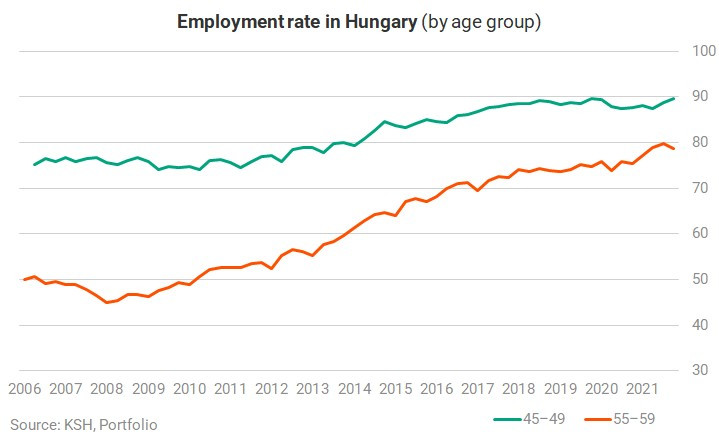
More and more people think that Hungary is reaching the limits of extensive growth. In the last decade, the number of people in employment has risen to 4.7 million from 3.8-3.9 million, so it is becoming increasingly clear that the expansion of the workforce will not be able to generate strong GDP growth for much longer, considering the domestic population, so Hungary has reached a kind of concrete wall.
The fact that a number of large investments have come to Hungary has played a role in employment growth, but it should also be pointed out that the continuous increase in the retirement age has been a key factor.
In this situation, a country poor in natural resources has little choice but to raise the level of intellectual capital if it wants to become a high-income country.
If we examine how educational attainment has evolved over the last decade, we find that the share of people with 8th grade or less in the population is declining, while the share of graduates is slowly rising.
This shows that the employability of the working age population has steadily improved over the past decade and a half, and this is in fact reflected in labour market data. One of the very important drivers of the increase in the number of people in employment has been the composition effect, which has increased the share of the more highly educated and thus more employable.

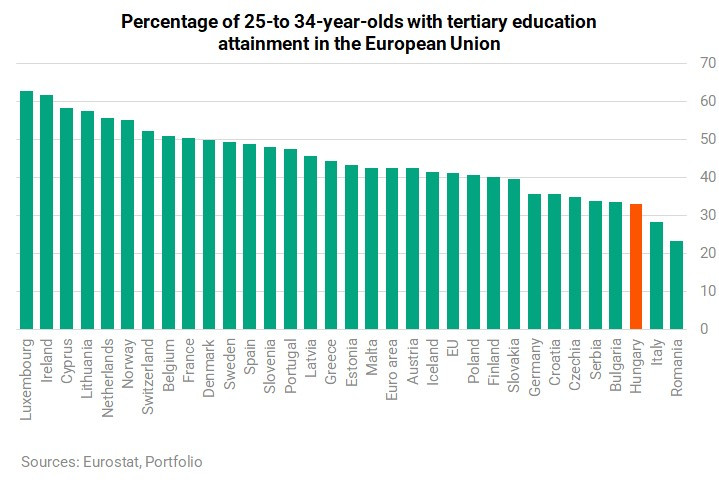
However, the country seems to be seriously lagging behind in terms of educational attainment by European standards, especially when it comes to spurring young people to aim for higher qualifications.
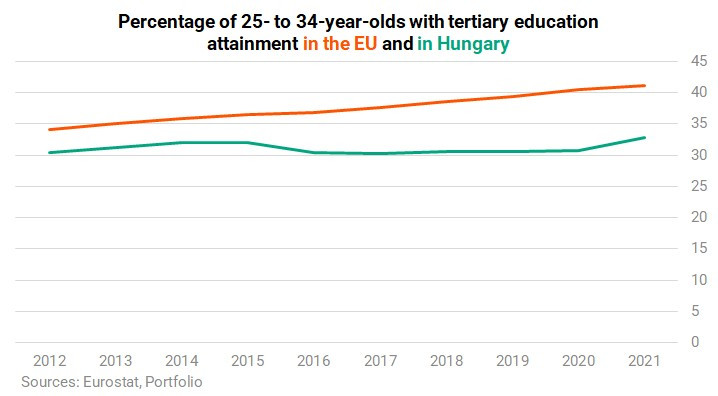
The rise in the educational attainment of the population over the past few years is partly due to the historical fact and inertia that the educational attainment of retirees and deceased people is quite low, while that of young graduates is higher, but the increase in the proportion of 25- to 34-year-old graduates has been stagnating for some time.
However, as the share of degree holders is still higher among younger people than among older people, the educational attainment level of the working-age population is improving. However, Hungary's lag is shown by the fact that while a decade ago the share of young graduates was 3-4 percentage points higher in the EU than in Hungary, the gap has now widened to 8-10 percentage points. In addition, the increase in the last year may be more a statistical factor than a trend (Hungary did away with the requirement of a language exam when awarding diplomas), so the gap could even stabilise at 8-10 ppts.
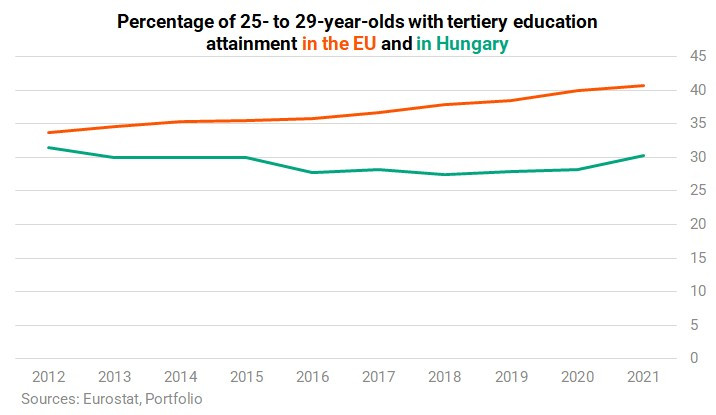
The picture is even worse if we focus on people under 30. The evolution of the share of 25-29 year old graduates can show the changes in higher education that have taken place in a very short time. While we see a decline in Hungary after 2012, the trend in the EU is one of growth.
As regards the older age groups, Hungary is lagging behind, but broadly in line with the EU average. This is not surprising, as those who graduated during the previous higher education expansion are getting older.
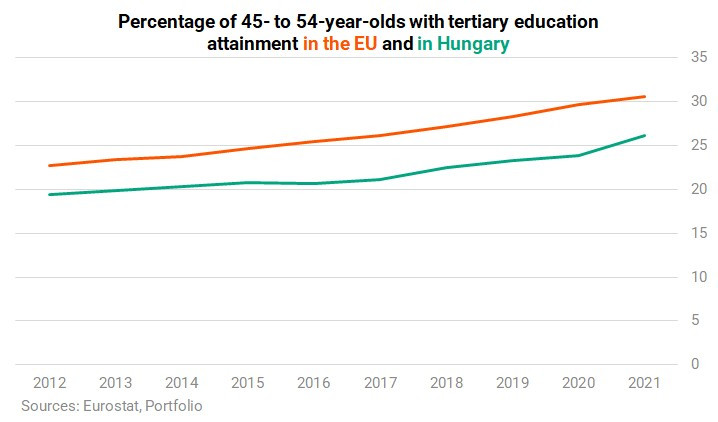
The findings show that Hungary is lagging behind both the EU and its own potential in increasing the share of young graduates. Meanwhile, however, there is no sign of any strategy on the part of the government to increase the share of graduates.
But we are hearing more and more that they would maintain extensive growth in some way. For example, Minister of Economic Development Márton Nagy spoke at a recent conference about an additional half a million jobs, partly through immigrants and partly by involving the inactive population.
Shortly after his speech, Prime Minister Viktor Orbán set out a similar strategy, which would involve hundreds of thousands of workers in the short term. The PM stressed that Hungary will need 500,000 new workers in the next few years. He said the cabinet would like to attract more labour from the inactive population in Hungary, and also from Hungarian-inhabited areas in regional countries.
So it seems that the government would continue the extensive growth of the past period. At the same time, economists say that the best way out of the middle-income trap, while maintaining high employment levels, is to get better education, which is now stalled among young people.
However, raising the level of education of the population is much more expensive, requires greater public investment in human capital, and pays off more slowly. For the time being, it seems that Hungary is not going down this path, but it will further facilitate the attraction of the inactive and the import of workers from abroad.
While higher education would bring about a substantial improvement at the level of society as a whole, the positive effect can also be seen at the level of individuals, as the better educated earn much more, as in all countries of the world.

Unfortunately, Hungary is not able to attract highly skilled workers, but rather medium-skilled workers from abroad. The arrival of these workers is a remedy for the shortage of low-medium skilled workers (especially in manufacturing), but research shows that the country does not need 500,000 workers in the short term.
There are also questions about how the government can attract labour from areas inhabited by ethnic Hungarians, as Hungary no longer offers the wage advantage that was obvious years ago and which attracted many people from various countries in the region. Attracting highly skilled foreign workers is therefore difficult, as the brain drain is not changing: everyone is looking for high-income countries when they leave.
That is why it makes sense for a country to raise the level of education of its own citizens, rather than to maintain extensive growth by focusing on immigration.
However, despite the demonstrable benefits, it looks very unlikely that there will be any significant catching-up with developed countries in terms of the share of highly educated young people in the coming years.
While it is good news that the rapid, trend decline in the number of people entering higher education has come to a halt, this will not be enough to catch up with more developed countries. On the basis of these trends, the share of graduates in the total population is expected to rise from the current 25% to over 30% in the next decade and a half, as older people drop out of the labour market (among whom there are fewer graduates), but this upward trend may stop here, as the improvement among young people (who have helped to push up the share of graduates in the total population over the past decade and a half) has stopped. To see better numbers, more students would need to be enrolled in college and university in the coming period.

Overall, the share of low-skilled people in Hungary has been declining over the past decade. Whereas several decades ago higher education was not a priority, it is now a key factor for high value-added, well-paid jobs. Hungary recognised this during the period of higher education expansion following the change of regime, the positive effects of which are still being felt today in terms of improving the educational attainment of the population as a whole. This is simply because the low level of skills of the older generation is being replaced by (relatively) higher levels of skills among the younger generation. However, the growth in the share of young people with a degree has stopped in recent years, putting Hungary among the last in the EU.
Rather than addressing this problem, the government's ambition is more explicitly to continue to raise employment levels, now partly through immigrants, and to attract the inactive.
Meanwhile, the increase in the share of tertiary education has taken a back seat, with a clear stalling of the transition to a knowledge-intensive economy. The result is that more and more low value-added assembly plants are being established in Hungary, relying on cheap labour at the saddest point of the smile curve, and it looks very likely that this will continue in the period ahead.
Cover photo: Getty Images





