Hungary sets incredible goal, it would take a miracle to achieve it


What is addressed in this article?
- The cabinet is looking to secure 500,000 additional workers
- Is there such a labour reserve in Hungary?
- What about the retired and students?
- Will employees come here from abroad in sufficient numbers?
- Who else could be lured to the domestic labour market?
Ambitious goal
Minister of Economic Development Márton Nagy said at a recent conference that the number of employed people should be increased by half a million, partly through immigrants and partly by involving the inactive population.
Shortly after his speech, Prime Minister Viktor Orbán set out a similar strategy, which would involve hundreds of thousands of workers in the short term. The PM stressed that Hungary will need 500,000 new workers in the next few years. He said the cabinet would like to attract more labour from the inactive population in Hungary, and also from Hungarian-inhabited areas in regional countries. His focus was on domestic reserves, but not those in public works, as that's an already depleted resource, he said.

The Prime Minister would like to see low unemployment in Eastern Hungary too, which means he could well be thinking of new investment in this part of the country. Orbán also hinted that he would like to attract more workers from Hungarian-inhabited areas elsewhere in the region.
In any case, migration has already played an important role in domestic demographic processes, which in recent years has substantially reduced the natural decrease, and certainly with people of working age.

Employment grows substantially
In the last decade, the number of people in employment has risen to 4.7 million from 3.8-3.9 million, which is a growth of nearly one million from 10-12 years earlier. This is a very significant achievement, and one in which the following factors played a key role:
- the retirement age was raised, which increased the number of people in employment,
- further labour market tightening is preventing "flight" into early inactivity,
- an increase in the share of graduates has improved the employability of the working age population,
- the starting point is the financial crisis trough, from which there has been a natural regain of a few hundred thousand people,
- for a large part of the period, the European and Hungarian economies grew substantially,
- while many industrial companies set up shop or expanded in Hungary.
Raising the retirement age has effectively prevented a large decline in the working-age population in recent years. It is now better to use this indicator than the 15-64 or 15-74 age groups because it shows how the change in the age limit changes the relevant population.
When the statutory retirement age was raised, the working-age population increased in a sawtooth pattern, but when there was no increase, demographic trends reduced this number. In the next period, there will be no more retirement age hikes under current laws, so the working-age population is expected to decline.
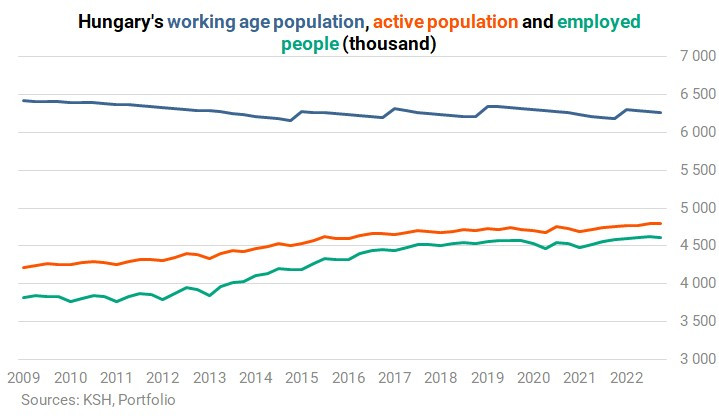
Labour could therefore be attracted from the gap between the employed and the working age population, while mobilising pensioners. Unemployed people are an immediate next step, but the space for this is very limited, as the unemployment rate has fallen from 8-10% in the first half of the decade to 3-4% by now. This reflects near full employment, so further substantial reductions in the number of unemployed are unlikely. There may still be a few tens of thousands of workers in the more economically backward regions, but this is a very different order of magnitude from what the Prime Minister has talked about.
Reserves drying up
Then there's unemployment in the broad sense, the potential labour reserve. But compared to the almost 200,000-strong group of unemployed people, this group is not as large as it used to be. Last year, the labour reserve fluctuated between 250,000 and 300,000 people, including inactive people who want to work but have not looked for work.
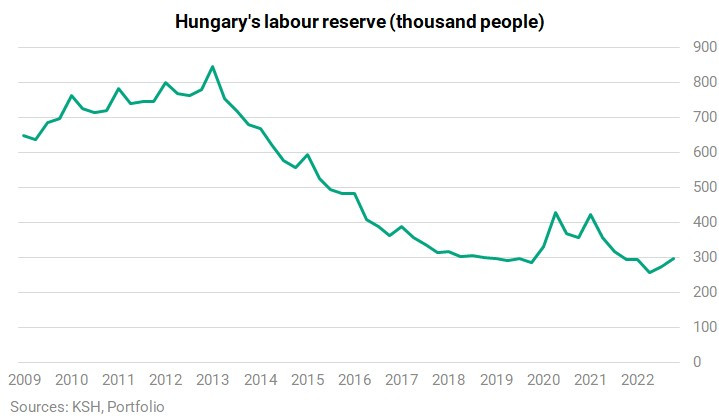
The graph above shows that when employment started to pick up considerably, the labour reserve was still between 700,000 and 800,000. These are the people who are most easily attracted to the labour market, most of them want to work, but many of them have lost hope of finding a job. The fact that many of the groups in the labour reserve have found jobs has played an important role in employment growth in recent years. This has reduced the labour reserve by 400,000 to 500,000 over the years.
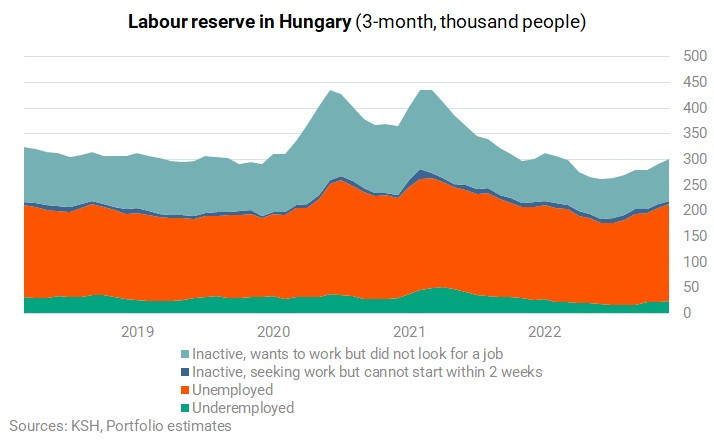
The data show that not only has the reserve fallen, but activity has also risen. However, there is less room for further, meaningful increases, unless of course the retirement age is raised further. While the employment rate for 60-64 year olds was only 10% in early 2021, it has now risen to over 50%.
In other words, it is clear that further, substantial increases in employment can only be achieved through some kind of regulatory change.
This would not be surprising in the light of the government's promise to the EU in a paper to further raise the retirement age (although such a move is usually made after a period of adjustment of several years).

Many a pensioners
To see what opportunities exist, it is worth looking at the 'non-employed' part of society in more depth. Based on data from the Central Statistical Office (KSH), we can show in detail how the number of unemployed and inactive people in the population develops alongside the employed.
As can be seen below, the unemployed are not much of a reserve, with 1.4 million of the 2.5 million inactive retired and over 600,000 still in education. While the employment of pensioners is questionable, the employment of young people, i.e. students, in the form of student jobs may be considered.
However, older people will not be the most productive workers even if they can be persuaded to work, and young people can at best take part-time jobs while studying. But the government does not seem to mind if they get into work as soon as possible.

Overall, therefore, there are no longer huge reserves within the domestic population that could be redirected onto the labour market. On the one hand, a further small reduction in the labour reserve and an increase in activity (especially in the less developed regions) could still attract workers onto the labour market, while retired people and young people, although a significant group in terms of numbers, are unlikely to be the answer.
Recruiting from abroad
It was not by chance that Viktor Orbán and Márton Nagy referred to workers from abroad. In the case of Hungary, this has long meant people from the Hungarian-inhabited regions of the Carpathian Basin. In a study by the Central Statistical Office (KSH), it is explained that foreign nationals began to migrate to Hungary in greater numbers after the fall of communism.
At that time, ethnicity played a decisive role, with Hungarians being the overwhelming majority. Later, after Hungary's accession to the European Union in 2004, global trends did not leave Hungarian migration networks untouched: the country's migration resource area widened, and it was able to attract foreign citizens from greater distances.
Within Europe, the importance of neighboring countries is tied to crossborder linguistic and cultural relations, the study shows. Thus, the consequences of the peace treaties that brought an end to World War I and World War II are still decisive in the migration processes of the Carpathian Basin today (Tóth 2005).
"If we look at the entirety of international migration movements in Hungary in what was the country’s territory prior to the Treaty of Trianon, we find that about half of the movement would count as internal migration. The consequences of the peace agreements that ended World War I and World War II and cross-border linguistic and cultural relations are still dominant in the migration processes of the Carpathian Basin (Tóth 2005). The data confirms that the migration trend that was occurring before World War I continued, whereby movements from the periphery to the center of the country were characteristic."
According to KSH data, immigration of foreign-born Hungarian citizens (which is of course does not perfectly cover the above group) is decreasing, and is already below 9,000 per year.
However, in recent years, the arrival of workers from third countries outside the EU has been made significantly easier, and their numbers have been steadily increasing. According to official figures, more than 70,000 foreign workers are employed by domestic companies and this number could easily increase by tens of thousands more in the coming years as labour shortages become a growing problem.
According to labour market experts, up to 500-1000 foreign workers may arrive in Hungary every month, for example from the Philippines or Vietnam. This is partly possible because the Carpathian Basin population is already considering whether to migrate to Hungary, as wages elsewhere in the region are increasingly on a par with Hungarian earnings, while Hungarian wages are lagging behind, especially in euro terms.

It would take an unprecedentedly stellar performance
As can be seen from the above, if trends continue, the number of people in employment will not increase by 500,000 in the next few years. Employment is now at a particularly high level, and it is harder to increase it from here than it was when it was below four million.
Over the past ten years, the number of people in employment has grown by an annual average of 70,000, with the largest increase between 2014 and 2016, when we saw a rise of more than 450,000. So in the coming years, Hungary would need a better-than-ever performance to reach the half a million increase. This would require some combination of the following steps:
- launching training programmes (finding jobs for part of the labour reserve),
- renewing employment services (activating the hopelessly unemployed),
- administrative instruments (e.g. employability of retired people, further raising the retirement age, increasing the activity of young people while they remain enrolled in education),
- stepping up investment in the Eastern Hungary region and/or mobilising the unemployed in the region,
- supporting immigration (with further facilitation, broadening the range of sending countries).
In other words, only extensive training programmes, administrative measures such as a further raise to the retirement age and making immigration to the country even more attractive can bring about a further, large increase in the number of people in employment.
With the increase in employment rates we have seen over the past decade, most of the extensive growth is now behind us: the current highs were reached by bringing the more employable people onto the labour market already. Nowadays, who are left are mostly inactive people who have compelling reasons for staying away. The inactive tend to be difficult to employ, so even if some of them were to enter the labour market, they would probably be among those with the lowest productivity stats.
From this point of view, the areas beyond the borders where ethnic Hungarians reside can represent a potential, as we have seen in the past decades. The experience of the past decades shows that the education and age composition of the immigrant population from the neighbouring countries is more favourable than that of the resident population, so they have a significant potential for the labour market and their productivity may be higher than that of those who are currently inactive in Hungary.
At the same time, it is certainly becoming more and more difficult to attract them here, as Hungary no longer offers the kind of wage advantage that it did a decade or two ago. From this point of view, it is understandable that immigrants are coming from increasingly distant, less developed (low-wage) countries, whose arrival has been made easier by the government in recent years.
Even so, it is much more likely that the pool of employable people can be substantially increased over a 3-5 year period rather than in 1-2 years, even if the government were to rely on both the domestic population and those from abroad.
Cover photo: Getty Images





