Do we really need to reshape the structure of the Hungarian economy? - Finance Minister


Healthy economies are based on three pillars: high employment, efficient production and marketability of products. These basic criteria are all met in Hungary. One million more people are in work today than in 2010, approaching full employment. GDP in dollar terms has also grown by 60% in the last decade or so, so there is production and value creation in the Hungarian economy. And in terms of export competitiveness, all international analyses show that we are among the leaders, i.e. our products are marketable. The main question now is how we can move to the next level of development, i.e. what criteria are needed to fine-tune the structure we have built up so far.
Exports are already up to par, among the top ten in complexity
The competitiveness of the Hungarian corporate sector in international comparison is mainly reflected in its export performance. In terms of exports as a share of GDP, Hungary is now one of the 15 most open economies in the world, participating in international trade far above its weight.

The decade-long improvement in export competitiveness is the result of the structural transformation of the economy and is mainly due to the inflow of foreign working capital and the increasingly specialised domestic supplier network built around the core sectors.
The competitiveness of the Hungarian corporate sector can be measured in international comparison primarily through export competitiveness, and Hungary is nowadays in a leading position in this respect. According to the World Intellectual Property Organization's latest Global Innovation Index, the production and export of Hungarian high-tech products is among the world leaders. And the latest Economic Complexity Index developed by Harvard University ranks Hungary 9th out of 133 countries. Hungary has been consistently ranked in the top ten since 2010, while the average of the other three countries in the V4 was ranked 15th, and the average of the EU countries was ranked 22nd in 2020.
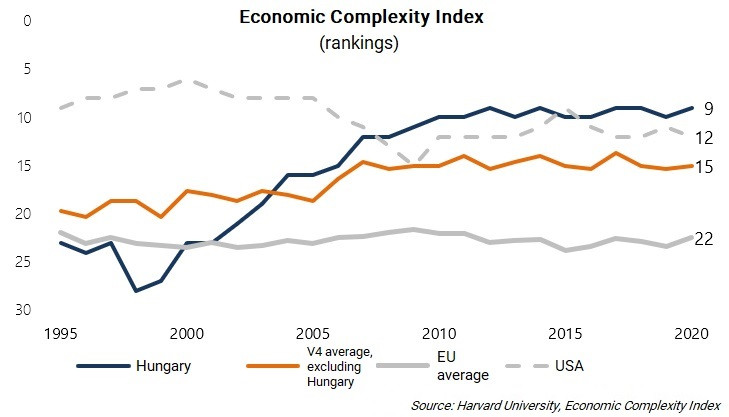
Through the Economic Complexity Index, Harvard University assesses the current state of productive knowledge in countries. The Index ranks countries according to the diversity of their export basket and the complexity of their export products, i.e. the more complex the export products a country produces, the higher it ranks. Economic complexity improves when an economy is able to increase the number and complexity of new, exportable products not previously produced. The least complex export products are raw materials and agricultural products, while the highest complexity is found in machinery, electronics and chemicals.
The Economic Complexity Index is also a credible measure of a country's knowledge capital. According to its developers, there is a close link between economic complexity and development: those that can maintain a high level of a wide range of production "know-how" that is competitive and in demand in international trade can also be high in human capital, a key factor in modern growth theories.
Hungary's merchandise exports are dominated by electronic products (including batteries), passenger cars and their parts, and engineering and chemical products.

It is therefore mainly these products whose production is a complex process. Among these, Hungary's export products with the highest complexity and share are serums and vaccines, thermostatic valves, pumps and computer components.
A new level must be reached
The high international rankings cited above reflect the outstanding performance of the domestic economy and corporate sector. However, from a Hungarian perspective, in line with government objectives, our position to date should be seen as a temporary, intermediate stop. Therefore, it is useful to explore and identify the challenges and structural problems that may hinder progress from the middle-income position.
1. The strong export performance is largely driven by the manufacturing and export activities of foreign multinational companies. These companies base their production on a highly skilled Hungarian workforce and the Hungarian-owned supply chains built around them. The next step should be to encourage an increasing number of large domestic companies to enter this field and to create new Hungarian brands in international trade. Recognising this, we have also launched government programmes to support large Hungarian companies.
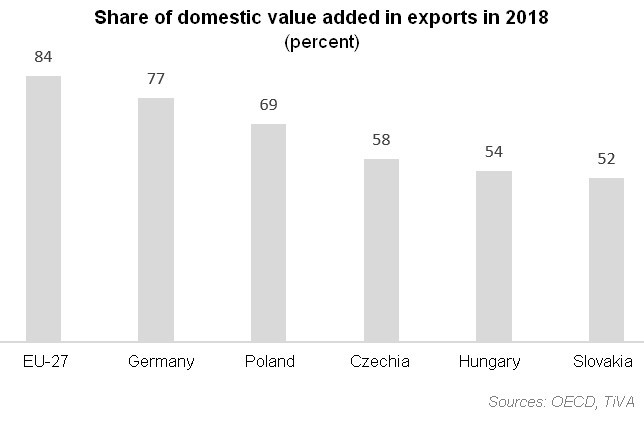
2. According to the OECD's external trade added value indicators, the value-added content of Hungarian exports was 54% in 2018, significantly below the EU average of 84%. In other words, the volume is doing well, but only a modest share of exports is still produced by Hungarian-owned companies. In the future, therefore, we need to support targeted developments to increase the share of domestic value added. And foreign capital should be attracted primarily for investment in manufacturing capacity that brings in new, world-class technology and knowledge.
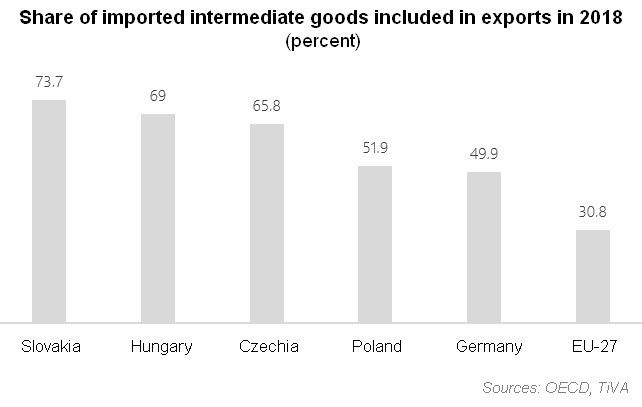
3. A related phenomenon is the relatively high share of imported intermediate goods in Hungarian exports, while the share of components produced by Hungarian firms is low. The share of imported intermediate goods incorporated in exports is 69%, while the EU average was 31% in 2018.
4. In many cases, Hungary is still most active in the lowest value-added stage of the production value chain, the manufacturing segment. This is an important stage in the development of the economy, but not the end of the road. Both product development (research, design, pre-production) and the post-production phase (marketing, logistics, after-sales services) require higher skill levels and generate higher value added than the production phase. This transition is being facilitated by the development of higher education, which is already underway, and its links with economic actors, the results of which are already reflected in international university rankings.
5. The same process is evidenced by the fact that there is still room for further strengthening innovation in Hungary, i.e. developing new goods, new services, new methods. According to the latest European Innovation Scoreboard, although Hungary's innovation performance improved between 2015 and 2022, it remains in the group of "emerging innovators", below the EU average.
6. The consequences of these structural challenges, which can also be found in the other Visegrad countries, are also reflected in the fact that, despite our high ranking in the Economic Complexity Index, our development is not yet where it should be.
To summarise, the structure of the Hungarian economy has improved over the past decade in complex, international terms, but it needs to be brought up to a higher level to continue to improve. To achieve more sustainable economic growth, investment needs to be better targeted in terms of both area and quality, and the focus needs to shift from cost-based competitiveness to quality-based competitiveness. To avoid falling into the development trap, we need to improve the balance between production and value added, by broadening and moving up the production value chains. Being among the world's elite in the Economic Complexity Index also confirms that there is scope for further diversification of the Hungarian production structure through the know-how and technology already available. In other words, the know-how, technology and human capital base accumulated over the past decades would allow the production of a wider range of newly developed products and services of increasing complexity and higher domestic added value. Above all, Hungary needs to stimulate innovation to create, produce and export entirely new products and services. This would accelerate the catch-up process and ensure sustainable economic growth in the long term. International experience has shown that countries that have avoided the medium-development trap have increased competitiveness through innovation and highly skilled workers.
THIS IS ON THE OTHER HAND, THE PORTFOLIO OPINION COLUMN.
This article reflects the views of the author, which do not necessarily reflect those of the Portfolio editorial team.
Cover photo: MTI/Zsolt Czeglédi





