Péter Ákos Bod: How did Romania catch up with Hungary?


Already last year, Eurostat released the consumption figures for 2021: in terms of actual individual consumption, Hungary was ahead of only Bulgaria among EU member states. It is well known that most EU countries have a higher level of consumption than Hungary, but the news of the penultimate place sent out a message that even Romania had overtaken us in this respect. This is a figure which, if correct, contradicts what has been one of the few certainties of our public opinion for as long as anyone can remember: the Hungarian level is well above the Romanian.
If one's convictions are contradicted by a piece of data, the first thought is that it is inaccurate and wrong. But Eurostat, which provides the data, is reliable, although it is known that it uses figures from the statistical services of the member states in its communications on income, inflation and employment; in any case, interpretative comments can be made on the specific indicator and its international comparison. Now, however, Eurostat has come up with another surprise with the publication of the best-known economic performance indicator, gross domestic product (GDP). According to the preliminary figures for real GDP per capita in 2022, the Hungarian and Romanian figures are both 77% by EU standards (EU average = 100). This means that Romania's economic development has caught up with Hungary's in 2022.
Given the recessionary or near-recessionary state of our economy, it will certainly overtake ours in 2023.
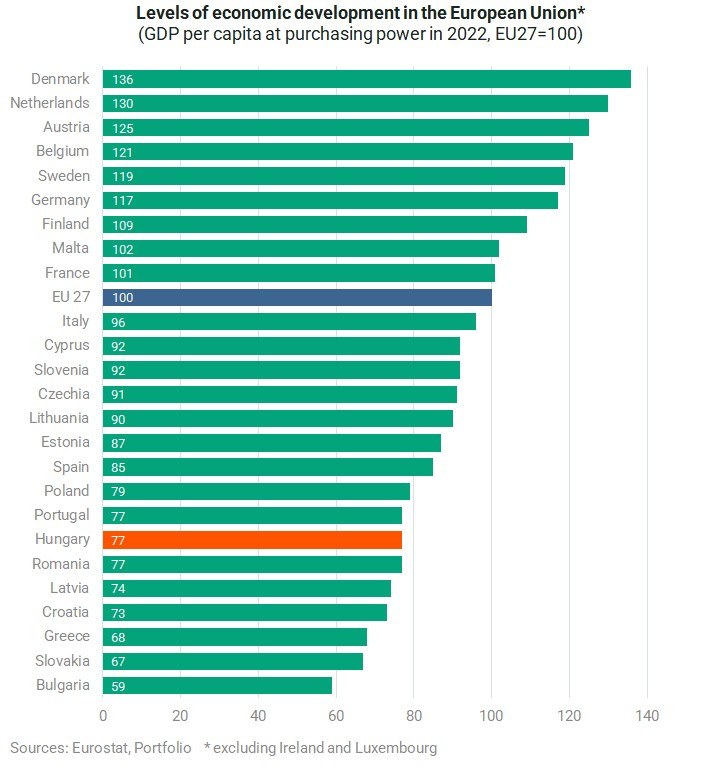
International comparisons of national income and consumption data are not easy due to differences in national price and exchange rate systems and social structures. However, the ranking of the EU Statistical Office, which is based on purchasing power parity and takes local price levels into account, should be taken seriously.
According to this, in our immediate region, excluding the Baltic countries, the economic development ranking last year was as follows: Slovenia 92%, Czech Republic 91%, Poland 79%, Hungary, Romania 77%, Croatia 73%, Slovakia 67%, Bulgaria 59% (We may also be interested in the Serbian data; Eurostat has only published data for 2021: Serbia's GDP per capita reached 55% of the EU average.)
In addition to the Romanian figure, the Slovak real GDP figure seems odd and even wrong, based on other economic indicators and other knowledge we have, especially Eurostat figures on the relative level of household consumption. Compared to the EU average, the regional ranking (2021) is: Slovenia 89%, the Czech Republic 85%, Poland, Romania (!) 84%, Croatia 72%, Slovakia 71%, Hungary 70%, Bulgaria 65%. The figure for Serbia, a non-EU country, is 53%.
Public opinion on the economy is more interested in material well-being, real wages, the level of real consumption, and less in GDP, which dominates the political discourse. Yet economic well-being would be better measured by Gross National Income (GNI) than GDP, especially for a country with a high share of foreign capital, whether Foreign Direct Investment (FDI) or foreign loans. This is because foreign ownership of the factor of production increases the exports and GDP of the host economy, but capital income accruing to foreigners does not, by definition, increase the income of the home (resident) population, since it is not theirs.
This is our case. Hungary is very open to foreign trade and highly dependent on foreign capital.
Capital imports have helped economic growth, bringing us up to a remarkable 77% of GDP per capita. But GDP overstates our national income. Not surprisingly, our position in the EU in terms of household consumption is only 70%. Thanks to export-oriented foreign capital, many indicators show nice progress, so the export/GDP ratio (and of course the import/GDP ratio) is impressive - we beat many countries in the region, especially the Poles and Romanians. But that is why it can be disconcerting that countries in the region that were once quite lagging are no longer behind us in GDP per capita, and both have moved significantly ahead of us in terms of household consumption.
And economic development is expected to increase material well-being and public consumption. We cannot therefore pass over in silence the fact that, in terms of consumption, Hungary's catching-up, which is the main objective of official economic policy, is not only disappointing concerning its promises and the expectations of the public ('catching up with Austria'), but that Romania has now also overtaken us, starting from a much more difficult position, under similar external conditions.
We already had the time to digest the Polish success story, their record of three decades of growth after the great crisis of regime change. But the Romanian case is different. How has our south-eastern neighbour managed to catch up? Has it really happened, and if so, is there a secret to their development? Is there any lesson to be learnt?
Their catching up with the Hungarian level is the result of a long dynamic period. According to the Romanian National Institute of Statistics, real GDP has developed as follows in recent years:
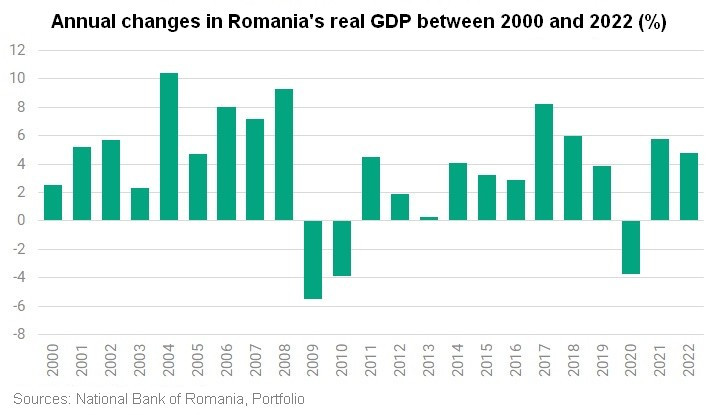
Given these growth dynamics, it is not surprising that the spectacular underperformance of the first decade of regime change has now disappeared: only three of the 23 years since the turn of the millennium have been recessionary, and Romania's real GDP growth has exceeded 5% per year nine times. Demographics are already playing a role in the evolution of the per capita indicator in the medium term. While none of the countries has been able to avoid natural attrition, the Romanian case is specific in terms of migration: even before EU membership (2007), Romania experienced a strong westward migration of its citizens. Its share was much higher than that of Hungary, and the composition was different. Among Romanian emigrants, the less skilled made up a larger proportion than in the Hungarian case: those who migrated westwards from Hungary were relatively more skilled and more productive than the national average. This has also contributed to the poor regional performance of Hungarian labour productivity in recent years.
What is similar, however, is that none of these countries has been a major migration destination in recent times. The Russian-Ukrainian war could bring a change in this respect, but for reasons of language, wage levels and other reasons, neither Romania nor Hungary has become a destination for Ukrainian refugees of working age to the same extent as Germany or Poland in particular. The growth rate of the Polish economy has already been strongly influenced by the fact that it has long been receiving large numbers of legal workers from non-EU countries (Ukraine, Belarus):
Poland issues work permits in the order of a million (!) per year.
Regional migration flows have now acquired macroeconomic significance. While many people take jobs in other EU countries (and transfer their saved income home), the Eastern member states attract guest workers to varying degrees, who contribute to the GDP of their economies by working and increase their disposable income at home by returning home. The World Bank's comparative estimates illustrate the significant differences in migration rates across the region.
| Remittances from guest workers abroad in some CEE countries | |||
| 2021, USD million | 2022, USD million * | as a percentage of GDP** | |
| Bulgaria inward | 786 | 850 | 1 |
| outward | 157 | 0.2 | |
| Czech Republic inward | 4387 | 4539 | 1.5 |
| outward | 4069 | 1.4 | |
| Croatia inward | 5045 | 3701 | 5.3 |
| outward | 632 | 0.9 | |
| Poland inward | 7131 | 8000 | 1.1 |
| outward | 9419 | 1.4 | |
| Hungary inward | 3497 | 2404 | 1.3 |
| outward | 1623 | 0.9 | |
| Romania inward | 9160 | 11064 | 3.7 |
| outward | 642 | 0.2 | |
| Serbia inward | 4598 | 5400 | 8.7 |
| outward | 471 | 0.4 | |
| Slovakia inward | 2235 | 2300 | 2 |
| outward | 441 | 0.4 | |
| *No data yet on outbound transfers in 2022. | |||
| **Incoming transfers are expressed as a percentage of estimated GDP in 2022 and outgoing transfers as a percentage of GDP in 2021. | |||
| Source: World Bank | |||
Guest worker remittances have so far counted for a lot, mainly in some developing countries, but we should take note that such remittances are already shaping household savings and consumption and strengthening the balance of payments. The World Bank estimate for Hungary for 2022 is surprisingly low; other data, such as national accounts, suggest somewhat different levels and balances of remittances. In any case, it is difficult to give a good estimate for this item because of the income generation of commuters and casual workers, but the surplus that would add to the Hungarian economy is estimated at around 1.5% of GDP. On the one hand, this is already roughly comparable to our EU transfer balance, but it is significantly smaller than in the case of Romania (or Serbia, Montenegro, Ukraine), so these differences must be taken into account when comparing purchasing power and consumption.
The Romanian case is different, however: the net remittances of €10 billion per year explain a lot about the level of household consumption in Romania.
Romania's rapid economic growth rate is said in domestic analyst circles to be accompanied by a severe current account and public finance deficit, and will not be sustainable. This is a valid argument, although with a record twin deficit in 2022 and EU-high inflation, it would be odd for us to dramatise Romania's imbalances. But the fact is that Romania has (also) enjoyed a wide positive output gap over the past two years, which should come to an end this year. Thus, growth is expected to moderate somewhat in the near term: the IMF's Article 4 Consultative Document for Romania projects annual real GDP growth of 'only' around 3-4% after 4.8% in 2022.
The current account deficit is indeed a concern for credit rating agencies, but in recognition of the government's consolidation measures, Fitch recently upgraded the country's sovereign rating from negative to stable, maintaining its BBB- rating. Romania's public deficit is well below the BBB average of 56% of GDP (Hungary's is above 70%).
The external financing situation and the capacity for sustainable growth will be improved by the fact that Romania has an agreed recovery programme. The IMF expects the combined use of the seven-year EU budget and the RRF to reach 1.7% of GDP this year, rising to 2.3% in 2024 and 3% in 2025.
Macro-financial conditions therefore seem right for Romania to continue to grow strongly.
Of course, there are many unknowns, as well as the risks of war at our borders. Romania's policy, with its strong commitment to NATO and its clear response to Russian aggression, has made it a valued partner within the Euro-Atlantic alliance. In the region, too, as shown by the joint Romanian-Polish government meeting held in Bucharest on 28 March under the leadership of Nicolae Ciucă and Mateusz Morawiecki, with a strong emphasis on military cooperation. Given their geographical position and their approach to the Ukrainian issue, these two countries can certainly play a major role in the reconstruction of Ukraine - a role to which the Hungarian economy cannot aspire.
There are a few other internal factors worth mentioning. The corruption environment is often mentioned by economic operators: the situation is improving, but Romania is still only ranked 66th in the Transparency International CPI world ranking. This is worse than the situation in Poland or Slovakia, but the Bulgarian (72nd) and Hungarian (77th) rankings are a worthwhile comparison. What is strikingly clear from the macroeconomic data is that the Romanian state centralises and redistributes a much smaller share of GDP than the Hungarian. The tax burden is therefore much lower, although of course the share of goods and services (community consumption) provided by the state is also lower.
With far less state intervention than in Romania, business competition is much stronger in Romania, according to authoritative observers.
Among the factors of economic competition, other strong economic, industrial and innovation centres have also developed outside the capital: Cluj-Napoca, Timișoara, Oradea, Sibiu, Brașov have all undergone considerable development in three decades. The international capital attraction capacity of these cities is strong, and their educational and research backgrounds have developed considerably.
Overall, Romania's growth path, as measured by export/GDP, import/GDP openness indicators, appears to rely more heavily on the internal market than either Hungary or Slovakia. As a result, it is less exposed to international market fluctuations and, with the right macroeconomic policies, can take advantage of the larger internal market, just like Poland. In Romania, many of the rules for adopting the euro are not yet fulfilled, so inflation is a particular concern, although it is much lower than in Hungary. The central bank accepts deposits at 6% and provides collateralised (lombard) loans at 8%; even in this interest rate environment, the Romanian leu is stable.
We can therefore dispense with the uncertainties of international comparative indicators if we have doubts about the catching-up success of our fellow nations that have previously been behind us. We have seen in the case of Poland, and we are seeing now with our south-eastern neighbour, that the paths of social modernisation and emergence from the middle development stage are clearly different. A smaller state, more decentralised development, a strong Euro-Atlantic commitment, a serious fight against corruption, educational reform, improved use of EU transfers: these are remarkable elements on the road to rapid catch-up.
THIS IS ON THE OTHER HAND, THE PORTFOLIO OPINION COLUMN.
This article reflects the views of the author, which do not necessarily reflect those of the Portfolio editorial team.
Cover photo: Getty Images





