Hungarian gov't about to hammer another nail in retail stores' coffin


A source with insight into retail processes told Portfolio that the measure is tantamount to the government setting up the National Planning Office again.
The central price regulator of the post-war deficit economy was established in 1947 as part of the socialist reorganisation of the economy. The first Three-Year Plan, devised by this bureau, was endorsed by Parliament less than a month later.
Indeed, food inflation has been rising steadily on a monthly basis in recent months, by 1.7% in February and 1.5% in March, while the annual index has remained above 40%. Hungary continues to have the highest inflation in the EU, and recent data show its CPI is now three times higher than the EU average.
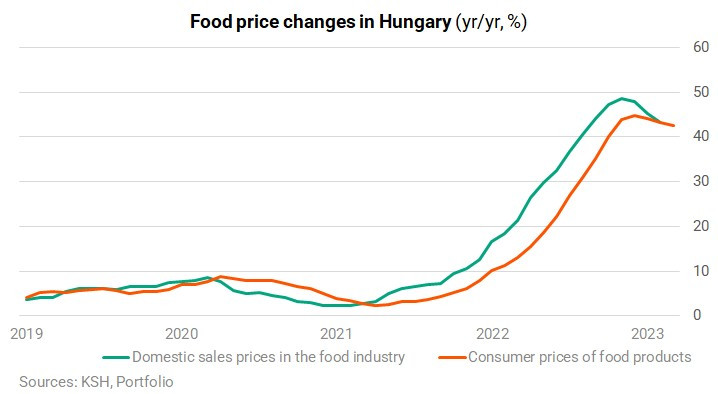
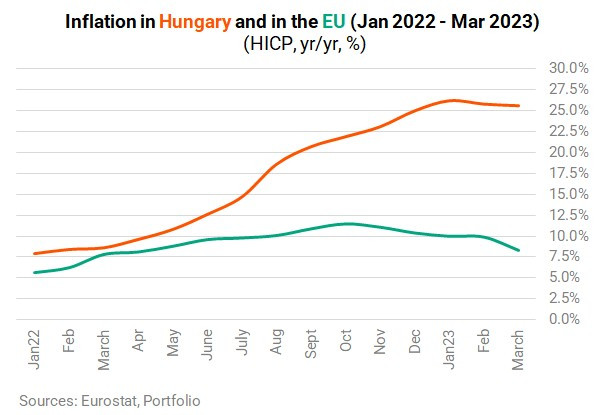

The government's target is to push inflation below 10% by the end of the year, but they might find that further measures are required to reach this goal. However, it may also want to present the expected fall in inflation in the coming months (guaranteed by the base effect) as its own success that was facilitated by the mandatory promotions.
In any case, it is certain that in each month of the first quarter inflation was north of the 25% mark in annual terms, and food inflation was the highest of all product groups.

Although there are still a lot of uncertainties, but this is clearly
a further and drastic restriction of market competition.
Some grocery chains may tread very carefully with these mandatory discounts, as they could be forced to sell some of their goods at heavy losses when forced to lower their prices.
As if the windfall tax (i.e. a raise to an existing special levy) imposed last year, and the food price caps in place for over a year were not enough, here's another regulatory uncertainty added to the system. The price of this will largely be paid by retail chains, which are already among the most expensive and have lost significant market share over the past year. Discounters, on the other hand, have responded effectively and quickly to regulatory challenges by attracting more customers through relatively low pricing.
Everyone has to manage the obligatory promotions somehow, and the easiest way to do this is to increase the price of other products. This has been perfected by the chains in just over a year of the price freeze: losses on price-freeze products have been made up elsewhere (with non-freeze products being raised to compensate). The situation will be similar for mandatory promotions.
However, hypermarkets, supermarkets and domestic chains are now in big trouble, as they have become too expensive for the increasingly leaner wallets of domestic consumers. However, there may well be room for manoeuvre in the discounters.
The government wants to prevent price increases by introducing an online price monitoring system. It is doubtful how successful this will be, as no business wants to operate at a loss.
In some cases, it may well be that the closure of certain units - which are operating at a loss - will be brought about by the tsunami of regulatory changes. Once shoppers see that there are new discounts (compulsory promotions) that small shops are missing out on, this could also push consumers away from Hungarian-owned outlets to chains that offer better prices overall.
In the coming period, chains may therefore focus more than ever on finding the cheapest sources of imports. The price freeze has led them to do so anyway, as their purchase prices exceed the prices at which they can sell their products. Since they want to minimise their losses, they are looking for the cheapest sources of supply. As a result, the share of imports in Hungarian shops is steadily increasing.
In addition, consumers have become increasingly price sensitive in recent months, which is no wonder given the record high inflation, and consumer behaviour is pushing shops towards such imported products.
The 'mandatory promotions' are another step in this direction. As shops will have to please consumers with additional discounts, they will be able to drive down product quality to levels close to the minimum required by the regulator for an increasing number of product categories.
As can be seen from the above, the experience in market economies is that it is not good to interfere with a complex system such as the price system. Prices are the main information carriers, and distortions in them can lead to changes in behaviour that no one can foresee, and these tend to be socially unfavourable.
This measure could also break the trend seen in recent months, whereby shops have reduced the prices of products where purchase prices have also moderated. The period ahead may be more about chains saving this resource away for 'rainy days' to cover the losses they are likely to incur in compulsory promotions. We would not be surprised if some shops have even longer queues than now, and others have padlocks.
The announcement of the mandatory discounts came out of the blue to us, György Vámos, Secretary General of the National Trade Association (OKSZ), told Portfolio. We are unable to give an accurate opinion, but the measure is similar in nature to a price freeze, as certain products have to be sold at a lower price, and part of the sales revenue has to be foregone. The big question is for how long the products that are subject to the compulsory sales promotion will have to be sold at a lower price, and how long the measure will be in place. So, in Vámos's words, it is yet another measure that traders have not been able to foresee and count with.
Cover photo: Getty Images





