Hungarian gov't reaches into banks' windfall tax by decree


What have the guidelines been so far?
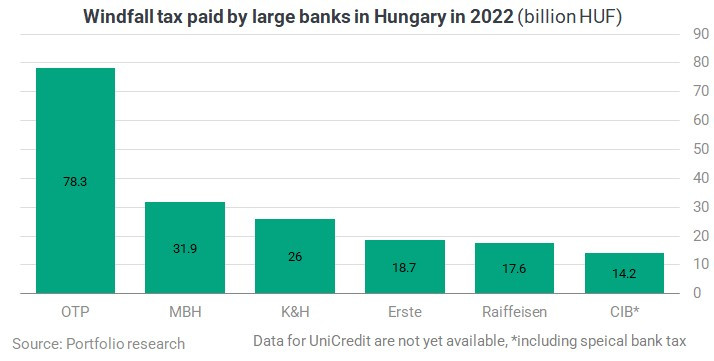
In addition to the special tax on banks, which has been in place since 2010, the government introduced an extra profit tax in the middle of last year to skim off part of the bank profits from the rise in interest rates. The tax liability is based on the net turnover calculated on the basis of the annual accounts for the previous tax year, in accordance with the Income Tax Act (Act C of 1990 on local taxes). The tax rate was 10% in 2022 and 8% this year, due to the dynamic growth of the tax base. The windfall tax, or as the cabinet likes to call it 'extra profit tax', does not meet the definition of an income tax under IFRS, so banks typically report it under operating expenses in their income statement. According to the National Bank of Hungary's (MNB) analysis and our own calculations,
the government took HUF 226 billion from the banking sector last year, which was about 29% of the sector's pre-tax profit (unconsolidated) last year excluding the extra profit tax.
What is changing now?
This is what the government is reaching into now, and the change published in the decree last night essentially affects the second half of the year:
- from 1 July, the tax base will change, and 50% of the profit from the sale of goods and services not made in the ordinary course of business in the previous year (i.e. the part per half-year) will be taxed instead of the previous net turnover,
- 50% of the bank tax charged in the preceding year, 50% of the financial transaction tax paid and 50% of the extra profit tax shall be taken into account as an addition,
- the tax rate will also change accordingly: the tax base (i.e. the adjusted profit) will be 13% for the part of the tax base not exceeding HUF 10 billion, and 30% for the amount above that.
We understand that the measure is neutral from a budgetary point of view and in terms of the overall tax burden on the banking sector.
According to our sources, the change is likely to be a move by the government to make the extra profit tax fairer, as net revenues and the net interest income, which accounts for the lion's share of net revenues, have not adequately reflected the extra profits banks have made as a result of the rising interest rate environment, and that the extra profit tax penalised more heavily those banks that suffered revaluation losses on their longer-term government bond investments due to the rise in the interest rate environment, while rewarding those that deposited their liquidity with the central bank in the short term.
Who are the winners and losers?
Some theoretical considerations can be made in this respect:
- shifting the tax base from income to profit should in principle take better account of the banks' ability to bear the burden,
- and taking profit as the tax base is more favourable to banks that operated less efficiently or with lower profits last year, or took less advantage of the rising interest rate environment,
- the banded rate is a positive development for banks with profits (adjusted for special taxes) below HUF 10 billion,
- but overall it is difficult to calculate which banks benefit from the current change, partly due to the incomplete disclosure of data.
As Portfolio understands it,
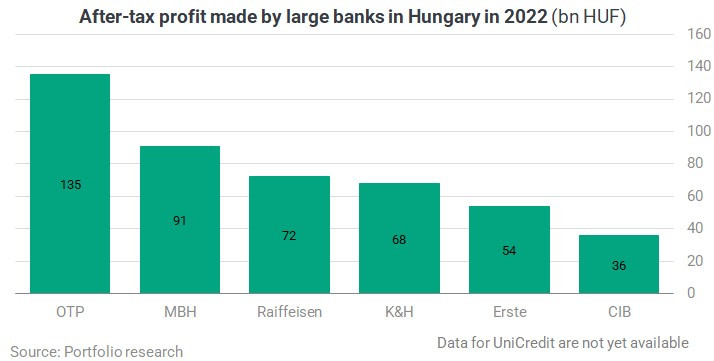
OTP could be the biggest winner, while Raiffeisen, UniCredit and K&H could be the biggest losers.
The others, such as Hungarian Bankholding, Erste Bank or most of the smaller banks, may come out of the change with a slightly positive balance.
However, there is a legitimate question as to whether the current change is really only for the second half of 2023, or whether it could form the basis of a longer-term system for taxing banks. We understand that the government's planning has already included a serious consideration of the latter, perhaps by fixing last year's tax base for the longer term. In any case, the regulation sets the extra profit tax until the end of 2023 for the time being.





