Hungary central banker Virág says food prices could drop already in April


Highlights of Barnabás Virág's remarks:
- inflation is to start falling at a faster rate from the second quarter and there will be further acceleration in its retreat from the middle of the year;
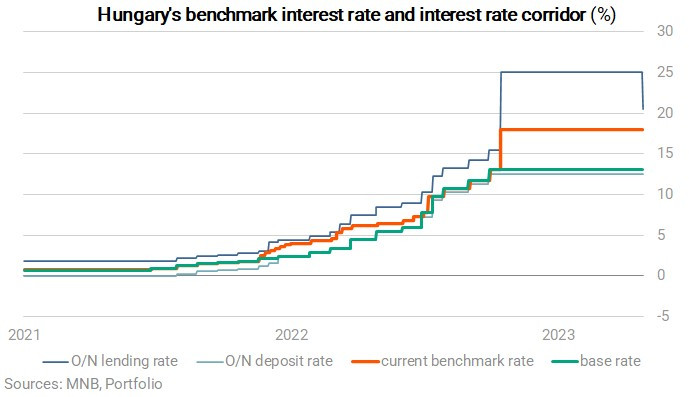
- the market expects the benchmark rate (18%) to be aligned with the base rate (13%) and Virág said this is a "realistic course";
- gradual, pre-communicated decisions can be expected from the central bank;
- the 450bp cut to the O/N lending rate was aimed at creating a 250bp gap between this rate and the benchmark that the MNB had before the extraordinary hike in mid-October last year;
- the 18% one-day deposit rate is still needed, and they may discuss its reduction at the next meetings;
- the MNB will adopt a prudent and cautious approach;
- the bank expects food prices to show a month-on-month decline in April;
- extreme risk scenarios have already been priced out.
Extreme scenarios are priced out
The current level of the base rate is appropriate to address fundamental inflation risks. The announcement of overnight deposit quick tenders at 18% remains justified in the Monetary Council's unanimous view, said Barnabás Virág. The narrowing of the interest rate corridor is part of a normalisation process, and we decided to do so because Hungary's risk perception has improved substantially, so that extreme risk scenarios have been priced out, the Deputy Governor added.
Improvement could be even greater than expected
Hungary's external balance has improved significantly and on trend, with the current account deficit narrowing further in February.
The evolution of our external position could be even more positive than previously expected
he stressed.
Help comes not only from lower energy prices
The significant improvement in the current account balance is partly due to the energy balance and partly to non-energy items, according to the Deputy Governor, who said that the positive trade balance in February for the first time since June 2021 is particularly positive. He said that a halving of the current account balance compared to last year is still conceivable.
Inflation could fall sharply from the middle of the year
In April, food inflation continued to fall, with a broader range of food products already showing signs of price declines. However, we saw a sharp repricing of non-food items, especially services. However, this room for repricing could narrow further, with a markedly rapid moderation in the inflation path from the middle of the year, said Virág.
The chart presented by Virág shows that the MNB expects April to have been the first month in a long time with a decline in food prices compared to the previous month (official data will be available in May).
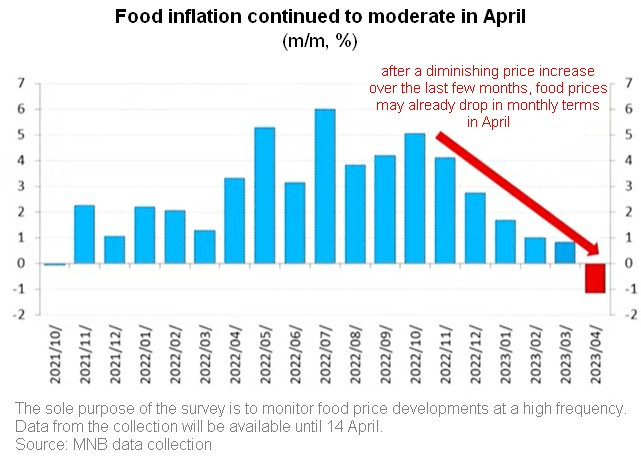
The turnaround in inflation seems to have started, but not only in Hungary, but also in Europe, core inflation seems to be moderating more slowly. We are confident that there will be a change in the pace of decline in the second quarter, and then a more significant fall from the middle of the year, added Virág.
In the coming months, the MNB will keep a close eye on these factors
The MNB will adopt a prudent and cautious approach, said Virág.
PRUDENCE, GRADUALISM, GRADUAL ASSESSMENT OF MARKET EFFECTS AND INTEREST RATE EXPECTATIONS, AND TRANSPARENT EX ANTE COMMUNICATION WILL BE OUR FOUR GUIDING PRINCIPLES,
he stressed.
The durability of the improvement in risk perceptions will be assessed on an ongoing basis, with a particular focus on the external balance position, developments in exchange rates and the preservation of market stability, as well as swap market developments and the proper enforcement of monetary transmission.
Among the external factors, he highlighted concerns about the banking system and the expected path of interest rates of major global central banks.
So which interest rate can change and when?
The base rate responds to fundamental challenges, while the one-day deposit rate provides market stability, stated Virág.
The base rate is justified to be maintained on a permanent basis, with no changes on the agenda. If fundamental inflationary developments justify it, the current base rate of 13% could be maintained for longer than previously expected, he added.
The 18% rate for one-day deposits is still needed, and a reduction could be discussed at future meetings.
Any shift will be linked to the monthly policy meetings, and their timing will be appropriate,
stressed Virág in respect of the benchmark rate.
Gradual, pre-communicated decisions are coming
The evolution of market interest rate expectations will be an important guide, and we will make our decisions on the one-day deposit rate accordingly in the coming period. Gradual, pre-communicated decisions can be expected, according to the Deputy Governor.
When can the benchmark interest rate reach the base rate?
Market expectations are for the benchmark rate to reach the level of the base rate sometime in the autumn, and at the moment I see this as a realistic path,
said Virág.
On this basis, the central bank could lower its benchmark rate by 75-100 basis points from May-June, which would allow it to fall to 13% from 18% in the autumn.
In response to the last question, Virág said the main indicator will be the communication channel in the coming period, and the pricing of foreign exchange swaps will move in line with the benchmark rate.
Why has the MNB cut 450 basis points today?
In mid-October, the Monetary Council set an extremely wide interest rate range, as there were significant and serious risks in the global and the domestic economy at that time. Thus, an appropriate intervention option was needed in case of any negative scenario. However, with the improvement in the risk environment, the extreme negative scenarios have been priced out, and the Council has responded to this today.
We wanted to achieve the same 250 basis point differential from the effective rate that we had before 14 October, explained Barnabas Virág why today's cut to the O/N lending rate was 450 basis points.
More to follow!





