Details of Hungary's mandatory store promotions published


Regulation details published
The Ministry of Economic Development and the Ministry of Agriculture have drawn up the detailed rules and the public consultation on the draft will start today. The draft government decree sets out the following provisions on compulsory discount sales:
- Mandatory promotions must be held between 1 June and 30 September 2023.
- It applies to retail sale in non-specialised stores with food, beverages or tobacco predominating (NACE 4711), with annual revenue of over HUF 500 million in 2021.
- the regulation covers not only commercial activities in shops or shopping centres, but also mail-order sales.
- Mandatory promotions must take place on a weekly basis, with the promotion period running from 0:00 on the Thursday of the week until 24:00 on the Wednesday of the following week.
- The retailers are obliged to display the information about the mandatory promotion in a prominent place in the shop and to include it on printed products and online in connection with their advertising activities.
- 20 categories of products subject to promotions have been defined, including: poultry meat; pork, beef and other meat products; milk, sour cream and substitutes; cheese; bread; pastries; dry pasta, rice, other cereals; fresh fruit; fresh vegetables; ready meals, spices, condiments. The information leaflet for products in the categories subject to the promotion is published on the website of the Ministry of Agriculture.
- The retail outlets concerned must sell a freely chosen product from each of the designated product categories at a price at least 10% lower than the lowest price they applied in the 30 days preceding the mandatory promotion.
- During the period of the promotion, the trader is obliged to sell and keep in stock an appropriate quantity of the product covered by the mandatory promotion.
- There will be continuous monitoring by the consumer protection authority, and breaches of the rules can result in fines of between HUF 500,000 and HUF 3 million, depending on the case.
By reducing prices and increasing competition, the government expects the new measure to stop overpricing and speculation, so that inflation can be further reduced in the near future, the statement said.
How many companies and stores will be affected?
The regulation is applicable on more than 300 companies, which means that several thousands of retail outlets are to be affected.
It was obvious that the largest retail chains would be hit by this measure, and they are: Aldi, Auchan, Lidl, Penny, Tesco, and Spar too.
The networks of the companies concerned currently include several thousand stores nationwide, including more than 600 Spar units, Aldi has around 150 stores, Lidl around 200 and Penny and Tesco have more than 200 stores.
What is new, however, is that Hungarian franchised networks
INCLUDING A SIGNIFICANT PART OF THE COOP, CBA/PRÍMA AND REáL STORES
are also be subject to the mandatory promotions rule due to the relatively low criterion of an annual turnover of over HUF 500 million in 2021.
If all chains are included, around 9,000 shops belong to the largest of the above-mentioned operators. However, not all of these at the franchise networks will be affected, but around 3,000 will almost certainly be.
Since the two ministries use the term "trader" in the communication, the regulation may also apply to self-employed persons, which means that some clarification is needed, as small, own-brand bakeries or grocery stores may also fall within the scope of the regulation.
If only companies are concerned, and small and the latter group is deducted, there are still 290 economic operators concerned whose main activity is food retailing.
Likewise, it is not clear from the communication whether the government considers the NACE code for food retailing as a principal activity or whether it counts if it is only included in the secondary activity.
IF ALL THE CLASSIFICATIONS ARE TAKEN INTO ACCOUNT, WE CAN TALK ABOUT 2,941 OPERATORS CONCERNED, ACCORDING TO THE OPTEN (company registry) DATA.
If the NACE code is interpreted freely, operators such as energy group Mol Plc. or certain construction companies with their own cafeterias would also be affected.
But the biggest news is that compulsory promotions are to be applied not only to physical shops but also to mail order. This certainly means home delivery operators such as Kifli.hu and Wolt Market. Besides the the two best known operators there are also several smaller businesses that could be affected, but here too there is a lack of detail to search for all operators in the business databases.
As we have written before in our analyses (see box below), it seems to have become a secondary concern for the government to consider both the distorting effects and the negative consequences of any new measure that hardly, if ever occur, in a market economy. But if they did, it would be obvious that what the cabinet is robbing Peter to pay Paul, and in effect it is forcing itself further and further into a cul-de-sac with more and more anti-market measures.
Foreign multinationals may be confirmed in their growing suspicion that the government perceives them as the enemy (well, one of the enemies among many). In the meantime, the further strengthening and rise of discounters is almost guaranteed, as they are the most flexible to react to the regulatory surprises of the past period.
Central bank expects food price drop
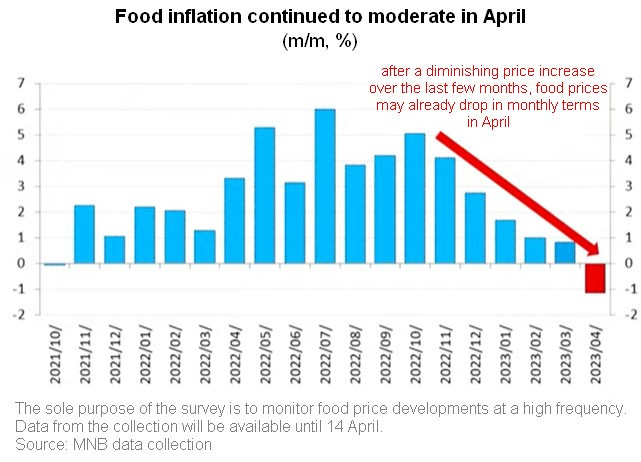
Interestingly enough, central bank (MNB) Deputy Governor Barnabás Virág just pointed out on Tuesday that food inflation continued to fall in April, with a broader range of food products already showing signs of price declines.
He added, however, that there was a sharp repricing of non-food items, especially services, but noted that this room for repricing could narrow further, with a markedly rapid moderation in the inflation path from the middle of the year.
The chart presented by Virág shows that the MNB expects April to have been the first month in a long time with a decline in food prices compared to the previous month (official data will be available in May).
The graph below shows a brief history of food price changes in Central and Eastern Europe and the EU since January 2021.

The government is unusually generous with retailers, giving them more than a month to prepare for the new measure. It generally demands close to instant adjustment to rapidly changing regulations.
With inflation, including food inflation, expected to drop, this is once again a win-win situation for the government, as it will be able to 'sell' the decline in prices as its own achievement. Unless the stores find a way to offset their losses (raise the price of other products, switch to cheaper and lower-quality imports, just like they did with the food price freeze, which backfired the same way, according to experts.
Portfolio survey
Portfolio has asked its readers in an online survey after today's announcement what they think about the upcoming measure.
A SWEEPING MAJORITY, NEARLY 70%, SAID CONSUMERS WILL GET THE SHORT END OF THE STICK.
These were the answers they could tick off and the percentages of nearly 7,000 responses:
- Yes, it will bring down inflation and finally prices will not go up (3%)
- Yes, it will even lead to price cuts (3%)
- No, shops will offset [their losses] anyway and shopping will not become cheaper (24%)
- No, shops will overcompensate for yet another hostile measure and I will be worse off (69%)
Cover photo: Getty Images





