No problem with Hungary's FX reserves, yet cenbank keeps very tight lid on energy bill spending


Hungary’s gross financing needs increased significantly in 2022. Following a gradual decline after 2011, gross financing needs have been on the rise over the past three years in parallel with the external balance position turning into net borrowing. Annual external net borrowing calculated from the items in the financial account, which shows the external funding requirement of the country, amounted to 9% of GDP. At end-December 2021, short-term external debt – i.e. expiring in 2022 – stood at 16% of GDP, which also represents an increase compared to the previous year’s level.
On the whole, the gross external borrowing requirement, which shows the Hungarian economy’s external liabilities to be renewed in a given year – and is the sum of the aforementioned two values – amounted to 25% of GDP.
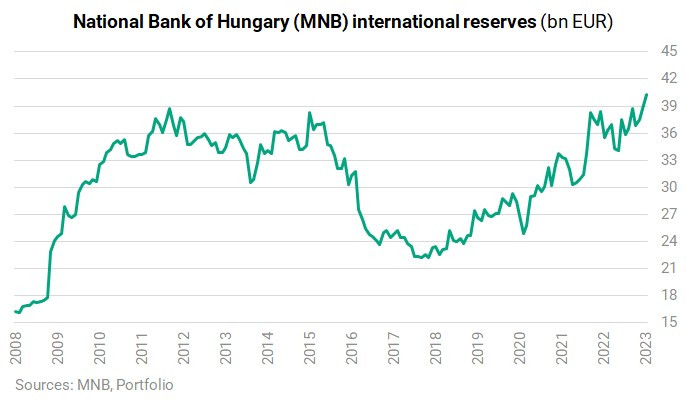
At end-2022, international reserves stood at EUR 38.7 billion, which corresponds to the September level. The stable development of reserves in the fourth quarter was affected by various factors, the most important of which were the following:
- The net FX financing operations of the Government Debt Management Agency (ÁKK) boosted reserves by EUR 1.7 billion in total, which was mainly the result of the ÁKK’s green bond issues denominated in euro and renminbi, as well as of the exclusive raising of USD-denominated bond issues.
- The reserve-increasing effect of EU funds amounted to EUR 1.3 billion, which was still primarily related to cohesion fund inflows linked to the 2014–2020 period, but already partly contained advance payments from the new cycle as well.
- On the whole, the revaluation resulting from the shift in the exchange rates of other currencies and the price of gold reduced the reserves.
- The instrument related to covering net energy imports was launched by the MNB in November 2022; satisfying the FX liquidity needs reduced the level of reserves. The central bank, did not disclose how much it had spent from its reserves for the energy bill.
- The foreign exchange transactions of the Hungarian State Treasury also contributed to the decline in FX reserves.
- The balance of the euro liquidity-providing swap instrument and the international repo drawdowns decreased reserves compared to the end of September 2022.
The MNB’s international reserves increased by EUR 0.3 billion in 2022 as a whole. Foreign exchange reserves rose from EUR 38.4 billion at end-December 2021 to EUR 38.7 billion by end-2022, mainly due to the following factors:
- Net foreign currency funding by the Government Debt Management Agency in the amount of around EUR 5 billion contributed to the growth in reserves. The GDMA issued FX bonds denominated in various currencies (euro, dollar, yen, renminbi) on several occasions. The state did not have any international FX bond maturities during last year.
- The annual net amount of transfers from the European Commission and of the payments made affecting the FX reserves exceeded EUR 4 billion.
- The decline to zero of the forint liquidity-providing FX swap instrument in the autumn of 2022 also reduced the level of reserves.
- Foreign exchange expenditures of the Hungarian State Treasury and the instrument related to covering net energy imports reduced the reserves.
- It also had a reserve-reducing effect that the stock of the euro liquidity-providing swaps and the international repo drawings used for their funding were different.
The report shows that at the end of 2022,
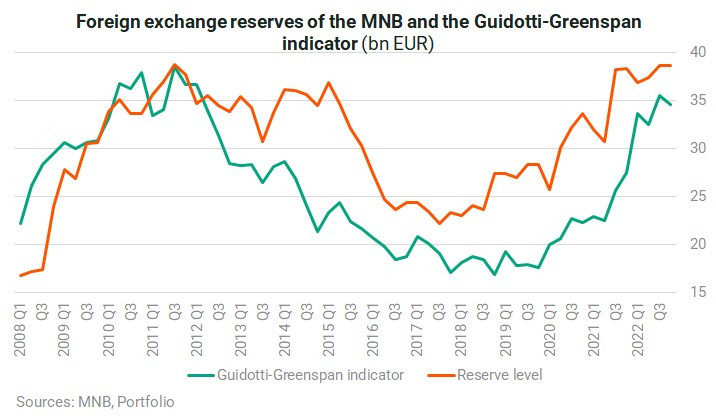
the MNB’s international reserves exceeded the level of short-term external debt, which is closely monitored by investors, by EUR 4.1 billion.
At end-December 2022, international reserves amounted to EUR 38.7 billion and short-term external debt stood at EUR 34.6 billion. The leeway above the Guidotti–Greenspan indicator, which is closely monitored by both the central bank and investors, rose from EUR 3.1 billion at end-September 2022 to EUR 4.1 billion (Chart 28). Last year, the adequacy measured on the basis of the Guidotti–Greenspan indicator was at a level similar to the one seen at the end of the year, i.e. around EUR 4.2 billion on average.
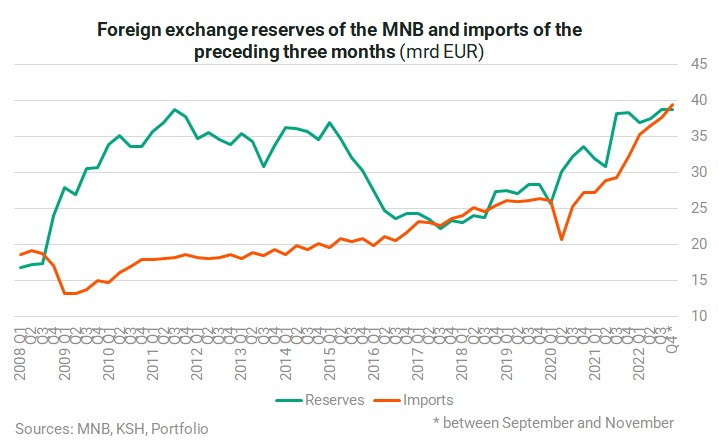
If we look at the other alternative indicator and compare the foreign exchange reserve to three months of imports, the picture is not so positive, as in the last three months of 2022, our imports were EUR 39.5 billion according to the Central Statistical Office (KSH), which exceeded the foreign exchange reserve of EUR 38.7 billion. However, this indicator is now rather kept only by statistics, and is considered obsolete as a foreign exchange reserve requirement rule.
Cover photo: Getty Images





