Is it really the influx of foreign labour that will save Hungarian jobs?


The government seems to be serious about increasing the number of employed people in Hungary by 500,000 in the next few years. Although the current growth model, based on expanding employment, is getting closer and closer to its limits, the country is not really moving in the direction of better jobs, but rather towards creating more jobs. However, it is not really possible to bring in more workers from within the country, it is almost full employment. Part of the justification for attracting foreigners may be that demographic trends mean that tens of thousands more people are leaving the labour market each year than are entering it.

"Despite the shocks to the economy, the Hungarian labour market appears fairly stable. There has been a succession of crises, yet our low unemployment rate has barely changed in recent years. So the Hungarian economy is fundamentally short of labour, partly due to demographic trends," Orsolya Nyeste, chief economist at Erste Bank, told Portfolio.

"Anecdotal evidence suggests that even in these difficult times, many firms would rather take on temporary out-of-work jobs than deal with the time-consuming and costly task of recruiting later in the recovery. In the absence of a significant additional pool of available labour, it makes sense to import foreign workers. Much has been said recently that the number of foreign workers needed could be as high as 300-500,000. It seems that this will now be a kind of solution," explained Orsolya Nyeste.
Foreign workers have been arriving in Hungary in increasing numbers for years as unemployment has fallen to low levels, making labour shortages an increasingly prominent phenomenon in recent years.
The government is seeking to make the inflow of foreign workers more regulated and easier to manage, with new regulations introduced recently and in the pipeline.
"One of the keys to the development of the Hungarian economy is to maintain and develop current investments. The availability of the necessary workforce is essential to keep investments viable. Any labour that is available is locally dispersed or inadequate in terms of skills," reads the impact assessment of the draft legislation on the employment of guest workers in Hungary. The government argues that,
in addition to addressing mobility problems and implementing retraining, the employment of guest workers is necessary on a temporary basis to ensure the sustainability of investments and to maintain competitiveness.
But Hungarian workers should not fear that "foreigners will take their jobs". Magdolna Mihályi, managing director of Jobtain HR Services Ltd., who herself brings foreign workers into the country, said in response to a Portfolio inquiry. Mihályi added that "the legislator's intention is certainly to protect Hungarian workers and to control the import and employment of guest workers as effectively as possible, and to maintain national security". Besides the legal protection, she added, the biggest safeguard for Hungarian workers is that the cost of employing guest workers is at least 30% higher than if the same position could be filled by Hungarian workers, due to the significant recruitment, transit and accommodation expenses. She believes
it is in the interest of all employers to employ Hungarian workers if they have the opportunity.
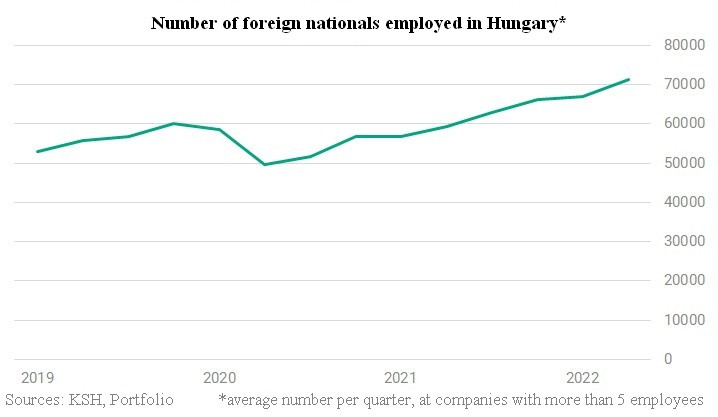
But foreigners are still in increasing numbers, as almost all domestic workers are now working if they have the right skills and want to. In Hungary, the number of foreign workers increased by 14% to 81,000 last year, according to official figures.
The biggest contributor to the rise was Ukrainian workers, whose numbers rose by 5,200, or 24%, in a year, due to the effects of the war.
According to Magdolna Mihályi, the number of Ukrainian workers is in the tens of thousands, despite the fact that their numbers have been decreasing since the outbreak of the war and their emigration to other countries, especially in Western Europe, is becoming more frequent. The labour shortage in Hungary can therefore no longer be covered by the available Ukrainian supply. For this very reason, the number of workers from third countries, including the Philippines, has been steadily increasing in recent years. Recently, more and more Kyrgyz workers have also been coming to Hungary, she added.
The analysis of the KSH also highlights that in the second half of 2022, there was also a slight shift in nationalities: while the increase in the number of Ukrainian employees since the second quarter of 2021 slowed down, so their share within foreign employees decreased slightly, while the share of employees from some non-EU countries (e.g. Philippines, India) increased.
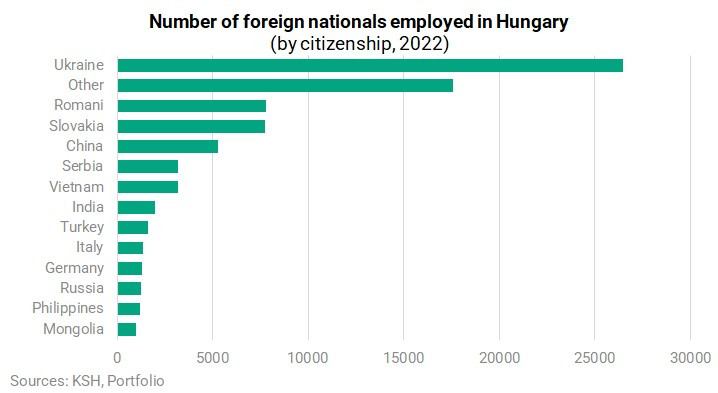
This is due to the relaxation of admission conditions for workers from several non-EU countries over the summer.
Qualified recruitment agencies can already import workers from 15 countries quickly and easily, without any special authorisation procedure. "Serbia is one of these 15 countries. Because Serbian workers are hard-working, disciplined and skilled, they are very popular with Hungarian employers," Minister of Foreign Affairs and Trade Péter Szijjártó said recently. Szijjártó was commenting on the entry of HR service provider Prohuman into the Serbian market, from where more than 1,300 people came to Hungary last year.
It is possible that more people from outside the EU will come in the coming period. It is now a common belief in government that foreign workers are needed to keep Hungarian workers in jobs. According to the explanatory memorandum to the draft legislation, "the government is committed to preserving jobs for Hungarian workers". They stress that "in order to ensure that the employment of guest workers in Hungary is carried out within a transparent regulatory framework, it is necessary to create a legal environment which, taking into account the employment rules and benefits in force, makes it clear to employers in a favourable position for the authorisation of employment under which conditions and procedural aspects they can employ guest workers in Hungary for a longer period of time".
Magdolna Mihályi said that everyone should see that foreign workers are needed in Hungary, especially to expand investment. "There has been a shortage of skilled workers in certain areas for years, and there is a constant demand for welders, CNC operators, forklift truck drivers and heavy machinery operators in the logistics sector. Language-speaking engineers and IT specialists are also needed," she concluded.
The labour needs of companies can no longer be fully met from within the country. Foreign investors are not investing in countries where there are not enough workers to do the job,
the expert said. She stressed that
in order to preserve Hungarian jobs and bring investment to Hungary, the import of foreign workers has become a key issue.
"There is a growing trend to recruit minimal domestic labour for factory jobs. There is an increase, but high employment is making it harder for companies. And those who are looking for work are not looking for the jobs that the market is currently offering," Magdolna Mihályi added.
This is why foreign workers are needed, especially in shortage occupations. "Parliament will vote on the draft law on the employment of guest workers in Hungary in the spring session," Sándor Czomba, State Secretary for Employment Policy, told Világgazdaság. The detailed rules are expected to be adopted in the autumn, with the full package coming into force on 1 November. Hungarian workers will continue to be protected by a fixed quota: foreign workers will only be allowed to come from third countries in the number allowed by the pre-defined quota.
The proposal sets out the rules for workers coming from abroad, under which conditions and criteria preferential employers may employ guest workers in Hungary for more than 90 days. Guest workers may be employed in Hungary for a maximum of 2 years; from specific countries, in specific numbers, in specific professions, by specific employers.
The change in the law therefore recognises that the construction and operation of assembly plants, which are largely low value-added, cannot be done without foreign workers. Overall, the above argument can be based on the fact that
large manufacturing plants need more (cheap) labour, as the total number of workers in industry and construction is now close to 1 million.
In other words, it is crucial to have the right number of workers for the industry, which is increasingly questionable in the context of tight domestic labour market conditions. And with new factories being built, the demand for labour will grow even more.

Low unemployment and labour shortages, which have reached historic highs in recent years, mean that firms are finding it increasingly difficult to find the workers they need, and that they have to give workers explicitly substantial pay rises or they will move on. This situation has been compensated in many cases by the depreciation of the forint in recent years, and the intensive inflow of foreign workers has also eased the problems of companies. If wages were too high (in euro terms) or if there were not enough workers (from abroad), these companies might consider relocating production to a country where it is cheaper and there are more workers available. In the period ahead, overall, detailed legislation will make it relatively easy for foreigners to come into the country - as we have seen over the past year or two - to ensure that there are enough workers to sustain the extensive growth model.
"The question arises whether it is certain that extensive growth based on the attraction of additional labour is the right way to achieve further catching-up of the Hungarian economy," Orsolya Nyeste told Portfolio.
"Wouldn't it be better to take advantage of the constraints of labour shortages to move on and start to lead the country towards more intensive, less labour-demanding sectors with higher added value?" asked the Erste Bank macroeconomist.
This shift would of course require further development of existing human capital, investment in education and health.
According to Nyeste, investing in human capital, improving education and healthcare would be more likely to break out of the middle-income trap - which we are heading towards - than importing large numbers of foreign labour.
Cover photo: Shutterstock





