Hungary cenbank can really start cutting rates now, provided that HUF easing does not scare it


Most exciting rate-setting meeting in a long time
The Monetary Council meets on Tuesday to decide on interest rate conditions, and we have known for a month how important this meeting will be. At the end of April, the MNB had already lowered the top end of the interest rate corridor and indicated that the next step on the agenda would be to lower the benchmark rate, which is the one-day deposit rate.

The question in recent weeks has been whether the central bank will start easing in May or wait for the new Inflation Report in June. The April inflation figure showed a positive change, and after a token decline in the preceding period, a more robust disinflationary process seems to have finally started. This could finally tip the scales,
and almost each of the analysts polled by portfolio project the benchmark rate to be lowered after the tuesday policy meeting.

There is full agreement that the decision-makers will not alter the 13% base rate, which is not even relevant for the time being, and that the first step is to close the gap between the base rate and the 1d depo rate.
The MNB may start to lower the benchmark rate cautiously. Most risk indicators have been very favourable: robust March trade surplus, surplus in the March current account, further decline in energy prices, which further improves the terms of trade, continued stable government bond and swap markets, oversubscription in government bond auctions. International sentiment has improved slightly, although EUR/USD has reversed, which is not positive for the time being, summarised Gergely Suppan, senior analyst at MBH Bank.
Over the past month, we have not seen a deterioration in any of the key criteria, but rather a further improvement. Overall, the Monetary Council can therefore consider the process to be in line with the trend, Péter Virovácz said. The analyst at ING Bank, who has recently won first place in the forecasting competition organised by the National Bank of Hungary (MNB) and Reuters Hungary, added that the condition for a sustained improvement in risk perception set by the Monetary Council for the interest rate cut may have been met.
Only HUF weakening can holding the MNB back?
"In the middle of last wee, we were confident that easing would start on Tuesday, but developments in the foreign exchange market in the second half of the week have introduced uncertainty into the system. On Friday morning, we still give more credence to the option of a rate cut the following week, but the actual decision will depend largely on developments in the FX market over the next two and a half trading days," Mariann Trippon, analyst at CIB Bank, said in response to Portfolio's questions.
She pointed out that the forint weakened significantly in the second half of last week, which may warrant caution from the MNB's part. Postponing the rate cut could be an option if market tensions continue to rise early this week, possibly spilling over into other segments, the expert added.
Mariann Trippon pointed out that the forint showed shifts similar to the current ones in March, during the banking crisis, but after the external sentiment normalised, the beneficial effect of the high interest rate differential was able to reassert itself, and the forint fully recovered its losses in a short period of time. Otherwise, during the April meeting, the EUR/HUF exchange rate was at about the same level as at noon on Friday, she said.
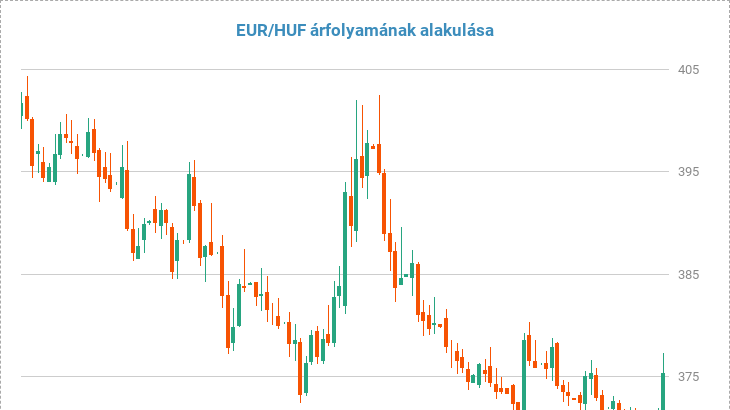
We do not think that the weakening of the forint seen on Thursday and Friday will discourage the MNB, Orsolya Nyeste, an analyst at Erste Bank, said in response to our questions.
The MNB is probably aware that the forint's volatility may increase and the exchange rate may weaken ahead of the expected move, but we do not think this is critical at the moment
she said.
"The volatility seen in the forint market in recent days has increased the risk of a possibly smaller (50- or 75- basis-point) cut, or even that the decision will be put off to June. However, the vast majority of the factors examined by the MNB point towards the start of normalisation," stressed Péter Kiss, investment director at Amundi.
Only Zoltán Török, senior analyst at Raiffeisen Bank, expects the 18% benchmark rate to remain in place for now and the MNB to wait until June. He says the turbulence seen in the forint market could cause increased caution, if the Hungarian currency strengthens on Monday and Tuesday morning, this could change, but for now he gives less chance to that scenario.
The weakening of the forint seen in recent days has also made others hesitant, Péter Vizkelety, an analyst at Fundamenta, previously expected a 100bp cut, but now he thinks that the central bank may start with a more cautious move and that the possibility of postponing the first step until June cannot be ruled out.
Various easing scenarios
The weakening of the forint also weighed on expectations about the size of the interest rate cut. Previously, a monthly rate of 75-100 basis points was likely, while now the consensus suggests a move of only 50 basis points.
Analysts at Erste Bank continue to expect the central bank to move forward in 100bp steps, and if all goes well, the base rate and overnight deposit rate could be closed by September. Later, a possible cut to the 13% base rate could be influenced by the inflation outlook, and the central bank can continue to send a tough message on this, stressing that a first cautious move from extreme highs towards normalisation will not mean abandoning tight monetary policy or caution, Orsolya Nyeste added.
"The day after the rate decision meeting, the central bank will announce the quick tender at a 17% rate. In addition, we expect the central bank to push the upper end of the interest rate corridor down by 100 basis points, so that it could stand at 19.5%," Péter Virovácz projected.
However, according to an analyst at ING Bank, the MNB will continue to emphasise the need to fight inflation. In his view, prudence and gradualism will remain important in the upcoming decisions, meaning that if the Monetary Council considers that interest rate expectations, market effects and market stability take an unfavourable turn, they will retain the option to stop lowering rates.
It is therefore possible that the central bank will not continue to refer to the period ahead as a rate cut cycle, but will define it as a series of individual decisions,
added Virovácz.
"If all goes according to plan, we expect the central bank to unify the base rate and the effective interest rate at 13% in September, and the 300 basis point interest rate corridor that existed before mid-October will be restored, with upper and lower band edges of 15.5% and 12.5% respectively. And before the start of the base rate reduction, we see a meaningful chance that another decision sending an important signal will precede the actual base rate cut: a renewed symmetry in the interest rate corridor," the ING Bank analyst added.
Cover photo: Shutterstock





