Is the real wave of bankruptcies only just beginning in Hungary?


Deteriorating economic situation
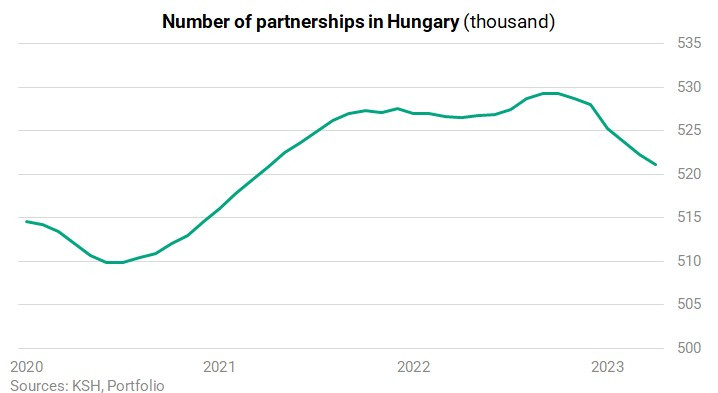
With the Hungarian economy contracting for the third consecutive quarter, entering its longest recession since 2009, it is not surprising that companies have also been hit by a wave of closures. Industry is ailing, construction is falling and retail sales are plummeting as inflation far outstrips wage growth.
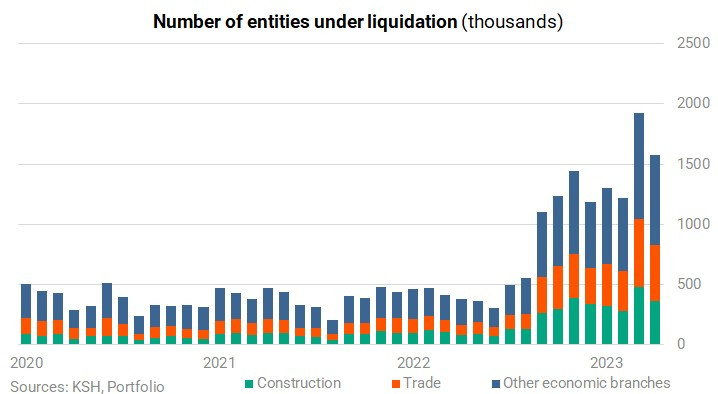
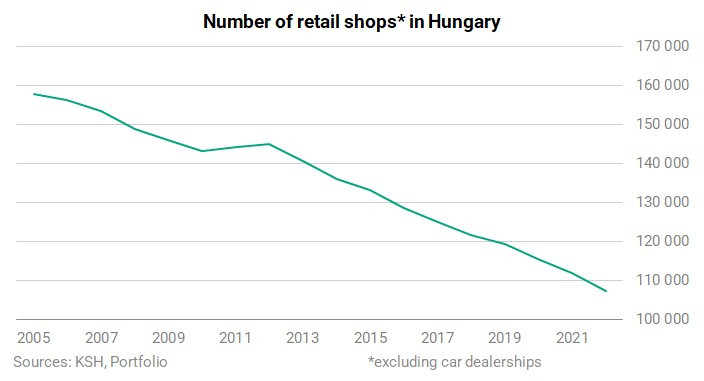
Liquidations mainly affect the retail and construction sectors, which are generally very sensitive to changes in the economic cycle. In 2022, 2,000 small shops closed in the first half of the year and 2,500 in H2, after facing severe difficulties due to weak demand, the energy crisis and an unfavourable regulatory environment (price freezes). The closure rate reached 4%, a record high. This year, the decline in retail sales has accelerated due to inflation, the worst in decades, and the wave of closures could continue.
The construction sector is facing similar problems: the recession has led to a fall in demand, which government orders are failing to cushion. In fact, forced budget adjustments are causing orders to fall even further, leading to an even deeper downturn in construction. Earlier renovation subsidies, which caused an investment boom last year, have also run out. Not only are public subsidies no longer available to families, but their real incomes are falling, causing them to postpone or cancel their renovation plans. Housing starts are falling, building permits are being issued, and the entire construction industry's contract backlog is plummeting. All these factors add up to a shock for construction companies.

A rebound will probably have to wait, as the economy is unlikely to find its footing in the second quarter. Although inflation has started to recede slowly, it will be months before CPI falls below the rate of wage growth. The budget will continue to be restrictive and there are few funds available to spend on stimulating the economy.
Is the great wave just starting?
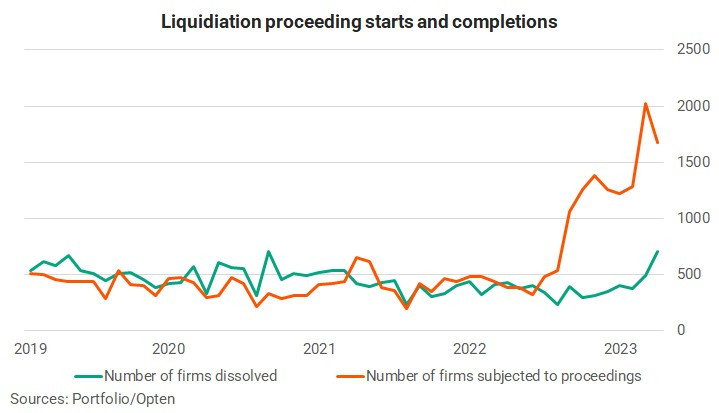
What is really worrying is not the increase in the number of completed liquidation proceedings, but the fact that there is also a marked increase in the number of newly started proceedings in March and April. Indeed, the liquidations themselves can take years to complete, while the debtors are negotiating their liabilities with creditors or even the tax authority. Furthermore, it may take a long time to assess the assets of the companies and to sell tangible assets.
- The number of companies that pulled the plug in April last year was only 423, but in the fourth month of this year it jumped to 707 (+67%).
- The number of company law proceedings opened jumped from 380 in April last year to 1672 (+340%).
The 67% rise in the number of completed winding-up procedures is the largest increase of the past three years. To put this figure in perspective, the second-largest yr/yr growth was recorded at 38.5% in September 2020.
The extremely sharp rise in the number of liquidation starts is the second-worst of the past three years, with the biggest yr/yr jump recorded at 368% in March this year, followed by a 265% leap in October 2022.
Moreover, in April, the working day effect distorts the pattern, as the Easter period brought a complete halt to the administration.
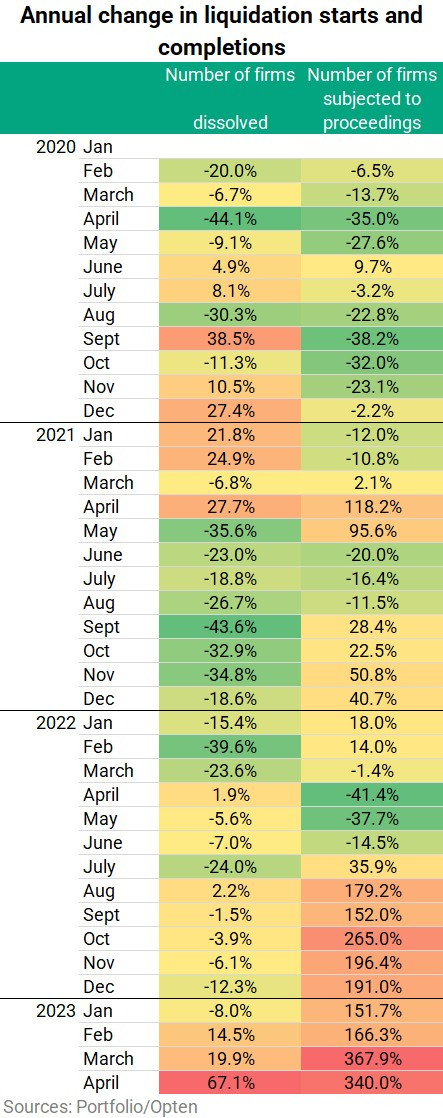
Now, due to the introduction of the moratorium in 2020, there is also a significant backlog of proceedings, with companies that have been closed for several years now being started. This points to a prolonged impact of the proceedings that have been opened. Firms in sectors that have been struggling, notably retail and construction, have been hit by the successive crises of recent years. These two sectors accounted for more than half of all liquidation proceedings opened in April.

Distortion of the Covid effect
The government has thrown a lifeline to Hungarian companies in the face of the 2020 coronavirus outbreak. Unlike the law on judicial company proceedings and winding-up, during the emergency there was a moratorium on the liquidation and suspension of businesses and a shift in compulsory liquidation procedures. "As the lead time for such proceedings is inherently several months until an initiated procedure turns into liquidation or cancellation, the current trend of company closures is still partly a delayed effect of the Covid moratorium," Csaba Alföldi, a business information expert at Opten, told Portfolio.
Alföldi said that in the case of companies that have now been liquidated, it is also important that the results of the restructuring of the KATA small business tax system are now being felt. As he explained using data from Opten, the ongoing decision-making situation of firms shows that there were about one thousand firms that previously wanted to change or opted for liquidation, but ultimately chose to continue in business. He estimates that up to 50% of the surge in liquidations could be due to the backlog caused by the Covid moratorium while up to 40% could be due to the KATA effect.
Alarming recent figures
However, he sees a negative trend in the increase in the number of winding-up proceedings without a precedent in both March and April,
with each month accounting for roughly 10% of all new winding-up proceedings.
Although, according to Csaba Alföldi, it may not seem much that 209 LLCs and 3 Ltds were liquidated without a precedent out of a total of just over 2.000,000 proceedings in March, if we compare this with the long-term average, it is clear that in "normal times" this number would be half of the monthly proceedings. Asked which sectors might be the most affected, he said that the problem was mainly in sectors that are also in crisis according to macroeconomic statistics, so that operators in the retail and construction sectors are mainly affected.
Cover photo: Getty Images/Wutwhanfoto.





