Hungary c.bank chief urges earliest abolition of price caps


Normalisation starts
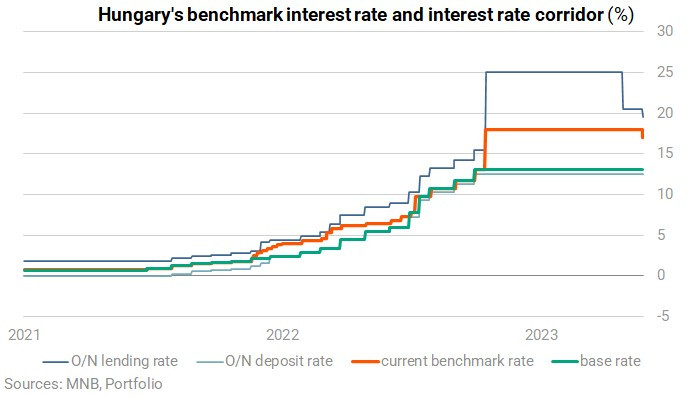
Today, the MNB has started the normalisation of monetary policy, with the benchmark rate falling from 18% to 17%, said György Matolcsy. He added this was made possible by the fact that the previous central bank measures have paid off.
There are other effects
The twin deficits have not put as much pressure on monetary policy as last year, and uncertainties about the U.S. financial system have only had a minimal impact on Hungary. These have also contributed to the start of normalisation, he said.
Inflation remains the public enemy
Inflation is still a public enemy, and our number one priority is still to fight inflation, as the 24% inflation rate is still three times the European average and ten percentage points higher than in the regional economies, said Matolcsy.
Harmony between monetary and fiscal policy
A further reduction in the budget deficit will bring monetary and fiscal policy back into line in the coming period, Matolcsy stressed.
Price freezes must be abolished
There is something, namely the fiscal imbalance, which is a specific and unfortunate reason behind Hungarian inflation. In addition, there are certainly some Hungarian causes that have a dampening effect on inflation at the beginning but then cause it to spike, these are price caps and other measures.
That is why we also recommend to the government to phase out these price caps as soon as possible and to introduce a stricter surveillance system,
said the MNB Governor.
There would have been trouble
Responding to an unexpectedly arising financial instability risk in mid-October 2022 by a "highly decisive" measure the central bank fended off major trouble, said Matolcsy.
He added that if the MNB had not reacted so forcefully and had not separated the base rate and the benchmark rate, then
there would have been a big problem.
In his view, this was the only good decision that they left the base rate alone in September and managed financial instability risks separately in mid-October.
Matolcsy highlighted the strengthening of the forint since last autumn, saying that a different exchange rate would have significantly reduced the room for manoeuvre of monetary policy and the government.
Stubborn inflation
The general inflationary environment, price caps and an unjustifiably high budget deficit in 2022 have caused a surge in Hungarian inflation. And the nature of inflation is such that after a rapid spike it retreats with difficulty, the MNB Governor said.
MNB to keep holding the rein tight
This is not the end of the story, we will continue the Hungarian central bank's strict and consistent monetary policy, as neither 24%, nor 14%, nor high single-digit inflation is acceptable, concluded György Matolcsy, giving the floor to Deputy Governor Barnabás Virág.
Inflation may speed up its retreat
Disinflation is starting from a significantly higher level than in the region, which should be taken into account in how monetary policy is formulated. The central bank will also pay close attention to the structure of inflation, said Virág, citing changes in the price of market services as a key factor. The central bank expects inflation to continue to fall even more sharply in the coming months, helped by stronger base effects from the middle of the year. The Deputy Governor said the MNB's tightening monetary policy is having an increasingly broad impact.
Base rate reduction will not be on the agenda for quite some time
With the decline in inflation expected to pick up in the coming months, there is a good chance for it to reach single-digit territory by the end of the year. However, we cannot sit back, as we aim to achieve the 3% price stability target, which means maintaining tight monetary policy is necessary to further reduce the rate of price increases in 2024.
This means that a cut in the base rate from 13% is not on the agenda and will not be for some time,
concluded Virág.
According to the central bank, the decline in inflation could ensure a positive real interest rate by the end of the year, which is needed to further reduce inflation. Barnabas Virág added that they will take a gradual and cautious approach to the one-day deposit rate.
Current account balance could be even better
In March, we had expected the current account deficit to halve from 8% last year, but the incoming data suggest that the picture could be even better, said Virág.
GDP could fall in the first half of the year
We forecast that overall GDP could shrink in the first half of the year after the first-quarter contraction, followed by a rebound in consumption and investment in the second half of the year, which could bring positive change, said the Deputy Governor.
Improved risk perception
Several external and internal factors have contributed to the improvement in risk sentiment in recent weeks, with Hungary's external financial position improving, emerging market sentiment ameliorating and interest rate hikes by major central banks continuing as expected, said Virág. Monetary transmission remains a priority, and in this respect the positive developments in swap markets and sovereign demand are also good news, he added.
Can the interest rate cuts continue?
If risk sentiment continues to improve, the central bank may continue to gradually move the one-day benchmark rate closer to the base rate,
concluded Virág.
Matolcsy adds remarks
An earlier assumption that inflation is over and that if it returns, growth and stability will be threatened is not true, said György Matolcsy, drawing lessons from recent years. He stressed that a central bank alone cannot be successful in the fight against inflation, it needs the help of the government, and is welcomed that this has happened.
Fighting the budget deficit
The price of inflation, of an over-distributive budget based on inflation-related surpluses, is extremely high, underlined Matolcsy, referring to interest expenditure. This is why we will now hopefully fight together with the government to bring down the budget deficit, he added.
The government and the central bank can make mistakes separately, but we can only win together,
he said.
According to Matolcsy, inflation was higher where productivity and competitiveness were weak, and there is a strong correlation in this area too. The central bank governor said that only those who restore the formula of balance and growth can win, and that the balance has now been upset.
Competitiveness and productivity
A sustained fight against inflation requires what the central bank has been highlighting since 2015: a competitiveness and productivity turnaround, said Matolcsy. Previously these were seen as the key to catching up, but now they seem to be the key to winning.
We are moving in the right direction and we support the government in all its efforts. It turns out that the central bank and the government can only succeed together, and next year's draft budget is a promise of that,
concludes the Governor of the MNB.
More to follow!





