Appalling figures on Hungary's state budget - Is the situation really that bad?


Two weeks ago, we reported that the bad run of monthly budget figures continued, and in no small way: the April shortfall of HUF 620 billion is the highest ever recorded in the fourth month of the year. On Tuesday, the Finance Ministry released detailed public finance data to give a more accurate picture of the budget's actual performance.
Mines on the spending side too
Spending in April was HUF 504 billion higher than a year ago, which corresponds to an increase of 16.3%. Of this growth, HUF 390 billion was due to individual and normative subsidies, which is where the government accounts for the cost of the system of discounted overheads. The Finance Ministry's briefing now details that in the first four months the state spent HUF 848.5 billion on overheads, meaning that in April alone it spent HUF 170 billion on this purpose.
Keeping the utility bills reduction scheme alive is by far the costliest spending item for the state, but the operation of the road network is also becoming an increasingly expensive endeavour.
The ministry said that the availability fee for the M5 and M6 motorways amounted to HUF 63.1 billion in the first four months of the year. In the reference period, this item was not yet accounted for on this balance sheet line, and based on the ministry's figure and a graph attacked, we can say that the state had paid out around HUF 70 billion in availability fees for the motorway network by the end of April.
This is now paid under a new contract awarded last year to the winning concessionaire, MKIF Hungarian Concession Infrastructure Development Ltd, an interest of Lőrinc Mészáros, an ally of Prime Minister Viktor Orbán. Mészáros is the country's richest man who only a couple of years ago was still a gas-fitter in Orbán's hometown Felcsút. The fees paid for the M5 and M6 motorways do not go to MKIF, as they were awarded to other companies.
The concession contract was awarded for 35 years, and the European Commission is already looking into it. The contract, classified for ten years, has recently been modified in a bid to save some money for the state this year and next. The government did not elaborate on how much could be saved, though. (One of the changes is that the renovation of the M1 motorway was put off from 2023 to 2025.)
In fact, the amendments actually favour MKIF for it introduces events that exonerate the contractor from carrying out new road construction and lane widening projects, i.e. the occurrence of said events may exempt certain works from contractual performance.
These are:
- significant negative changes in the international financing environment (in particular extreme increases in interbank interest rates);
- a significant negative change in Hungary's sovereign debt rating;
- a significant negative change in Hungary's sovereign risk rating reflecting its political and economic state;
- failure by the Concessionaire (i.e. the Hungarian State) to meet a basic, reasonable financing requirement that does not conflict with public procurement requirements.
It was obvious from the very start that the hosts of projects pencilled in for the first ten years of the 35-year concession carry immense financial risks for the contractor. Not so much now, as if it somehow cannot conjure up the funds for some of the works, it can cite exonerating circumstances. Extremely high interbank rates is already a given, and a downgrade by some of the three major credit rating agencies is also not a farfetched possibility. They are generally not fond of the government's ad hoc and anti-market economic policy and the state budget is also in a bad shape. Getting dumped to junk grade is not exactly an impossible scenario.
Housing subsidies were also higher than last year, but the increase is not significant in nominal terms: they went up by HUF 12 billion to HUF 56 billion. The same can be said for spending on state assets, which rose to HUF 65 billion in April this year, compared with only HUF 50 billion a year earlier.
The government is keeping in check expenditure on budgetary bodies and chapter managed appropriations, with an 8% decline on an annual basis.
There are two key negative developments on the expenditure side.
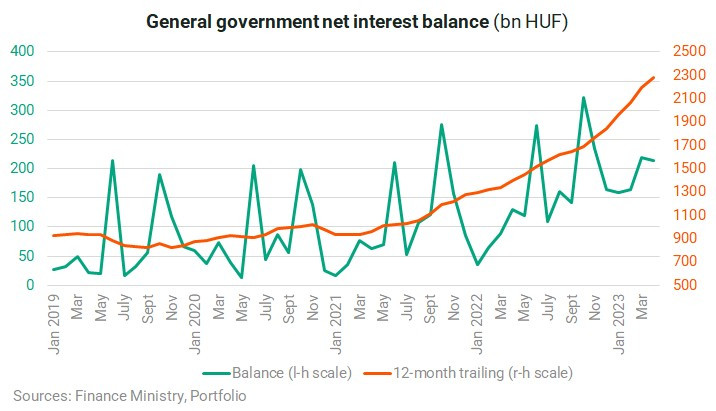
In April, net interest expenditure of the central subsystem was HUF 214.6 billion, compared with HUF 129.3 billion a year earlier, according to the detailed general government accounts published on Tuesday. This means that in each of the first four months of the year, interest expenditure exceeded last year's level, and in total, debt servicing cost more than twice as much as in 2022.
The budget's net interest expenditure in January-April totalled HUF 756.8 billion, compared to HUF 318.2 billion in the first four months of last year. The significant increase again shows the burden of high yields on the budget and, while the trajectory within the year may still change substantially,
Based on pro rata temporis data it is highly questionable how realistic the government's plan is to keep this expenditure item under HUF 3,000 billion after HUF 1,844 bn posted in 2022.
In recent weeks, we have repeatedly discussed the fact that the risk of interest expenditure slipping is already a significant risk for this year's budget. Including the latest data in the current report, 12-month rolling interest expenditure has risen to HUF 2,283 billion forints.
The other development is not surprising in the light of macroeconomic data: pension payments amounted to HUF 427 billion in the fourth month of the year, which is 26%, or HUF 88 billion, higher than a year ago. And with higher inflation expected to leave hundreds of billions more to be paid out by the state to pensioners in the second half of the year, there is no end to the tension in this respect.
The real time bomb
Perhaps the most worrying trend is that, while spending in April was up 16.3% year-on-year, revenues grew by a more modest 7.6%, including central budget revenues by only 3.1% (vs. central budget expenditure, which grew at a 15% rate).
Meanwhile, payments from business organisations offer a lifeline, but this alone will not suffice: HUF 282 billion, 29% more than in the previous year, was collected under this heading. This development is not unexpected, as this is the main source of the increased special taxes, and the windfall tax. It is no coincidence that the government does not really want to surrender this instrument, which has a spectacular stabilising effect on the budget balance, next year. We wrote an analysis of this just yesterday:
Looking at the detailed figures, perhaps the biggest problem in this year's budget could be with the revenue from the sales tax.
The chart below shows the scale of the problem: VAT receipts are essentially stagnating compared to the 2022 figures.

Consumption-related taxes generated HUF 932 billion in revenue for the state budget in April, 3.2% more than a year ago. Within this, VAT brought in HUF 766 billion, up only 2.3% on April last year. In other words, VAT receipts are barely growing, while the Hungarian economy is experiencing 25% inflation.
It is clear, therefore, that shrinking real household incomes and the resulting fall in household consumption are reducing retail sales and hence VAT receipts.
There's another possible impact in terms of VAT receipts. It should not be forgotten that this time last year, the fuel price freeze was still in force, which encouraged the public to over-consume fuel, and the surging gasoline consumption could have resulted in higher than normal VAT receipts (in March, fuel retail sales were 29.3% lower in calendar-adjusted terms). In other words, this base effect may also play a role in the fact that the growth in VAT receipts has been very disappointing so far this year. Although this fact was presumably known to the Ministry of Finance and anticipated when it redrafted the 2023 budget at the end of last year.
In contrast, payments by households into state coffers turned out better in April this year than in the base period, with HUF 40 billion more in social contributions, an increase of 15%. And meanwhile, the receipts of social security funds also managed to grow by 20%, with both the pension insurance fund and the health insurance fund seeing a 17-18% year-on-year increase in contributions.
So overall, our view of the budget has not changed, quite the contrary. Even the government itself admitted last time that the trends are worse than expected and it is not yet clear what can come to the rescue of the budget. 80% of the annual cash deficit target has already been reached by the end of April. This extremely high ratio suggests that without an adjustment the end-year deficit goal (3.9% of GDP) could be easily missed if these adverse trends (especially the VAT revenue dynamics) prove to be persistent.
Therefore we believe the most crucial question now is
WHETHER THE GOVERNMENT WILL be willing to implement FURTHER ADJUSTMENT MEASURES at the expense of ECONOMIC GROWTH, RISKING A RECESSION, OR WHETHER IT WILL GIVE up THE DEFICIT TARGET, EVEN THIS YEAR.
Note that it has already revised the 2024 deficit target upwardly to 2.9% of GDP from 2.5% previously.
In addition to the extremely high April cash deficit figure, the first quarter accrual deficit data (close to the EU methodology) has just arrived, which also shows a deteriorating fiscal position. It shows a general government deficit of 12% of GDP in the first quarter and a total deficit of 8.4% for the last four quarters.
Both indicators show that the budgetary position is as dire as it has been in the periods in the last 25 years when the government balance has been most seriously disturbed.

Cover photo: Getty Images





