Hungary average gross wage reaches HUF 578,000 - Price-wage spiral awakened?


In March, full-time employees' average gross earnings were HUF 578,000, up 16.6% year on year, the Central Statistical Office (KSH) reported on Wednesday. The one-off impact of the 'firearms money', a six-month bonus to law enforcement staff is evident in the February data. Estimated average gross regular earnings (gross earnings without premiums and one-month bonuses) were HUF 520,600, which corresponds to a 15.7% growth from the base period.

The data for the corporate sector, which better reflect market developments, show that wage dynamics are really accelerating. Average gross wages in the business sector rose to over HUF 599,000, 18.7% higher than a year earlier. In the previous months, wage dynamics had fallen to around 17%, a sign that the price-wage spiral was already in a dormant phase. By comparison, the March data suggest that with inflation at its highest level in decades and a tight labour market, companies are being forced to raise wages substantially, which most can make up for from the recent rise in profits.

On a quarterly average, inflation was over 25% in January-March, hence companies
- either had to give a substantial pay rise to employees;
- or had to get used to rising fluctuation,
while they are able to recruit new staff only by offering higher wages than what the current payroll gets.

Real wages in the whole economy fell by almost 7% in March, as inflation continues to significantly outpace the rate of wage growth. (The February figure is also affected by the 'firearms money'.)

In the business sector, the fall in real wages is smaller, at 5.2%, still reflecting a sharp decline in purchasing power. Yet the decrease is now more modest than in recent months, due to the slight retreat in inflation and the "awakening" of the price-wage spiral.
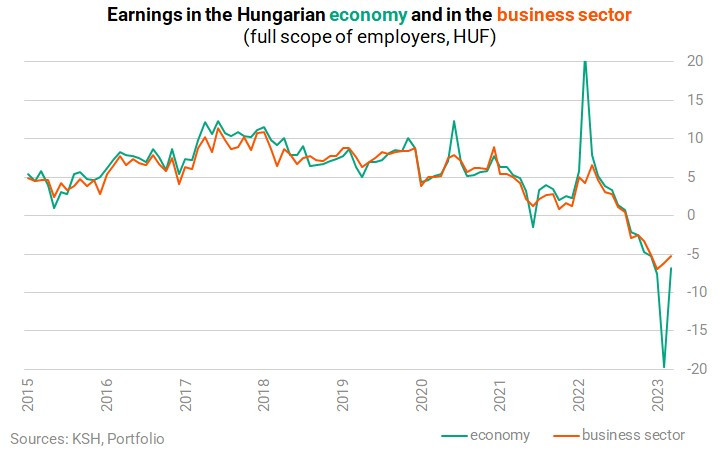
It is a bit more difficult to decipher what is really going on in the budget sector, but it is easiest to ignore the distorted months of last year and this the 'firearms money' allocation this February (since only a narrow group received a significant six-month bonus, while this sector is where the full impact of the extra payment is felt). In March, the real wages of public sector workers fell by almost 12%, a significant contraction not previously seen when the impact of the 'firearms money' distribution is excluded. This is the result of just over 10% growth in gross wages in the public sector.
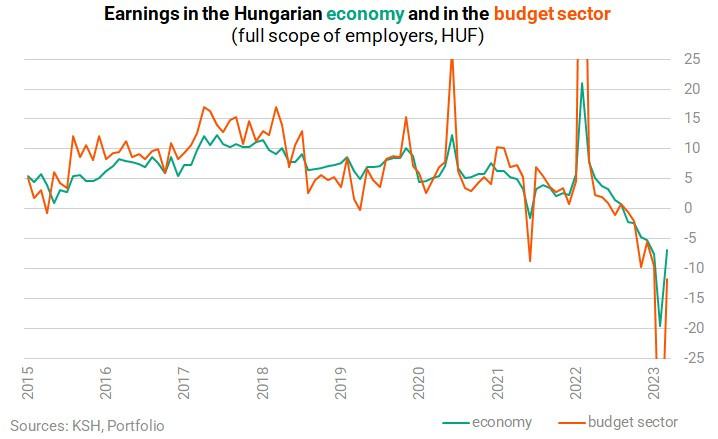
Overall, wage growth is accelerating but its rate remains below inflation. This is not surprising given that retail sales are diminishing and grocery store sales are showing a decline in volume not seen since the 2008-2009 crisis.
The data suggest that the wage-price spiral is getting activated as wage dynamics accelerate, but the picture is clouded by the lack of an upward trend in regular earnings. The coming months will determine whether wage dynamics accelerate further, because if they do, price stability will be particularly difficult to achieve, as firms will be raising prices more boldly again as wages rise and demand recovers.
Cover photo: Getty Images





