Brutal landmines in Hungary's 2024 draft budget, special taxes to remain


Landmines all over the place
The budget deficit target for next year, raised in the Convergence Programme to 2.9% of GDP from 2.5% previously, is subject to risks, the Fiscal Council points out in its opinion, and then lists these risks:
- The expected economic growth will not be attained, which will reduce budget revenues.
- Certain tax revenues, particularly sales tax receipts, could turn out lower than expected in 2023 which creates a worse base for the related goals in 2024.
- Operational expenditures of budgetary institutions could be substantially smaller than price increases carried out in 2022 and projected for 2023 and 2024.
- Other operating appropriations of several budget chapters of institutions not under the control of the government will be reduced by up to 10% compared to the 2023 appropriations, causing a very significant fall in real terms for these institutions. Without targeted austerity and rationalisation measures, there is a risk that maintaining the viability of the budget bodies will require large unplanned expenditures in 2024.
- The budget bill does not include the expected necessary loss compensation for the National Bank of Hungary (MNB), and thus it is not in line with the Central Bank Act, which provides that "if the amount of equity capital falls below the subscribed capital at the end of the year under review, the difference shall be reimbursed by the central budget in equal annual instalments [...] within five years directly to the profit and loss reserve."
- The Council has identified that the achievement of several revenue and expenditure estimates will require further action. In this context, the FC was informed by the Ministry of Finance that "these measures are being developed". What this means in practice is that the government is presenting a budget that in many respects is not sound. For this very reason, the FC argues that the early budget has a limited ability to meet its objectives because of the risks and the considerable uncertainties that are inherent in the draft. "The inherent risks may require a reprogramming, which limits the budget's ability to fulfil its role as an economic compass," they point out.
The deficit target of 2.9% of GDP implies that a small surplus in expenditure and a slight shortfall in revenue would push the deficit above 3%, the FC warned. They added that the cash deficit would also increase if the HUF 2,479.8 billion in revenue from EU funds planned for 2024 is not fully disbursed, while the HUF 3,605.5 billion in spending from EU programmes would be largely used.
Meeting the deficit target can be considered risky overall,
the FC said.
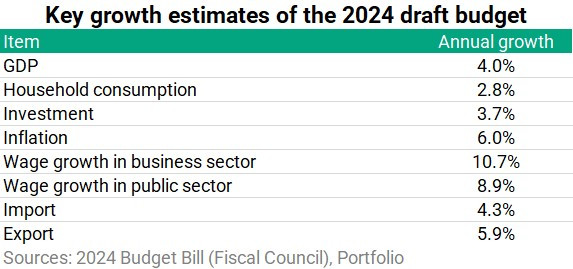
"The main reason for this is that there are a lot of risks associated with macro outlook. In 2024, the government's forecast for GDP growth, public and private consumption, gross fixed capital formation and exports is more optimistic than the projections of recognised macroeconomic analysts. This is compounded by uncertainties about the disbursement of EU funds to the country."
Against this, there is little manoeuvring room separating the deficit target from the deficit required by domestic and EU fiscal rules. The general government deficit may be exceeded only by HUF 51.2 billion to meet the deficit rule, assuming unchanged GDP growth.
Breach the law or revise plans
The Council also underlined that the MNB's equity is expected to fall below its subscribed capital by the end of 2023. "The Council considers it necessary that the draft law also takes this expected legal obligation into account so that the deficit target and the debt rule continue to be met," the document says.
So, in effect, the FC is saying at the same time that
- the budget is in breach of the law because it does not take into account the impact of the central bank loss compensation (which according to some market estimates is 0.2% of GDP, or HUF 180 billion in nominal terms), and
- the budget explicitly contains a real bombshell that the government has quite simply ignored. In other words, if it wants to comply with the law, it would have to find another HUF 180 billion from somewhere to meet next year's deficit target.
The fate of special taxes
The Council's report discusses in detail the sectoral and windfall taxes.
Read more about those affecting the financial sector here:
A flash estimate of the figures provided by the Fiscal Council shows that the cabinet is ready to surrender some HUF 555 billion tax revenues next year. The table below shows all the revenue items, comparing them with the 2023 objectives. (The colouring in the first column shows the largest revenue items. In the second column, the closer the colour of the cell is to red, the larger the annual increase in that revenue item is.)

Based on the above information, it is still possible to draw cautious conclusions on how the tax burden of the sectors subject to special taxes will change in 2024 (we will have final information on this when the new tax rules, and windfall tax tax rules are published). But these need to be cautious conclusions only because the Budget Council document lists tax revenue changes. In most cases it specified the change both in percentage and amount, but in other cases it revealed only one of these figures.
Where tax revenue shifts are more modest, this is presumably due to changes in tax bases, and where there are larger revenue shifts in either direction, there may be government intervention in the special tax / extra profit tax rules (either by reducing the tax base or by reducing rates in the case of more rounded percentage changes, e.g. a halving of the tax burden on banks).
In light of this, the windfall tax burden on the energy sector is expected to be reduced, Mol's mining royalty liability will also be cut, the extra profit tax on banks will go down, and the special tax on pharmaceuticals manufacturers (which they were hit with last December) may be slashed considerably.
The rules on the financial transaction tax are expected to remain unchanged. The retail sector will pay more tax next year than expected this year, and this may be due to the government tightening its squeeze further, but it cannot be ruled out that the tax base will increase, leading to more special tax payments next year. Similarly, the extra profit tax for insurers will remain.
Overall, the government is not phasing out the windfall tax (i.e. increased special taxes) after a transitional period of two years, contrary to its original promise in summer 2022, but only certain sectors will get relief compared to this year. This means that Hungary is not fulfilling the promise it made to the European Commission last December in its recovery plan. It will be interesting to see under what title these extra-profit taxes will remain in the tax system, i.e. whether it will legally/technically phase them out and bring them back under other headings, so as to seemingly fulfil its commitment to the Commission.
Expenditures
We have summed up the data provided by the Fiscal Council in the table below.

Some of the FC's key comments are as follows:
As regards the major reduction in the overheads reduction spending, the big difference stems from the moderation of energy prices after a peak in 2022.
In addition to maintaining reductions in household utility bills, the Fund is also available to central budgetary bodies, municipalities, church and civil institutions and state-owned companies.
Spending of budgetary bodies and chapter-managed appropriations are planned 2.3% lower than in 2023. The FC warned that although the source of the increase in personnel expenditure is included in the provision, there is a risk that the appropriation will no longer cover the higher expenditure due to the 6% rise in consumer prices and the increase in capital expenditure set out in the government's targets following the earlier restraint.
The small growth in spending pencilled in on general practitioner and on-call GP services may be attributed to a structural change in 2023, as on-call care under municipal responsibility was transferred to the ambulance services, but there is no information on this in the explanatory memorandum.
As regards the high-value medicine financing, the target remains unchanged, but the Council warned that the sum earmarked may not be enough. By the end of April, this spending reached 35.3% of the annual target.

Cover photo: MTI/Attila Kovács





