Hungary FinMin Varga submits 2024 budget to parliament, windfall tax remains in place


About the special taxes
The government does not plan to lower the extra profit tax on retailers. The rules are expected to remain unchanged even in 2024.
Tax laws are expected to be submitted a week from now.
Tax revenues will increase, thanks to the performance of the economy, and inflation will be lower, dampening the pace of revenue growth, even if only compared to this year. Meanwhile, overall tax revenues for the budget are still expected to rise, while revenues from windfall tax are to drop.
Varga said they government expects to rely on the windfall tax only temporarily, adding that they will start phasing them out in 2024, more specifically for banks, pharmaceuticals and energy companies. We have already highlighted several times that the cabinet explicitly promised the European Commission that the windfall tax imposed in 2022 would be scrapped at the end of this year, and that it could still come up with a dodgy solution to save face.
According to the principle of social justice, sectors that perform better in times of war should be expected to contribute more to the common purse, the minister said, justifying the extra profit tax.
As promised earlier, we will start phasing out the extra profit tax
announced Varga, generously skipping the part where they promised the Commission to rid of the windfall tax by the end of 2023.
The government is also setting aside a reserve of 220 billion forints.
Families, pensions, health budget
The government plans the pension budget at HUF 6,542 billion, which marks a HUF 392 billion bump compared to this year.
The 13th-month pension payment next year will cost HUF 449 bn and the pension premium will absorb HUF 20.5 bn.
Pensions will be raised 6% on 1 January 2024, said Varga.
The health care budget is set HUF 424 billion higher at HUF 3,225 bn.
The government supports families through tax cuts and subsidies. The social security exemption for mothers with four or more children and the tax exemption for those under 25 years of age will be maintained, he said.
HUF 3,307 billion is to be available to support families, the minister added.
Defence Fund, Overheads Protection Fund
The Defence Fund will have HUF 1,310 billion to spend, with defence spending reaching 2.1% of GDP or HUF 1,796 bn, up HUF 401 bn from 2023.
Varga said protection from waves of refugees will cost the budget HUF 650 billion next year.
The fund created to finance discount utility tariffs for households is to have a budget of HUF 1,360 billion. Varga said the European Commission has no jurisdiction on overheads reduction measures, referring to the EU executive's call for winding down energy support measures and making them more targeted.
Key targets
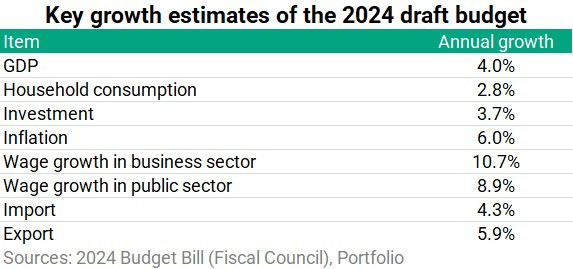
Risks, Fiscal Council opinion, central bank loss compensation
The government has taken into account the recommendations of the Fiscal Council and has amended the original draft accordingly, he said.
He stressed that the FC has adopted the draft budget. The Council's legal possibility is to examine the compliance with the constitutional debt rule. The legislation complies with this, and we do not expect a veto from the Council, explained Varga.
The budget deficit will be below 3% of GDP. If and when the situation changes, for example if the war escalates or peace is brokered, there are alternative scenarios. If we realise there is a risk of a deficit target overshoot, we will take the appropriate decisions, Mihály Varga said, recalling the measures taken last year.
Asked about the compensation of the central bank's losses, Mihály Varga said that the laws in force must be respected, and if the central bank incurs a loss, the government will compensate it. But this calculation needs to be clarified. The Fiscal Council has already given an indicative figure as a percentage of GDP. Calculations are under way to determine the size of the loss, the minister explained. After that, it will be clear whether and in what form this compensation needs to be compensated in the budget, he added.
The Parliament's decision on the compensation of the central bank's losses will be the guiding principle, Mihály Varga added.
The Fiscal Council said the budget bill fails to include a compensation for an expected loss of the National Bank of Hungary (MNB), and thus it is not in line with the Central Bank Act, which provides that "if the amount of equity capital falls below the subscribed capital at the end of the year under review, the difference shall be reimbursed by the central budget in equal annual instalments [...] within five years directly to the profit and loss reserve."
So, in effect, the FC is saying at the same time that
- the budget is in breach of the law because it does not take into account the impact of the central bank loss compensation (which according to some market estimates is 0.2% of GDP, or HUF 180 billion in nominal terms), and
- the budget explicitly contains a real bombshell that the government has quite simply ignored. In other words, if it wants to comply with the law, it would have to find another HUF 180 billion from somewhere to meet next year's deficit target.





