Latest ranking of Hungarian banks and insurers shows gov't measures threw acid on profits


Banks
2022 was a mixed year for Hungarian banks. On the positive side, the interest income from the central bank increased by HUF 779 billion due to the rise in the interest rate environment, while on the negative side, the newly introduced windfall tax increased the special tax burden by HUF 264 billion, while the interest rate freeze measure reduced banks' profits by almost HUF 200 billion, the MNB reported.
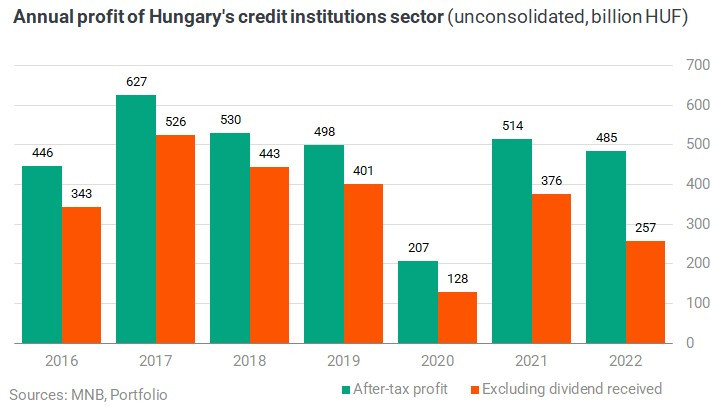
Risk costs and operating expenses grew considerably in 2022 due to the Russia-Ukraine war and surging inflation, due to which the credit institution sector recorded an after-tax profit of HUF 485 billion according to non-consolidated data, down 5% on the previous year’s result of HUF 510 bn. We wrote about this in detail in early March.
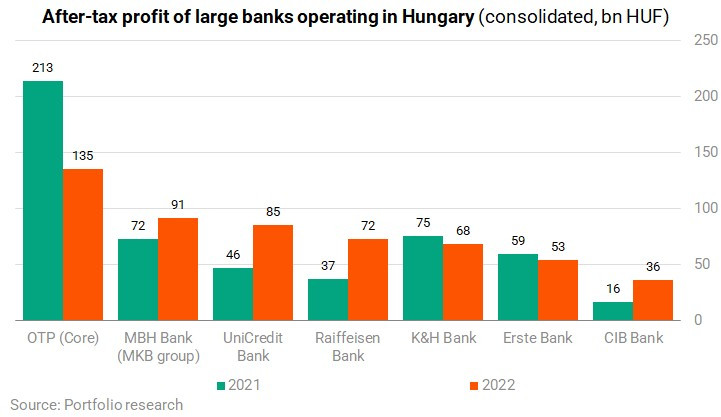
Of the seven largest banking groups, OTP again achieved the largest domestic profit with HUF 135 billion, followed by MKB Bank, now MBH Bank (or Hungarian Bankholding), with HUF 91 billion. For these two banks (for better comparability between players and over time), we present data taken from the fourth quarter flash reports, while for the other banks we present data taken from published audited annual reports.
Four of the seven big banks saw their after-tax profits rise in 2022, while three saw them fall. CIB Bank (+128%) achieved the largest improvement in profit, while OTP Bank (-37%) saw the largest contraction in unadjusted profit. Only K&H Bank (the local arm of Belgium's KBC Group) is not paying a dividend to its shareholders on last year's result. The respective general meetings authorised dividend payments of HUF 84 bn at OTP Group, HUF 25 billion at MBH, HUF 51 billion at UniCredit, HUF 25 billion at CIB (the subsidiary of Italy's Intesa Sanpaolo), HUF 20 billion at Raiffeisen and HUF 15 billion at Erste, both with Austrian parents.
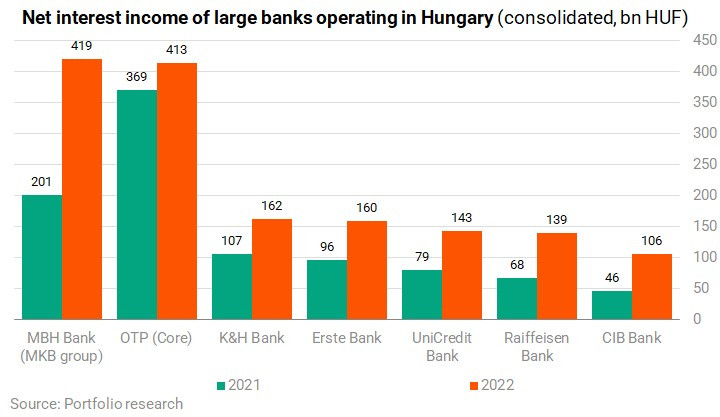
The banks that have increased their profits have typically done so thanks to a HUF 675 bn growth in net interest income. According to the MNB's report, the NII consisted of a HUF 779 billion increase in net interest income on on-balance-sheet items with the central bank and a HUF 104 billion decrease in net interest income with other sectors.
MBH Bank also outperformed OTP Bank's Hungarian operation in terms of net interest income. However, CIB Bank's interest income grew the most (+129%), while OTP Bank's interest income went up the least (+12%). The amount of liquid assets held by the central bank and the amount of long-term government bonds held to maturity played a major role in this respect, with the former being the most important in terms of the growth rate of interest income.
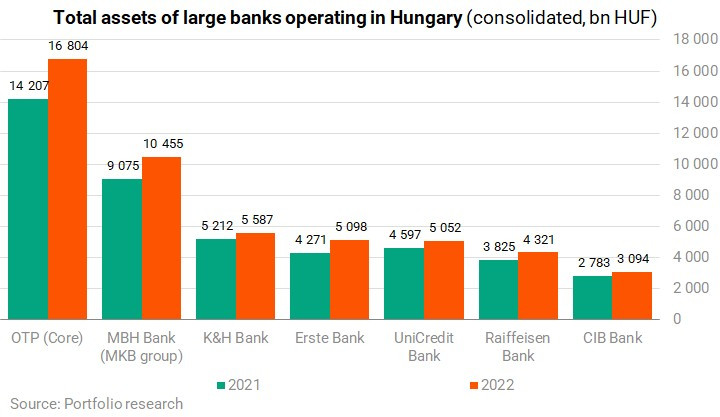
2022 was also a mixed year in terms of lending, with lending booming in the first half of the year, but slowing down in the second half, especially in the area of retail, including mortgage loans. However, there was no sign of a decline in the volume of loans in 2022, and banks' balance sheet total rose dynamically. Of the seven banks, OTP Bank is the largest and CIB Bank the smallest. Erste Bank (+19%), which also acquired Commerzbank, saw the largest increase in total assets last year, while K&H Bank (+7%) saw the smallest.
Insurers
Compared to banks, insurers, newly identified as a strategic sector by the government, had a more difficult year in 2022, and accordingly started to implement significant restructuring measures, starting with the acquisition of 45% of Aegon and Union and the 100% state ownership of Posta Insurance, as well as the 'reforming' of the rules of the home insurance market.
The insurance market ended last year with a nominal premium growth of 7.4%, well below inflation.
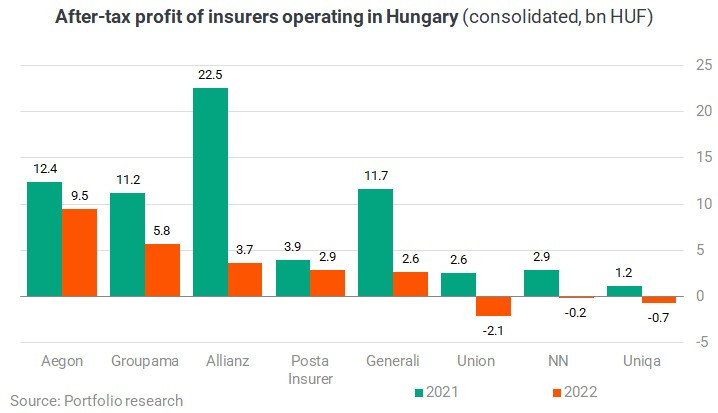
The profit of insurers fell to less than half of the level of a year earlier, to HUF 35.8 billion, as the sector had to pay a new surtax of HUF 51 billion in addition to the original insurance tax of HUF 112 billion. While banks will be able to halve their extra profit tax next year if they buy a lot of government bonds, insurers, perhaps the most over-taxed of all, have not been given this opportunity, with MABISZ protesting against the tax burden being kept in place.

Three of the eight largest insurers made a loss last year, mainly due to the new special tax, which is particularly high for medium-sized insurers compared to their profit-generating capacity.
The biggest profit (HUF 9.5 billion after tax) was achieved by Aegon, the third largest insurer in terms of premium income, which has been operating under the name Alfa since 1 August this year, and it became the only insurer among the big ones to pay a dividend: 60% of its after-tax profit, HUF 5.7 billion. All the insurers on the list saw their profits fall last year, helped by last year's drought losses of more than HUF 40 billion (but covered to a large extent by reinsurers). Some of the insurers are forced to raise capital because of the significant burden, but most of these are not public.
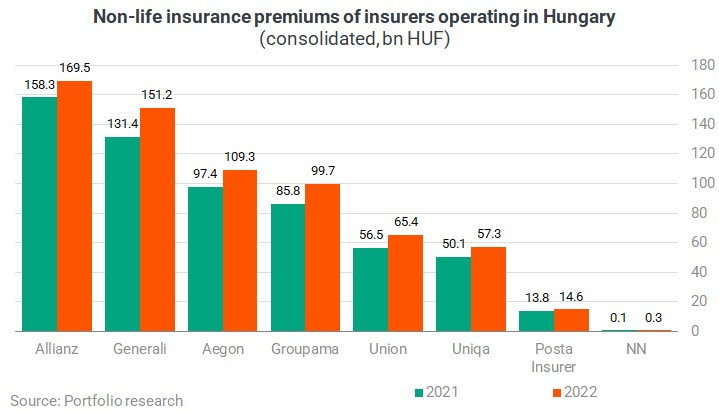
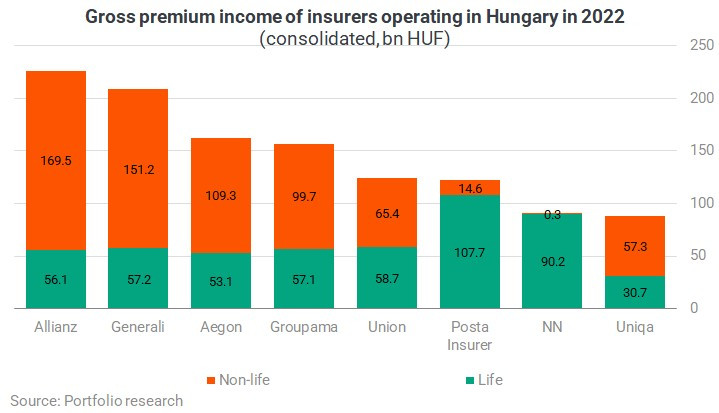
In terms of premium income, Allianz, Generali and Aegon were the largest last year, as in previous years. The share of life insurance is highest at NN (over 99%) and Posta Insurer (88%), which mainly sells single-premium life insurance, while non-life insurance premiums are dominant mainly at Allianz (75%) and Generali (73%).
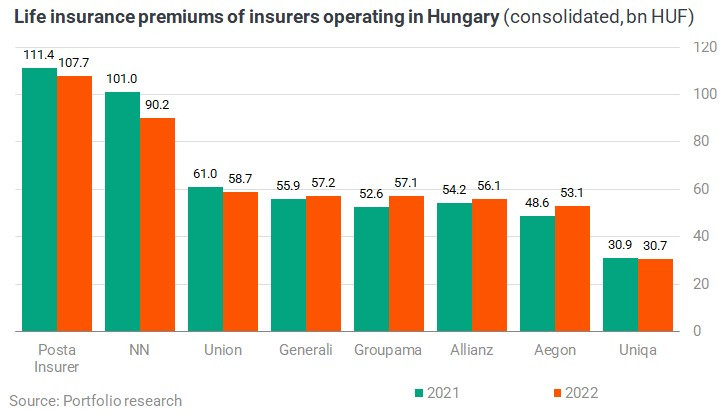
Life insurance premium income increased for half of insurers last year, but fell for the other half, mainly because the new banded supplementary tax makes it impossible to make a profit on single-premium products, so many stopped selling them in the second half of the year. NN (-10.7%) saw its life insurance premium income fall the most last year, while Aegon (+9.4%) saw the biggest increase.
The picture is different for non-life insurance, where all insurers have managed to increase their nominal premium income, but most of them by less than the annual average rate of inflation. Apart from NN (+370%), which is just starting up this business, Groupama (+16.2%) saw the biggest increase in non-life premiums. Posta Insurer (+5.8%), on the other hand, recorded the smallest increase in non-life premiums.