A pleasant surprise at last: inflation drops sharply in Hungary


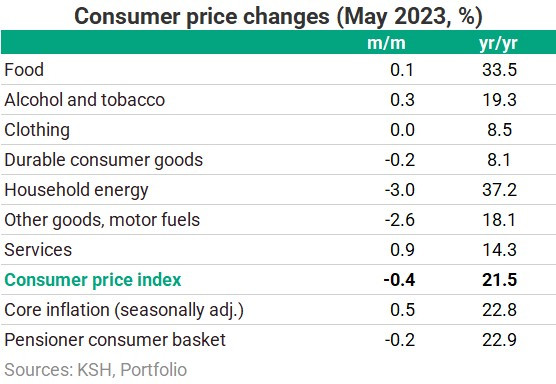
The consensus forecast of analysts polled by Portfolio was for a year-on-year inflation of 22.2% for May. In this respect, the 21.5% figure is a nice surprise.
Core inflation retreated to 22.8% from 24.0% in April, while pensioner inflation was 22.9%.

On a monthly basis, consumer prices fell by 0.4%, which is an extremely pleasant surprise, as prices last fell on a monthly basis in November 2020, i.e. two and a half years ago. Analysts had previously expected a price rise of around 0.5-0.7% compared to April.
As for the structure of the May CPI, the highest price rises were measured for electricity, gas and other fuels as well as food over the last twelve months. Interestingly enough, food prices still edged up 0.1% on a monthly basis, while the majority of analysts thought a m/m decline was on the cards due to the mandatory discount sales forced on the shops by the government.
The table also shows that the pleasant surprise was almost exclusively due to a 3% m/m fall in energy prices and a 2.6% decrease in the prices of fuels and other items. The annual index showed a minimal acceleration only for services, with the rest of the index dropping compared to April.
In light of today's release
it seems increasingly certain that the government's target of single-digit inflation by the end of the year will be achieved.
In our survey a few days ago, Péter Virovácz, analyst at ING Bank, said that if inflation data come in around stagnation on a monthly basis, a rate below 10% by the end of the year is basically a done deal. In view of this, the 0.4% m/m decline makes this outcome pretty solid.
Following this data release, the central bank (MNB) is expected to continue to lower its benchmark rate at the end of June, as the forint has been stable at around 370 against the euro since the easing started in May, and inflation appears to have started to fall sharply as expected.
the benchmark interest rate (i.e. the one-day deposit rate) is thus expected to be lowered by 100 basis points to 16% after the monetary council's 20 June policy meeting.
Annual changes
According to KSH data, the largest price rises over a year were recorded at confectionery products (59.6%), bread (52.7%), dairy products (51.3%), butter and spreads (46.8%), eggs (46.1%), dry pasta (37.4%), pastry (36.6%), milk (34.9%) and cheese (33.7%). Within food, the smallest price increases were observed at flour (7.2%) and edible oil (3.5%). Among durable consumer goods, the price of new passenger cars rose by 17%, kitchen and other furniture by 16.1%, heating and cooking equipment by 14.5% and household furniture by 12.1%. The prices of pet food rose by 51.7%, washing and cleaning products by 37.1%, personal care articles by 25.9% and household repair and maintenance articles by 16.4%. Motor fuel prices rose by 17.7%. Prices for services went up by 14.3%, with motorway use, car hire and parking up 28%, sports and museum admissions up 27.1%, domestic holidays up 26.8%, vehicle repair and maintenance up 23.1%, taxis up 22.2% and home repair and maintenance up 19.8%.
Monthly changes
Consumer prices decreased by 0.4% on average. Food prices rose by 0.1% on average. Within this, the price of other meat preparations edged up 0.9% and seasonal food items (potatoes, fresh vegetables and fresh domestic and tropical fruits altogether) cost 0.4% more, while prices dropped for cheese (-2.3%), rice (-1.7%), butter (-1.3%), rolls (-1.3%), milk (-0.9%) and poultry meat (-0.6%). The price of electricity, gas and other fuels decreased by 3.0%, within which 6.4% less was paid for natural and manufactured gas (Press release). Motor fuels got 6.6% cheaper. Price increases were recorded for detergents (+1.0%) and for toiletries (+0.7%), while the price of pet food dropped 2.6%. Services prices rose by 0.9%, including 2% more for domestic holidays, 1.4% more for shared costs for condominiums, 1.2% more for rent and 21.7% less for travel to work and school.
Cover photo: Shutterstock





