There is a huge pay gap between companies of different size in Hungary


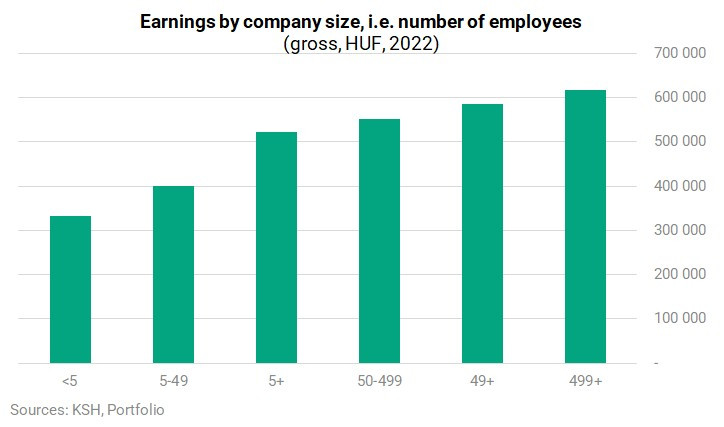
The largest companies paid their employees nearly HUF 620,000 gross last year, while the average salary in companies with less than 5 employees was just over HUF 330,000, according to detailed salary data sent to Portfolio by the Central Statistical Office (KSH). This indicates that on paper, large companies pay their workers much more than small ones. This is not surprising in view of the fact that companies with hundreds or thousands of employees have much higher productivity than smaller domestic companies.
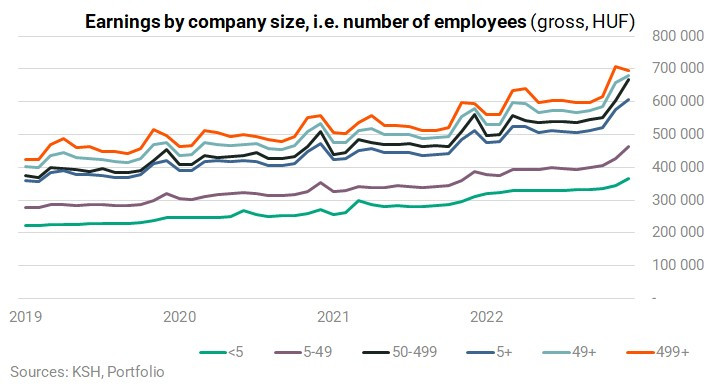
We asked for more details after the KSH made significant changes to its wage data from this year. Whereas previously only companies with more than five employees were included in the statistics (i.e. in the stats office's preliminary reports), from this year onwards the earnings statistics now show data for all companies. The change in methodology was made possible by the fact that the KSH now has a longer time series for the whole national economy.
For many years, several economists have argued that average wages in Hungary are high because they do not include data from small firms, which pulls the average down. Portfolio has reported several times in the past that the wage data of the smallest firms does not pull down the average wage significantly, as the full national economy data were available in a data table since 2021; i.e. the wage statistics including firms with less than five employees.
(All this stems from the fact that in its flash reports the KSH published data about companies with more than five employees every month - which were covered by virtually all media outlets - so the full national economy wage statistics did not reach all interested parties).
The difference between average monthly earnings for firms with more than five employees and in the economy as a whole is only HUF 15,000. And with an average salary of half a million forints, this is not the main reason why so many people feel they earn less than the official average wage. The most important explanation is that the number of employees at small firms is not high enough to be a larger drag than this on the national average wage.
Since the average wage figure seems overly high not because the smallest firms were not included in the data before, the question arises as to why this is the case. The actual reason why people feel that they earn little is that the "average Joe" earns the median wage, which is substantially lower than the average wage.
The median wage is currently around HUF 110,000 to HUF 120,000 gross less than the average wage. This is because the median shows the pay of the worker in the middle, ranked by the size of the pay (half of people earn more, half less), while the average wage is pulled up by very high wage levels. Some 60 to 70% of employees earn less than the average wage in Hungary, which explains why most people feel they make less than the average.
- Whether or not we include small companies with fewer than five employees in the statistics causes a difference of some HUF 15,000 in the average wage, which does not explain why most people feel they earn less than the "average".
- The gap of HUF 110,000 to HUF 120,000 between the average wage and the median wage already brings us closer to the solution, as the gross median wage is around HUF 400,000, which is somewhere around the figure the "average Joe" perceives as a realistic average wage.
However, there is another complicating factor. While the payroll figures for large companies certainly reflect reality, the employment practices of a significant proportion of the smallest firms may belong to the realm of the grey and black economies. Resorting to illegal practices may also be a symptom of low productivity. The productivity of the domestic SME sector is so far behind that of the large enterprises that it hurts the eye even in international comparison. Therefore it is likely that there is also a fundamental reason for the significant pay gap by company size.
Although there may be structural differences in the economy (smaller firms may have proportionally more people working in sectors offering lower wages), it is clear that no one would work for half the money they could earn in a similar job and at a similar skill level.
With the minimum wage and the wage minimum for skilled workers raised markedly in recent years (outpacing average wage growth in several years), payments under the table could have become less frequent, but the data suggest that undeclared work remains an integral part of day-to-day operations for the smallest firms.
One of the key questions is whether the official pay of an employee in the middle of the wage scale (earning the median wage) matches the sum he/she pockets or they also get an envelop on the side.
In any case, there is no doubt that undeclared work takes the actual gross average wage even higher than what the stats office reports, and in certain cases it can drive even the reported median wage higher. It may well be that a not insignificant part of the wage gap between firms with fewer than five employees (HUF 333,000 gross) and those with more than five employees (HUF 522,000 gross) is actually explained by the prevalence of undeclared work in small firms, but it is also possible that even firms with slightly more than five employees are paying a part of the salaries under the table.
A tell-tale sign of small businesses inclination to pay workers off the record may be that their wages do not show an end-year jump. Of course, this could also mean that bonuses, premiums and other fringe benefits are not as common at these firms, but it is also possible that the the employee and owner share the approach that they are both better off if there's no tax on the bonus, so in the end the gross is the net.
However, the data suggests that companies with more than 50 employees do not conceal their salaries, and it would certainly be difficult to hide from the tax authority. What is certain is that the bigger the company you work for, the more unemployment benefits you can get, the better your sick pay, and the more secure your retirement.
Cover photo: Getty Images





