Hungary intervenes in fixed-price electricity contracts of businesses


Price cap on SME electricity contracts
As the first step of the economic protection action plan, Gulyás announced that the government will intervene in this year's electricity contracts, which were concluded last autumn at very high price levels of around 250-300 euros/MWh/above. "We will introduce a price ceiling", with the highest price set at 200 euros from 1 July, which is the net price, Gulyás said.
He stressed that the measure is affecting three sectors only:
- the manufacturing industry
- accommodation services, and
- storage & transport.
These are productive or production-related activities, so their economic impact is significant, as is their inflationary impact, he explained.
In return, we expect them to increase their production capacity and not to raise their prices, stressed Gulyás, adding that the Hungarian Chamber of Commerce and Industry (MKIK) is undertaking to check compliance with these conditions.
He pointed out that more than 5,000 companies will be affected and that the measure will cost the budget HUF 40 billion.
It looks like the measure will affect a lot fewer companies than was outlined last Friday in a joint article by the MKIK and the Ministry of Economic Development. They estimated that about 20,000 companies had concluded their electricity contracts at an average price of around EUR 320/MWh or more, while market prices are currently around EUR 100. So, in effect, the government has decided on sectoral targeting, rather than setting a limit based on the share of energy costs in turnover.
Read more about the drivers of the measure below:
Changes made to the SZÉP Card
As the second step of the new 'economic protection action plan', the government will allow the use of the Szép Cards to buy cold food from August. Employees will be able to raise the limit of the cards by HUF 200,000, Gergely Gulyás announced.
Employers can support their employees under the most favourable tax contribution conditions, the minister added.
The move is temporary from 1 August to 31 December.
In Hungary, fringe benefits or non-salary compensation are regularly referred to as 'cafeteria', which should not be mixed up with a self-service restaurant. The various fringe benefits or cafeteria elements, which often involve targeted spending, are taxed differently from regular salary, where the employer pays social contribution tax on the gross salary, while the employee pays personal income tax and social security contribution. Instead, the employee receives net benefits, while the employer pays more taxes. However, the tax content of the fringe benefits is lower than the tax content of regular employment costs.
The most well-known cafeteria element in Hungary is the Széchenyi Card (SZÉP card), which works very much like actual money, but sums sent there can normally be spent only on holiday accommodation, hot meals, and culture, managed in separate “pockets” of the card.
Relief in the pharmaceutical sector
The windfall tax for pharmaceutical companies (this is the revenue-based special tax) will be halved if they spend on research and development or expansion, Gulyás announced. Drugmakers will already pay half as much windfall tax next year as they did this year and, under the current announcement, they can halve this extra profit tax by accounting for R&D activities.
In addition, for pharmaceutical distributors subject to the special tax, half of the extra charges will be waived from 1 July if they are used for research and development (R&D). Remember, this is the same special tax that the government raised to 28% from 20% last summer (for products costing more than 10,000 HUF), and then increased the clawback obligation to 40% from 28% in its latest decision. This 40% rate may be reduced to 20% for those carrying out research and development.
The government had expected a total of HUF 32 billion from the special tax on manufacturers in 2024, half of which could be lost if the sector's representatives can make maximum use of the R&D tax relief. In this context, Gergely Gulyás also spoke of a tax holiday of HUF 15 billion.
EU funding still uncertain
Gergely Gulyás said the timing of the transfer of EU funds for Hungary is a political decision. He said the government's position was that it had already met the European Commission's requirements.
By implementing the judicial reform Hungary has fulfilled the conditions for access to seven-year budget funds, according to the minister.
He did not give a precise date on when the funds would be available.
He later said, quite hilariously, that there's a 50-50% chance that Hungary will receive EU funding by the end of 2023, but he stressed that this is what the cabinet would tap to raise teachers' pay.
Can we expect a reduction in the interest rate premium?
After the central bank started cutting interest rates last month, the Government Debt Management Centre Agency (ÁKK) also reduced the interest rate premiums for the Premium Hungarian Government Security (PMÁP) series. The series, available from 1 June 2023 and maturing in 2028 and 2031, will pay an interest rate premium 0.5 percentage points lower above inflation.
Now, Gergely Gulyás did not rule out that this could happen again if the central bank continues monetary easing. Information on this will be released in due course.
Orbán's travels: Kyiv? Maybe. Moscow? No.
If it makes sense, Prime Minister Viktor Orbán will travel to Kyiv, Gergely Gulyás said, referring to the PM's previously announced possible official trip to Ukraine. He has now indicated that there are no concrete discussions on this at the moment.
In reply to a question, he said that the Prime Minister travelling to Moscow is not on the agenda at the moment.
Government awaits proposals on reducing compensation of central bank loss
Gulyás also received a question about the fact that according to the law, the Hungarian budget should make up for the HUF 2,000 billion loss of the National Bank of Hungary (MNB) this year in equal amounts over five years, so this item should be included in next year's budget, but it is not.
Gulyás responded: we are waiting for guidance from the central bank on the amount of this loss, and we are waiting for proposals from the Fiscal Council and the central bank on how to ensure that
this is not such a big burden on the budget, but a smaller one, or not a burden at all.
Military co-operations
In the current situation, in a state of danger related a war in a neighbouring country, all security plans have been reviewed by the relevant ministries and amended where necessary. There is also military and defence cooperation with Israel. The Minister of Defence will also visit Israel soon, Gergely Gulyás said in response to a question.
The Dunaferr case: steel works cannot have a Ukrainian owner
No Ukrainian company can buy Dunaferr, stated Gergely Gulyás, following the rejection of the application of Metinvest BV, a Ukrainian company, for the steel works. He did not comment on the reasons for excluding the company.
There are two out of five bidders still in race for Dunaferr: Liberty Steel Central Europe Ltd. and Vulcan Steel Private Company Limited by Shares.
Price freezes - Several solutions on the table
A joint Hungarian-Serbian government meeting is set to take place in Palić on Tuesday, said Gulyás, adding that no decision on the price caps, which are to be in place until 30 June under current regulations, has been made yet, but several solutions are on the table.
Status law to be adopted by 7 July
The government aims to adopt the status law and the budget by the end of the extraordinary parliamentary session, Gergely Gulyás said.
He did not take a position on possible further amendments to the draft law. He said that the teachers' career model had already been subject to meaningful consultation, and the government had adopted dozens of proposals, including the 24-hour working time definition, at the request of trade unions and interest groups. For the time being, he sees no room for further changes, but he says the cabinet is ready to discuss sensible proposals.
Gulyás clarified that although the cabinet had promised pay rises with retroactive effect to January, as soon as EU funds are transferred to Budapest, he believes it is possible that this decision will have to be reviewed.
"In early 2022, teachers’ unions began organising a strike to protest, among others, heavy centralisation, shrinking autonomy, low wages and growing workload. As a reaction, the Government emptied out teachers’ right to strike in a government decree, abusing its excessive regulatory powers it continues to have in the ongoing special legal order. This step was criticized by the International Labour Organisation as well. Since meaningful strike action was no longer possible, teachers turned to civil disobedience, resulting in retaliatory dismissals throughout the autumn of 2022," the Hungarian Helsinki Committee said earlier this year. Read their full report here. You can read another analysis by the Heinrich Böll Foundation (a German, legally independent political foundation, affiliated with Alliance 90/The Greens) here.
Later Gulyás claimed that the status law was also accepted by the European Commission when it was negotiating with the government. According to Gulyás, education is in the purview of the member states, so he does not expect that the unions' appeal to Brussels will have any significant impact.
Government does not expect mass resignations in the teaching profession
The government is not expecting mass resignations in among teachers, but of course "we are not happy to see anyone leave the teaching profession", even though the number of teachers has fallen by 14% in the past period, while the number of students has fallen by 3%, he said. The government fully agrees on the need for further pay rises, but there is no general shortage of teachers, rather a geographical shortage in certain areas.
How do you explain when the government is raising the excise tax on fuel by double of the required rate? It's easy. You don't.
Nobody disputed the validity of the fact that the Hungarian excise tax on fuel had to be raised because of an EU requirement, said Gulyás, adding that the increase would bring the tax burden "around the minimum". In fact, as Portfolio has pointed out earlier, the hike to be implemented in 2024 is double the mandatory minimum, given the current exchange rate. The tax burden would return to the minimum level required by the EU only at around EUR/HUF 420.
The price increase will not lead to an excise tax "around the minimum" of the EU requirement. Portfolio's calculations show that the price increase is 18-20 forints more per litre than what the government's forecast for the forint-euro exchange rate would justify. Since the increase is HUF 41, the price increase is almost twice as high as the "minimum". The government has set the excise duty rate from 1 January 2024 according to the exchange rate on the first working day of October 2022, although EU rules require this to always apply for the following calendar year. The exchange rate has appreciated a lot since then, so it is currently unclear why the government decided as it did, as it had not previously raised the excise duty to the required level.
Why would Hungary let go foreigners convicted of people smuggling?
Gergely Gulyás was asked about a recent Hungarian announcement to release 777 (typically) foreign people convicted of human-trafficking. He explained that the government had calculated that the country would be better off if it did not pay the costs of keeping these people in prison, and that was why they were released. If we had not done so, EU regulations (not enough square metres per prisoner) would have meant that we would still have had to pay compensation to the traffickers, so the government decided on the basis of weighing up the two costs, he added.
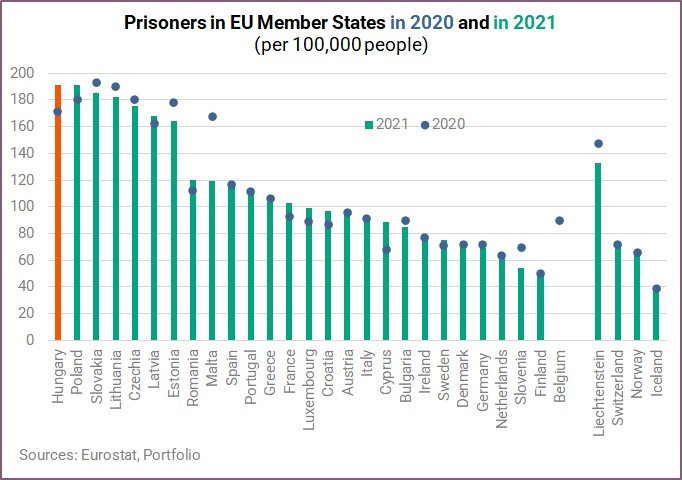
The highest prisoner rates per 100 000 people in 2021 were in Hungary and Poland (both 191), followed by Slovakia (185). The lowest rates were in Finland (51), Slovenia (54), and the Netherlands (65). In 14 out of the 26 EU countries that provided data, the prisoner rate increased compared with 2020.
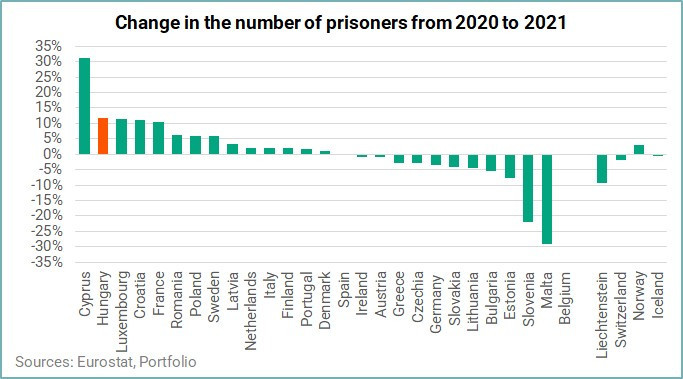
As regards the annual rise in the number of prisoners, Cyprus came out on top (31.1%), followed by Hungary (11.61%), Luxembourg (11.57%), and Croatia (11.19%).
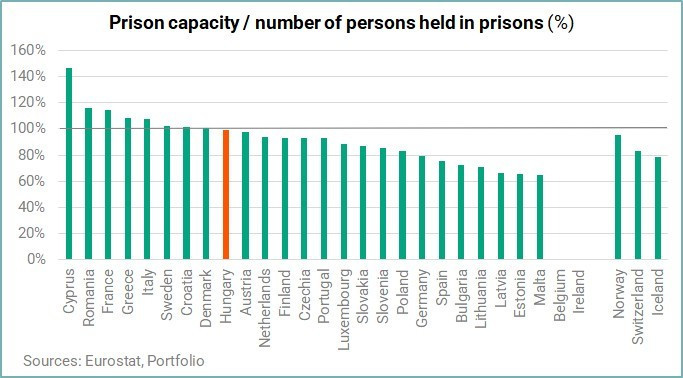
Overcrowding rates were observed in Cyprus (146), Romania (116), France (114), Greece and Italy (both 108), Sweden (102), Croatia, and Denmark (both 101). Hungary just missed this category with an occupancy rate of 99.5%.
Why did the government get involved in the HUF 244 billion project in Zugló?
The government's intention is that government institutions and companies performing central government functions should not be located in the city centre and not in rented buildings, which is why the government got involved in the construction project in Zugló (Budapest's 14th district), Gulyás explained. Getting involved means paying a whopping sum, HUF 244 billion, for the project.
According to him, it is not right for companies of tens of thousands of people to sit in downtown offices, either in leased or owned properties. The government has looked into the issue, so with a few exceptions (e.g. the Prime Minister's Office) large public organisations, such as tax authority (NAV), the Directorate-General for Public Procurement and Supply (KEF), state-owned companies, will move out of the city centre.
This means the relocation of thousands of jobs, he added, saying that the project in Zugló is effectively about "one government building". He acknowledged that the move will give the organisations less space than they are using now.
More to follow!





