Can the time bomb of the 2024 budget be defused?


Budget rests on huge ticking time bomb
In recent weeks, we have written several times about the potential burden of the MNB's loss on the 2024 budget. The central bank ended last year with a deficit of more than HUF 400 billion, but even so, its capital remained positive, so there is no need for state intervention for the time being. However, this year's loss could be as high as HUF 1,000-1,500 billion, while the capital loss could be around HUF 2,000 billion due to the HUF exchange rate equalisation reserve.
Under the current legislation, this would mean that
the MNB would have to be recapitalised from the budget by around HUF 400 billion a year for five years, just to cover this year's loss.
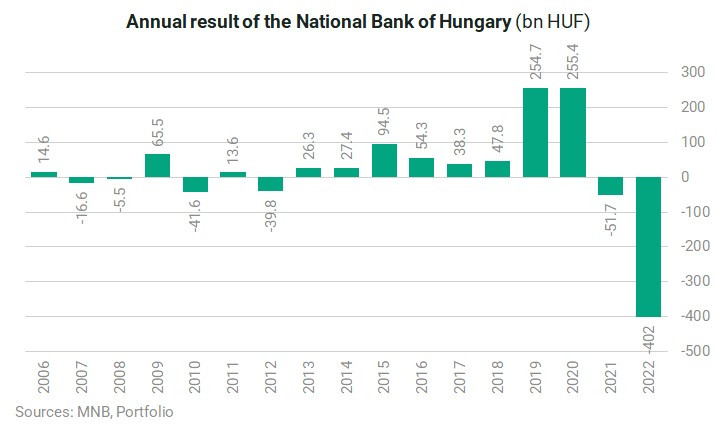
And on top of that, there would be potential further losses in the years to come, meaning that the budget would be burdened with hundreds of billions of forints for years to come.
But why should the state recapitalise the central bank? According to the Central Bank Act, if the MNB's equity falls below the HUF 10 billion subscribed capital, the state has to inject capital. The law was amended by the Parliament once already in the spring, so that any negative capital must be removed in equal instalments over five years. Thus, the HUF 1.5 to 2.0 trillion bill will not be paid in a single year, but gradually. However, it now appears that even this will be a significant burden on the budget; the 2024 budget currently under discussion, for example, does not even include this item amounting to roughly 0.5% of GDP.
Even the gov't starts to get worried now
Up until now the cabinet has not really addressed the issue of the central bank's loss. It ignorance was so great that the 2024 budget bill does not include the obligatory compensation, even though the Fiscal Council did point to this flaw.
The issue popped back up in recent days, though. Gergely Gulyás, Prime Minister Viktor Orbán's chief of staff, told journalists on Monday that they are awaiting recommendations from the Fiscal Council and the central bank how this deficit-boosting item could be reduced or completely removed from the budget.
On Tuesday, after the central bank's monthly policy meeting, MNB Deputy Governor Barnabás Virág told a press conference that there's ongoing dialogue with the govenment on the matter. He also noted that international practice suggests that many of the world's central banks face similar problems, and
there are several central banks that can operate credibly with negative equity during a transitional period.
It's unclear what concrete proposals could be tabled to resolve this issue, but the wiggle room is rather tight.:
- They could raise the possibility of re-amalgamating the Pallas Athena Foundation into the central bank, particularly as the MNB had already promised Eurostat to do so by the middle of this year. At the same time, the total assets of the central bank foundation were around HUF 280 billion at the end of 2022, and a merger would not add the entire capital to the bank's capital or revenue. In other words, this operation would probably not solve the problem.
- The central bank could generate significant additional income if it switched to the asset side, i.e. if it used a loan as its benchmark instrument instead of the current deposit. However, this would require the banking system to be short of resources and to need a loan from the central bank. At present, however, the opposite is the case: there is considerable excess liquidity in the system, which the MNB has been trying to absorb for years, so far with only moderate success.
- The most obvious way would be to amend the Central bank Act again, by removing from the law the requirement for the budget to reimburse negative equity. This could have been suggested by Barnabás Virág's words on Tuesday about the experience of international central banks.
This is the current rule on the Central Bank's recapitalisation
(3) If, at the end of the year under review, the amount of equity capital falls below the subscribed capital, the difference shall be reimbursed by the central budget in equal annual instalments within 5 years [...] directly to the profit and loss reserve. If the amount of equity capital exceeds the subscribed capital, all outstanding reimbursement obligations shall cease. If, within the 5-year period, a new reimbursement obligation arises for the central budget, the provisions set out in this paragraph shall apply, provided that the central budget ensures that the MNB's own funds do not remain below the level of subscribed capital for a longer period.
Can a central bank operate with negative equity?
MNB Deputy Governor Virág has already remarked that there are examples of credible central bank operations in recent years, even with negative capital. The problem is not unique to Hungary: central banks around the world are facing a similar dilemma, as they inflated their balance sheets during the coronavirus pandemic to stimulate the economy, and then had to suddenly raise interest rates sharply in the last two years as inflation soared, causing them to incur heavy losses.
Even in the case of large developed central banks such as the Federal reserve or the ECB, this has already led to significant losses and sometimes negative capital.
What the central bank and the government have to do with negative capital differs from country to country, and the state budget does not have an obligation everywhere to reimburse the negative level capital, unlike in Hungary. In some cases, the central bank is allowed to operate with temporarily negative equity. However, a study by the International Monetary Fund (IMF) underlines that if the independence of a central bank is to be guaranteed, it is important to replenish capital.
In the business sector, if a company's equity falls into negative territory, the owner is obliged to recapitalise. The case of the central bank is special because it cannot go bankrupt, as it can create practically as much money as it wants in the national currency, with the consequence of higher inflation at most. That is why we can see a more lenient approach to this all over the world, and
it is now generally accepted that a central bank can temporarily operate with negative equity.
The Bank for International Settlement (BIS), referred to as "the central bank of central banks" also came to the conclusion that losses and negative equity do not directly affect the ability of central banks to operate effectively. Even the rigorous ECB also argues similarly. In their view, the budget is affected by a central bank loss to the extent that, unlike in the preceding years, they cannot pay dividends, while the objectives of price stability and financial stability are not affected by the level of capital.
The BIS argues that several central banks had negative equity yet fully met their objectives – for example, the central banks of Chile, Czechia, Israel and Mexico experienced years of negative capital. Between 2002 and 2021, some 10 out of 32 EME/SOE central banks had negative equity, only briefly in many cases, but for more than 30% of the time for three of them. But throughout, financial and price stability were maintained.
Of the above examples, the Czech Republic is the closest to Hungary in terms of geography and classification. The Czech central bank's capital was negative for more than ten years between 2002 and 2013, and has been negative again since 2017, as they have tried to curb the strengthening of the koruna and have built up significant foreign exchange reserves, which have been running at a heavy loss year after year.
The MNB is not the only central bank with losses. Its Polish peer in the region incurred a loss of PLN 16.9 billion last year, after a profit of PLN 10.9 billion in 2021. Under Polish law, in the case of a profit, 95% of it has to be paid to the budget as dividends, and equity is positive for the time being, so there is no obligation to compensate now. The Czech central bank is forecasting a loss of 412 billion korunas in 2022, compared with a loss of CZK 38 billion in 2021.
Can the Central Bank Act be amended again?
On the basis of the above international experience,
the Hungarian government can relatively easily wiggle itself free from the current situation, if only it would amend the central bank law again and abolish the recapitalisation requirement.
This would immediately remove the looming risk from over the budget. On the other hand, in the eyes of investors and credit rating agencies, a repeated amendment of the law would probably not send a positive message of credibility and predictability.
However, the amendment alone does not necessarily offer an actual way out. The European Central Bank, for example, may take issue with the Hungarian practice from the point of view of central bank independence, and the Commission from the point of view of fiscal stability.
For example, the central bank act may contain a more vague promise/expectation that in the medium term the capital will be restored, but it is not at all certain that the EU will not try to have this revised into a more concrete plan, even by prescribing a rapid partial recapitalisation - which would put the budget back into the current squeeze.
A similar situation could arise if the law does not include any obligation for the budget to compensate the central bank for its losses. In addition to the notoriously fragile state of the budget, the EU's intentions regarding the Hungarian central bank's loss are likely to be the subject of intense interest in the context of the excessive deficit procedure (EDP) and the convergence programme.
Therefore, the government should seriously consider whether it is worth relaxing its loss compensation obligation in the face of these risks, as the price of doing so could be that the solution could be partially taken out of its hands in another round of negotiations.
However, it increases the likelihood of this scenario that the alternative is not promising either, namely that the extremely heavy budgetary burden remains. And in the current state of the budget, this will inevitably lead to further painful adjustment measures and an upwardly revised budget deficit target that will rattle the nerves of Hungary's creditors and credit rating agencies.
Cover photo: Getty Images





