One scary graph to show why the Hungarian government is in deep trouble


We reported again this week that, based on detailed public finance data, the fundamentals of the budget are not very solid, with VAT receipts showing a particularly scary picture, being already down on a year-on-year basis in May.
The Report on Inflation published last week also deals with the outlook on the budget of this year and next.
The MNB staff said that based on the general government data published by the MNB in the preliminary financial account, the Q1 accrual-based deficit amounted to around 12% of GDP. 66% of the accrual-based deficit target was met in 2023 Q1. Major contributors to that were the expenditures paid to cover the elevated energy costs, amounting to some HUF 800 billion
The decline in the budget deficit compared to previous years is supported by the significant fall in energy prices, although at the same time it is hindered by the deceleration in the previously dynamic increase in tax revenues
and the rise in government interest expenditures due to high inflation. In 2023, interest expenditures will rise by 1 percentage point to 3.8% from the previous year’s 2.8%.
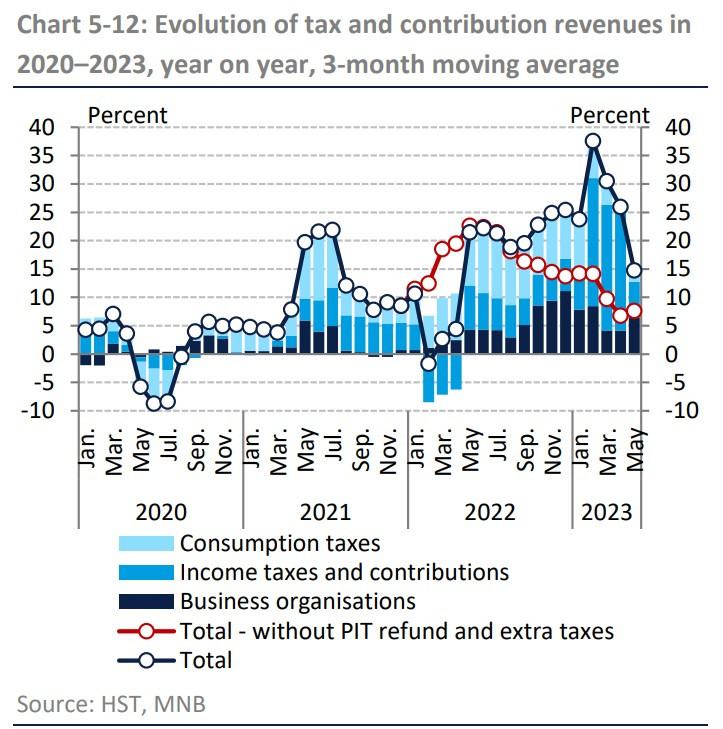
The importance of the former factor was shown in a graph too, which highlights that
the previously dynamic growth of tax revenues appears to be petering out.
What is even more apparent in the chart below is that the increase in consumption tax revenues has been almost unbroken for two years, but in early 2023 there was a spectacular negative turnaround in this area.
The contraction in household consumption (weak retail sales due to falling real earnings, changing household spending, lower VAT receipts) and feeble domestic demand (falling performance of various sectors of the economy) leave a deep scar on the consumption-type tax revenue side. One of the key factors that has stabilised the budget so far (VAT receipts) is under threat from the consumption crisis.
The central bank's staff have analysed developments in the period up to April, and since then we know that May has seen even more unpleasant developments on the revenue side, especially on the VAT side.
The central bank's economists have also warned that the achievement of the fiscal deficit target is surrounded by risks in 2023 and 2024 as well.
The largest risk on the revenue side is the decline in tax revenue dynamics in parallel with the deceleration in economic growth,
they pointed to the process that has already marred fiscal developments in the first few months of the year.
They also point specifically to the problem of the compensation of central bank loss by the budget, on which we have published several analyses in recent days.
The central bank points out that the 2024 budget bill does not foresee any refunding of the MNB’s loss. "Central bank activities – stimulation of the economy during crisis management and then the series of measures necessary in order to reduce inflation – exert a favourable impact on the whole economy, while the related costs are reflected in the central bank’s balance sheet."
"Together with this year’s expected loss, the MNB’s equity will become negative by end-2023, creating a compensation obligation for the budget distributed over five years as of 2024.
The 2024 budgetary expenditure related to the reimbursement of the loss expected for 2023 may reach 0.4–0.5% of GDP under current legislation,
although the exact value is significantly affected by the changes in both the domestic economy and the international environment."
The MNB staff also highlighted that "the risks related to EU funding still persist, because until the receipt of the funds the expenditures related to the new cycle are pre-financed to the beneficiaries from the budget. The pre-financing and receipt of funds affect developments in government debt, while the scheduling of implementation has an impact on the accrual-based balance and real economy trends."
Interestingly, despite the significant risks and challenges (mainly the expenditure stemming from the central bank's loss compensation of 0.5% of GDP), the central bank's experts expect the deficit target of 3.9% of GDP in 2023 and the deficit target of 2.9% in 2024 to be met.
Cover photo: Getty Images





