Greedflation is real! But how concerned should we be about it?


Where will the ECB stop?
The European Central Bank raised the key deposit rate by 25 basis points to 3.5% at its latest policy meeting and in its forward guidance it said that further rate hikes could be forthcoming. Analysts and the market had expected in the spring that the deposit rate would peak at 3.75% in the summer, but this estimate appears to have been outdated by the latest ECB message and there is considerable uncertainty about the outlook.
The ECB is determined to continue hiking rates. It currently is willing to go too far, rather than stopping hikes prematurely,
said Carsten Brzeski, Global Head of Macro for ING Research. As a consequence, he expects the ECB to hike two more times, by 25bp each in July and September. Brzeski does not believe the first rate cut will come before the summer of 2024.
Luca Mezzomo, Head of Macroeconomic Analysis at Italy's Intesa Sanpaolo, believes that in a bid to restore its credibility many economists in the ECB's Governing Council "perceive raising rates too much a lesser evil than raising them too little."
His forecasts are now broadly in line with market expectations: peak level of the depo rate at 4.00%, no rate cut until 2024. As a matter of fact, with a terminal level of 4%. Mezzomo expects the ECB to remain on hold until Q3 2024, but in his response to Portfolio's questions he pointed to many uncertainties. He said "we need to be open to different outcomes. The transmission of monetary policy to the real economy is crucial, and highly uncertain."
Hans Dewachter, Chief Economist of Belgium's KBC Group, however, expects only one more rate hike in July and the deposit rate to peak at 3.755.
Given the stickiness of inflation (expectations), we expect the first rate cut by the ECB only from the second half of 2024 on,
he added.
Rate hike will inevitably affect the economy
When economists talk about "over-tightening", they mean that the central bank, in its fight against inflation, raises the policy rate to a level higher than the minimum level that would be sufficient to achieve the inflation target but would not yet cause excessive damage to the economy.
Since it is impossible to foresee where this interest rate level will end up (since, of course, only afterwards will it be known whether that level has been successful in bringing down inflation), the central bank tends to over-tighten: they prefer to play it safe by raising interest rates significantly, considering the impact of monetary tightening on the real economy (which could even lead to a temporary recession) less damaging than a permanent loss of price stability.
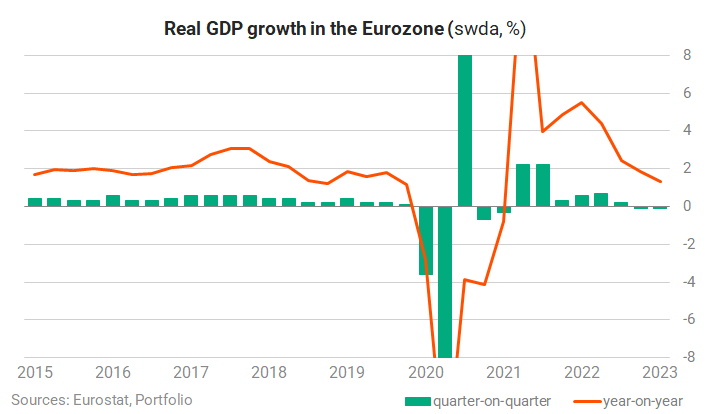
The impact of monetary policy is lagged, taking more than a year for the tightening of financial conditions to fully feed through to the real economy. So the effects of the ECB's monetary tightening cycle, which started last summer, are not yet fully felt. The impact of the tightening will become palpable just the economy expectedly starts to recover from the winter slump: the eurozone economy contracted in the fourth quarter of last year and the first quarter of this year as a result of the energy crisis. Two consecutive quarters are usually referred to as a recession, but the situation is currently more ambiguous.
Hans Dewachter pointed out that the recession during the winter 2022-2023 was much milder than initially feared by many institutions. Europe, through swift actions and mild weather managed to avoid a deep recession. On the other hand, persistently higher interest rates will likely weigh on the recovery.
In its forecast, KBC pencila in that this will be the case for the euro area throughout the rest of 2023, resulting in positive, but very low quarter-on-quarter growth rates until the end of the year.
We expect a moderate recovery from 2024 onwards.
This scenario results in an average year-on-year growth of euro area real GDP of 0.6% in 2023 and 1% in 2024, added Dewachter.
I would not call the small GDP decline of last winter a recession. Too many ingredients of a proper recession are missing, such as an increase in unemployment rates,
commented Luca Mezzomo, who thinks labour markets were simply too tight for firms to shed workers.
He sees a stronger risk of a proper recession next year, as the result of tighter financing conditions maintained for long enough, and of tighter fiscal policies. This is not yet Intesa's central scenario, however. At present, their central forecast for GDP growth is 0.6% in 2023 and 1.1% in 2024.
Mezzomo noted, however, that they put little confidence in their 2024 projection, at present: "there are too many unprecedented developments to consider."
Unless inflation surprises to the downside, the tightening of monetary policy may bring the euro area economy into a moderate recession.
ING also currently expects the eurozone to experience only subdued growth. "There might be some very minor rebounds in the course of the year on the back of stabilsing private consumption but overall cyclical headwinds like the stuttering Chinese reopening, a looming US recession and the impact from higher interest rates will weigh on economic activity," said Brzeski. They expect eurozone GDP growth to come in between 0 and 0.5% this and next year.
Is there such a thing as 'greedflation'?
The rise in inflation above the target in Europe and globally was caused by supply shocks after the coronavirus crisis, but these effects are now diminishing. In the current situation, it is feared that high inflation expectations will allow companies to push through price hikes even when cost shocks no longer justify them. In such a case, profit margins will increase as inflation rises - what is now called 'greedflation'.
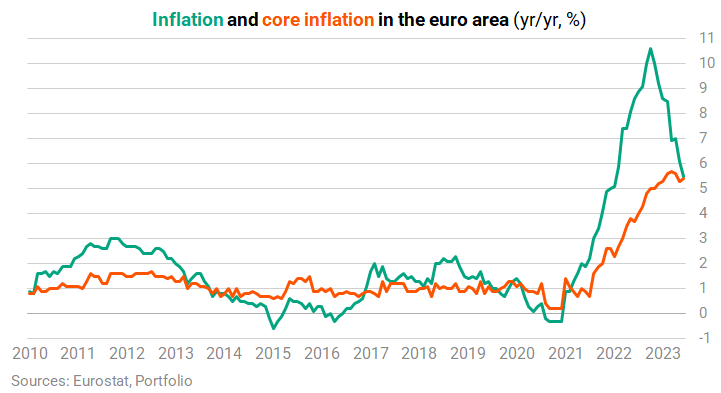
The other type of second-round effects is when the pressure comes from the workers' side, as falling real wages lead to higher wage demands, and thus demand may persistently outstrip supply, i.e. inflationary pressures persist.
The ECB is more wary of this risk for the time being, while analysts - and the European Commission - see growing signs that corporate profits are driving inflation. Earlier, ING was also the first to write about the surprisingly high and concerning profit margins in Germany.
Greedflation is too strong but yes there are signs that companies widened their profit margins,
said Carsten Brzeksi at ING. This, he explained, simply means that there had been more prices increased than justified by higher costs. "However, there are many factors or drivers behind these higher profit margins, other than ‘greed’," he added.
He reminded that
the ECB, interestingly, has been very clearly indicating that it is also looking at this profit-price spiral and not only a wage-price spiral.
As a side remark, he noted that the current profit-price spiral might actually help avoiding a wage-price spiral if companies absorb higher wages in their profit margins.
I see the strong pass-through of cost increases to final prices, and the evidence of fat profit margins in some sectors, as a sign of demand-driven inflation,
said Luca Mezzomo.
Strong demand also favours wage increases. Tighter monetary policy acts on both fronts by restraining demand, he added.
"It is not a targeted tool, it is very unselective: it will hit both the ones behaving more responsibly from a social point of view and the others. We, as consumers, can be selective by not buying the goods or services of firms that raise their prices too much."
The argument of ‘greedflation’ has some ground
to the extent that increases in margins (profit per unit production) did contribute to inflation," said KBC's chief analysts.
Dewachter noted in his e-mailed response that "standard decomposition of GDP by income source confirm that at the level of the euro area profits contributed to the GDP deflator. But margin increases were certainly not the only driver of inflation. Unit labour costs also contributed, and this contribution increased in the course of 2022 and at the beginning of 2023.
Given the size of the recent inflation shock, we can expect some catching-up of wages to recover at least part of workers’ losses of purchasing power, when wages are (re)negotiated. This will certainly contribute to more persistent core inflationary pressure,
he added.
What to expect on the inflation front?
Still, we don’t think this would result in a wage-price spiral (i.e. a self-reinforcing escalation of wage price interactions),
added Dewachter.
- First, the weaker economic outlook may temper wage demands somewhat, despite structurally tight labour markets in many euro area countries.
- Second, the pricing power of firms is likely to weaken as consumption demand is set to weaken on the back of the tighter monetary conditions, but also as a result of the normalisation of demand, following the post-pandemic reopening adjustments, and uncertainty related to the geopolitical environment.
"Moreover, increased margins allow firms to absorb at least partially increasing labour costs. This should ease inflationary pressures in the economy, and allow a very gradual return of inflation – and in particular core inflation – to (or slightly above) the ECB’s target of 2%," he said.
KBC does not think this target level will be reached within their current forecast horizon of 2023-2024.
At ING, however, they expect inflation to come down faster than the ECB currently expects. "Disinflationary forces are already at play and should gain momentum after the summer. We currently expect headline inflation to come down to around 2.5% by year-end," said Carsten Brzeski.
Mezzomo does not see any sign of a wage-price spiral yet, but he does see "signs of a catch-up process in which workers try to recover some of the purchasing power they have lost, with the help of tight labour markets."
"This is fair, and it is still consistent with a drop of inflation rates in services and manufacturing, if weaker demand forces business firms to give up some of their profitability," he said.
As for inflation, I bet that inflation will fall very quickly in the second half of this year:
energy prices are lower, international prices for goods are weaker. Perhaps, even the crazy price adjustment in hotels and restaurants will soon start to backfire and dent demand for those services."
Mezzomo sees inflation back to about 2% from next year. However, core inflation may remain slightly too high for the ECB to feel comfortable. Hence, monetary policy will probably remain restrictive for some time, he concluded.
Cover photo: Getty Images





