Hungary's budget really is in big trouble - Q1 gap largest since 2006


Widest gap of the last 17 years
According to preliminary data the deficit of the general government sector in the first quarter of 2023 was HUF 1,728 billion, 9.8% of GDP. Such a gap in the first three months was last recorded in 2006.

The general government sector’s revenue was HUF 7,210 billion and its expenditure HUF 8,938 billion.
REVENUES
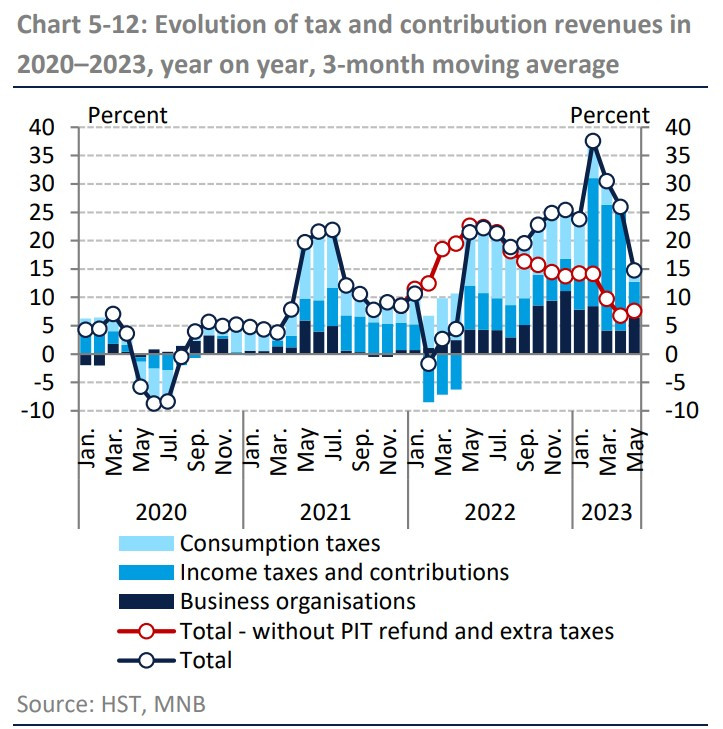
Revenues went up by HUF 607 billion or by 9.2%. The largest, HUF 415 billion (15.6%) increase in value was recorded in taxes on production, primarily due to the special taxes introduced during 2022.
VAT revenue growth was HUF 129 billion (8.8%). Revenues from taxes on income were HUF 169 billion (16.4%) higher than a year earlier. Social contributions increased by HUF 186 billion (by 11.9%). Other revenues decreased by HUF 164 billion (by 12.2%).
EXPENDITURES
Expenditures increased by HUF 1,872 billion or by 26.5%. The reduction in case of paid compensation of employees was HUF 151 billion (8.2%), being impacted by the payment of the six-month ‘firearms money’ in the base period as well.
Social benefits other than social transfers in kind rose by HUF 436 billion (by 23.4%), owing mainly to increased amounts of paid out pension benefits.
Intermediate consumption surpassed by HUF 153 billion (by 13.6%) the previous year’s value, interest expenditures grew by HUF 395 billion (by 113%). Gross fixed capital formation decreased by HUF 46 billion (by 9.8%).
Other general government sector expenditures went up by HUF 1,085 billion (by 77.3%) year-on-year, mainly due to a sharp increase in subsidies for energy supplier companies.
Unfavourable trends
Smoothed processes also reflect a highly unpleasant trend. The four-quarter rolling average of the government sector balance has continued to rise, and reached 7.8% of GDP.
This was the third quarter in a row that the rolling average has risen.

We have already devoted several articles to how bad shape the budget is currently in:
The data just released by the Central Statistical Office (KSH) are accrual-based and cover the months of January, February and March. However, cash flow data for April and May have also been released in recent months, and these have also shown that fiscal processes have not improved. And the preliminary cash deficit figures for June will be available next Monday, which we will also report on in a separate article, analysing the first half-year trends.
Okay, what just happened?
What we have learned from the detailed general government statistics of the first few months:
- The main problem is on the revenue side of the budget, including VAT receipts, which are barely increasing, and in May there was already a year-on-year decline.
- Meanwhile, the expenditure side of the budget is weighed down by the cost of maintaining the utility bills reduction scheme, and interest expenditure is also higher than planned.
- In November, there is expected to be additional pension expenditure, which will require hundreds of billions of forints from the budget.
Cover photo: Finance Minister Mihály Varga speaks at the opening ceremony of the 66th International Financial Tournament at the sports ground of the Pénzügyőr Sports Club in Budapest on 26 June 2023. Source: MTI/Zoltán Balogh





