Hungarian gov't decides on major budget reallocations


Government does not back EU budget top-up either
The European Commission had requested a top-up for the common EU budget for the period 2024-2027. The government does not consider this acceptable because it is not yet known "what Brussels has spent the money on," said Gergely Gulyás, Prime Minister Viktor Orbán's chief of staff.
The cabinet also objects that €50 billion will be spent to support Ukraine over the next four years, while €1.5 billion would be spent to pay Brussels bureaucrats. The Hungarian government refuses to vote in favour of the Commission's proposal.
What about the EU budget?
Asked about Hungary's expectations of the European Commission in the context of the EU budget review, Gulyás said that
Brussels is trampling the rule of law underfoot, and so no one can think that when Hungary has not received a penny, we are in favour of topping up the [EU] budget.
In essence, the politician said Budapest will not back the Commission in budget talks unless it is willing to unblock cohesion funds and the recovery and resilience facility (RRF) for the country that were suspended for Hungary is persistently flaunting democratic rules. The rule of law report just released by the Commission tells us this tactic is not going to work. The EU executive could easily solve the budget deficit next year, either by rescheduling EU programmes or by other reallocations.
The government considers the economic expectations of Brussels unacceptable
Gulyás said that as part of the country-specific recommendations, the European Commission has asked the government to reconsider energy subsidies, and has also asked for a review of the budget for education, health and family support spending.
He added that the government was not prepared to make further cuts in family allowances.
Gergely Gulyás's statement is interesting because in its decree published on Tuesday night, the government made a clear commitment - in line with the recovery plan of last December, which it undertook as part of the agreement with the European Commission to unblock EU funds - to achieve a 3% saving in the area of public spending. The text of the government decree contradicts what the minister has just said. The the same behaviour as with the windfall tax all over again. Although the government promised in the recovery plan to phase it out completely from 2024, it has not done so. There will be only a partial phase-out and reduction starting next year. However, the extra profit tax burden will largely remain in place, and most of the tax revenues will be collected in state coffers.
Public spending scrutiny: the government has already made up its mind
In response to a question, Gergely Gulyás said that the government plans to review public spending in line with the European Commission's expectations. Asked if the government is now saying that it will not make savings on family and housing allowances, but will nonetheless carry out a review of the related spending, does this mean that the government's decision has already been taken, regardless of the outcome of the review, the minister replied that the journalist had got the gist of the government's position right.
There is an absolutely amazing Hungarian film, The Witness (A Tanú), directed by Péter Bacsó in 1969, which was banned for over a decade for its outspoken criticism of the post-WWII communist regime. This whole situation is as if it were from that movie.
There is a scene in the satire where Comrade Virág hands over a pre-fabricated statement to József Pelikán, a humble and clueless dike-keeper who finds himself being the key witness of a show trial that is just about to start. Pelikán starts to read the document but he suddenly pauses, looks up and says: “Excuse me, Comrade Virág! This is the verdict."
Gulyás has practically admitted with a straight face that although the government will carry out a review of public spending on family benefits, housing benefits, health spending and tax credits following the agreement with the European Commission, he already knows that none of the substantive economic policy proposals to be made by the Ministry of Finance and the newly established Task Force will be adopted.
This begs the question: what is the point of such an exercise and of tying up the capacity of the state apparatus for such a purpose? It also seems to be a foregone conclusion that the government will not undertake any meaningful spending cuts that would permanently resolve the budget situation, and that across-the-board one-off spending cuts will continue to be deployed in the future.
He later added that a review provides an opportunity, for example in a large system such as health care, health insurance, on which the state spends a lot of money, to find points and elements where intervention may be justified, but the essence of the system will not change.
Deficit target remains
The official deficit target is 3.9% [of GDP], Gergely Gulyás said, adding that the first-half data show that consumption is worse than expected, so VAT receipts are below target. Even so, they are still waiting to see what steps might be warranted for the deficit target.
He pointed out that most analysts and even credit rating agencies expect growth in the third quarter. For this reason, they are not preparing for a downgrade of the Hungarian sovereign debt rating in the near future.
The government is still playing for time with the budget
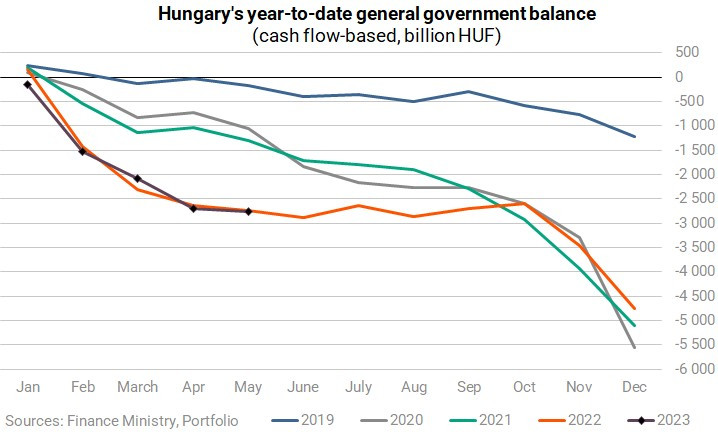
The budget is generally characterised by the fact that most of the expenditure occurs in the first half and most of the revenue in the second half, Gergely Gulyás said. He added that the situation has now changed to the extent that inflation was higher than expected in the first half of 2023 and the economy "entered a minimal recession".
He believes that although there is a shortfall in revenues from consumption taxes, this could improve in the third quarter.
Although the minister is adamant that there are clear limits within a year as to when expenditure and revenue are higher, there is no such general trend. While it is true that expenditures may be front-loaded, i.e. there is a lot of one-off spending by the general government at the beginning of the year, it is not necessarily true that revenues increase significantly in the second half of the year. In recent years, for example, this has not been the case at all, as can be seen in the accompanying graph:
Why is the forint weakening? Are speculators scheming?
The forint is moving hectically which stems more from speculation than real market developments, Gergely Gulyás said, reacting to the forint's rapid weakening this week (it is currently still worth 383 forints to 1 euro, a three-month low).
According to the minister, the situation in the foreign exchange market is much better than it was one year ago; it is visible that inflation can be brought down quickly and next year it could be in the manageable range between 5 and 6%. The politician assessed that
the deficit reduction has apparently been successful.
It's all a matter of perspective, really. Exceeding 80% of the annual target by the end of the fourth month can also be called a success.
He also said that he is confident that the major trends in the Hungarian economy are going in the right direction, with only household consumption falling, but that this could change by the third quarter, when the Hungarian economy is expected to be growing.
I think that the fundamentals are strong, especially as we have not even received any money from the new EU cycle,
he said.
He also said that he is confident that the major trends in the Hungarian economy are going in the right direction, with only household consumption falling, but that this could change by the third quarter, when the Hungarian economy is expected to be growing.
I think that the fundamentals are strong, especially as we have not even received any money from the new EU cycle. - he said.
The European Commission is biased
Gergely Gulyás said that they do not attach much importance to the annual rule of law report published by the European Commission on Wednesday and the criticisms it contains against Hungary. He said that "Brussels is biased against the Hungarian government", but assessed the report as acknowledging a number of government measures taken to remedy the rule of law situation.
According to the minister, the balance shows that the EU executive has recognised a number of Hungarian measures and made roughly the same number of recommendations.
As we reported, the rule of law report highlights that Hungary has implemented many of last year's recommendations, as well as those of the conditionality mechanism, but it still identified a number of shortcomings.
Thus, according to Brussels, the government has made no progress in adopting comprehensive reforms of lobbying and conflict of interest rules, and only some progress in strengthening the system of asset declarations. There has also been no significant progress in the follow-up of investigations, prosecutions and final convictions in high-level corruption cases.
A one-off reallocation of HUF 170 billion in the budget
The government has decided to transfer a total of HUF 169.44 billion from the Overheads Protection Fund. Most of the funds will thus go to schools and health institutions, but church institutions will also receive HUF 11 billion, and clinics under public interest trusts will receive around HUF 25 billion, according to a decree decision published earlier in the Hungarian Gazette. Local governments received a total of HUF 76 billion in overhead compensation under the government decision, which was published on 29 June.
What will happen to local government taxes?
The government has amended the relevant regulation, so that the Hungarian State Treasury can deduct the solidarity contribution from the accounts of the municipalities concerned. Meanwhile, Mayor Gergely Karácsony has refused to pay the tax until the government transfers the necessary subsidies.
According to Gergely Gulyás, this is not a new regulation, as it was possible to settle debts in such a situation before. In response to a question, he said that they do not plan to consult the mayor separately at the moment, but are willing to do so in justified cases.
What will happen to family allowances next year?
The government has already cut the number of beneficiaries of the family housing allowance (CSOK) and baby loans in June, and there will be no more changes, Gulyás said. He added that the HUF 335 billion budget for 2024 [for these purposes] will remain.
The purchase of the airport remains on the agenda
The government is negotiating the purchase of Budapest Airport. For the time being, Gergely Gulyás could not provide any details on the size of the stake the state wants to buy or the specifics of the transaction.
Nationalisation
Compensation will be provided for diagnostic imaging companies that have been receiving their orders from the state but whose job will now be taken away by the state. In future, this activity will be performed uniformly by the state, Gulyás said in response to a question.
The aim is not to have shared capacities, but to ensure that the imaging equipment (CT, MR, X-ray) is clearly in the public service and that patients receive the service as quickly as possible.
The state will be able to operate these machines without time limits. The waiting lists will not get longer, but shorter if rational processes are put in place.
Rationality would justify this, but in the health sector we have already seen situations that have not been implemented in a rational way," Gergely Gulyás said in relation to the nationalisation of the diagnostic imaging market.
Yeah, it's a great idea. The public health care system is in such a tip-top shape, they just couldn't pass up the opportunity to use some of the invaluable lessons learned during its operation on diagnostic imaging tasks too. Can hardly wait to see the shortening of waiting lists.
"Nationalisation, when bypassing impact studies and professional consensus-based decision-making, could worsen the already critical shortage of specialists in diagnostics and outpatient specialist care, lengthen waiting lists, worsen the chances of recovery for cancer, musculoskeletal and cardiovascular patients, and force more patients into private care," the Hungarian Medical Chamber (MOK) told local daily Népszava in response of the news of the nationalisation.
According to Népszava, currently one third of CT and MR scans are performed by private companies.
The withdrawal of diagnostic imaging services by the state may cause some challenges only in the capital, Péter Zöldi, an expert at radiology.hu, commented to the paper.
Here, three or four major hospitals - Péterfy, Bajcsy, Kistarcsai and the National Institute of Traumatology - provide such services through private companies. In these hospitals, the service is provided either through so-called intermediary contracts or via direct contracts with the insurer, and in some other larger cities in the countryside, such as Győr, Székesfehérvár and Szolnok. He estimates that the cost of "nationalisation" could cost the budget up to HUF 5-6 billion including compensation. Another expert, however, estimated the cost to Népszava at at least HUF 15 billion.
Private CTs are being taken over for two reasons
During the coronavirus pandemic, many procedures were postponed, which is why waiting lists have grew greatly in length, the minister explained the nationalisation of diagnostic imaging companies. He added that the government is not in favour of mixing private and public health care, which was the case in this area.
He did not go into details about the costs, but estimated budget expenditure to between HUF 5 bn and HUF 10 billion (also mentioning HUF 7 bn).
He elaborated on what the contracting possibilities mean for private care: there are specialised areas of care, such as spinal surgery, where it is not worth building capacity in the public care system, but private providers have it. Thus, Gergely Gulyás argues that it is better to contract these services from the competitive market at the expense of the health care system.
Hospital pharmacies
The government also plans to outsource hospital pharmacies. Under the amended law, the state will tender for the operation of some 107 hospital pharmacies.
According to the explanatory memorandum, the legislator's aim is to ensure a uniform quality of service and to make investments in high-value, personalised medicine dispensing.
I would be careful with the word nationalisation, said Gulyás. What will change is the way hospitals buy medicines. If you can save money here without compromising the quality of patient care, you can save money here. But we are not there yet with the plans, he replied to another question on the need to take over hospital pharmacies. The minister did not give a substantive answer to the question on the reasons for the change.
Disappointing decline in retail sales
The minister is disappointed that retail sales fell by 12.3% last month, but he said that the fact that household consumption was very high in the spring of 2022 played an important role in this, so the base effect distorts the year-on-year comparison of the current data.
However, Gergely Gulyás also indicated that they had not expected such a downturn and hoped that retail sales would soon start to expand.
Inflation is having an impact, which is already causing consumption to decline, he acknowledged, noting the negative impact of Hungary's extremely high inflation.
As Portfolio reported,
ON A MONTHLY BASIS, SALES HAVE AGAIN FALLEN BY 0.8%, MEANING THAT A TURNAROUND IS STILL A LONG WAY OFF.
In April, compared with March, the rate of decline was 0.9%, but before that it had increased by 0.7%.
Gulyás added that the government will monitor the implementation of the price freezes and the mandatory discount sales, and retail chains will be subject to strict supervision. He said the government was pleased that the new system had been launched and hoped that it would have a positive impact on sales too.
Selling off public assets. What next?
The government is planning to sell 74 state-owned holiday resorts. In this context, Gulyás was asked whether any compensation was planned for state employees, as many employees had planned to take advantage of the discounted holiday opportunities.
According to Gergely Gulyás, the increase of the SZÉP card limit to HUF 450,000 will compensate the workers. He also believes that these resorts are not in a good condition at all, so they would rather raise wages so that employees of state-owned companies can go on holiday to fancier places.
In some cases, such as the government resort at Balatonkenese, it was decided not to sell some of the accommodation because it was in better condition and offered good socialisation opportunities.
The one-day sticker will not be cheap
Gulyás said the Hungarian government does not want a one-day motorway sticker, but the European Union has already decided that its introduction is mandatory.
He added that since the one-day stickers would be bought mainly by foreigners, the cabinet's aim will not be to help them save money.
WITHOUT GIVING FURTHER DETAILS, HE SAID THAT THE PRICE OF THE NEW VIGNETTES WILL BE CLOSE TO THAT OF THE TEN-DAY STICKERS, SO IT WILL NOT really BE FINANCIALLY WORTHWHILE FOR MOTORISTS TO CHOOSE THIS OPTION.
He also reminded the price of vignettes cannot be raised by more than the annual rate of inflation in the previous year.
That's quite an interesting remark, considering that the price hike is currently maximised at the previous year's August CPI. And this was also the rule the government simply shrugged off last year when it decided on a differentiated price increase. The price of vignettes mostly used by Hungarians, e.g. the annual and county passes, was raised by 5% each, while others saw their price jump 44% or even 72%. According to our present knowledge, tolls can be expected to be raised by 15% in 2024.

The government will soon send an invoice to Brussels
In July we will also send an invoice to Brussels, which the Commission has 90 days to pay, said Gulyás. The cohesion funds could start coming in soon, and it is only a matter of political decisions before their transfer commences, he added.
No deadline for the transfer of EU funds
In July, the government will send an invoice to the European Commission for the first batch of cohesion funds to be drawn. The cabinet's position is that, in addition to the rule of law conditionality mechanism, the EUR 13 billion blocked by the horizontal enabling conditions should be opened by Brussels, Gergely Gulyás said, adding that all EU requirements are met with the judicial reform.
The politician says there are still technical issues, but the European Commission will have to pay once the invoices are received. However, he believes that "Brussels is not trustworthy", so no deadline has been set for newly appointed EU minister János Bóka as to when the withheld EU funds should arrive.
The European Commission has previously indicated that in order to access 55% of the cohesion funds, the government will need to clarify certain implementation details, in addition to the entry into force of the justice reform package. If the Budapest administration considers that all conditions have been met, it will have to send a self-assessment to the European Commission that it has already met the horizontal enabling conditions. The EU executive will then have up to 60 days to assess this and may pay only after a positive decision.
The frequently mentioned rule of law report acknowledges the achievements of the judicial reform, but also lists a number of shortcomings, including the lack of transparency in the allocation of cases in lower courts. It is therefore possible that the debate on EU funds for Hungary will continue.
What about the central bank's loss?
The central bank's (MNB) management has just proposed that if it happened to incur a loss it should continue to operate with negative capital. When asked about this, the minister said they support this proposal. The European Central Bank will also be informed of this, because the parties have an obligation to do so.
As we are talking about a technical profit or loss, I see room for the future profit of the central bank to offset the current loss. The central bank's capital should be compensated from the budget in the case of a longer period of losses at most, Gulyás said.
He also said that a longer period of loss would be set at 5 years, in line with the current Central Bank Act.
Cover photo: Gergely Gulyás, the PM's chief of staff (right) and government spokeswoman Alexandra Szentkirályi hold a press conference in the Prime Minister's Cabinet Office on 22 June, 2023. Source: MTI/Zoltán Máthé





