European Union running low on workers


Tight labour market
Labour shortages rebounded sharply in 2022 as the economy and labour market recovered from the COVID-19 pandemic, coming back in line with previous occupational and sectoral patterns. Employment rates were at a record high at 74.6% with 213.7 million people employed in 2022, and unemployment rates at a historic low at 6.2%. The job vacancy rate rose to 2.9%, the highest rate ever recorded, compared to 1.3% in 2012, with labour shortage indicators showing increasing tightness in the labour market.
Following demand interruptions during the COVID-19 crisis (except healthcare, which saw soaring demand during the pandemic), these shortages exceeded pre-pandemic levels by the end of 2021. For example, labour shortages in manufacturing and construction are now nearly three times the level observed 10 years ago, and have more than doubled in services.
Cyclical and structural problems
While part of these developments reflects a cyclical upturn in the economy following the substantial dip during the COVID-19 crisis, structural determinants remain crucial. Many of the current shortages (e.g. in science, technology, engineering and mathematics (STEM), including information and communications technology (ICT), construction, healthcare, hospitality) are long-standing and likely to have be further exacerbated by the green and digital transitions.

In Q1 2023, labour shortages were reported as a factor limiting production by 28% of employers in manufacturing and 31% in both services and construction in the EU.
Persistent labour shortages are found in a diverse range of sectors and occupations across all skill levels. Persistent labour shortages are particularly prevalent in healthcare, STEM (notably ICT), construction, and certain service occupations. While this list includes some relatively high-skilled occupations, it also includes middle-skilled and low-skilled occupations.
The importance of different structural drivers of labour shortages varies significantly by occupation and sector.
Overall, employers’ difficulties in finding people with the right skills are often linked to their inability to attract and retain workers (e.g., due to poor working conditions or human resource management (HRM) practices) rather than a lack of skills among job applicants.
However, a limited supply of skilled workers poses challenges for persistent labour shortages in fields such as STEM or healthcare. In other occupations, especially those characterised by more manual skills and lower literacy, numeracy and digital skills requirements (e.g. cleaners, personal care workers), poor working conditions and challenges in attracting and retaining workers play a more significant role. Labour shortages in some occupations might be exacerbated by evolving skills and employment needs due to the green and digital transitions
Population ageing
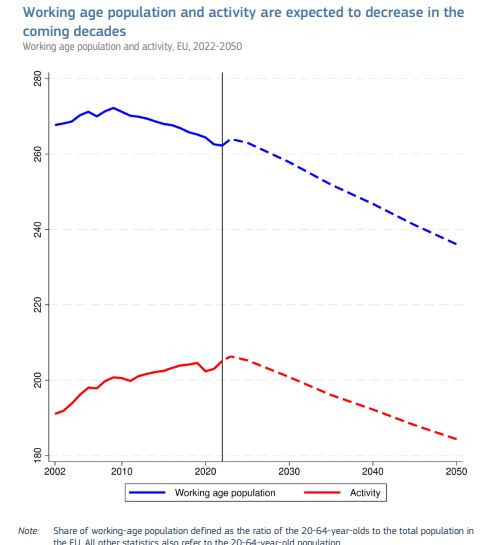
The aging population is a major trend affecting labour shortages, considering that, while fewer people will be working, consumption by an increasing older population will remain sustained. According to Eurostat’s EUROPOP2023 baseline population projection, the number of people in working age (blue line) is expected to decrease in the coming decades. While the working-age population (20-64-year-olds) reached a record of 272 million people in 2009, it declined to 265 million by 2022 and is expected to fall further, to 258 million by 2030, 247 million by 2040, and 236 million by 2050.
While the digital transition contributes to persistent labour shortages in the ICT sector, it does not seem to be a key driver of shortages in other occupations. Indeed, one third of the skills required for an ICT professional are digital skills, while for most other occupations digital skills represent less than a tenth of all skills needed.
ICT occupations are the most digitally intensive form of work in the EU, by a considerable margin. In this context, lower average digital intensity of work among women, older people and those with lower levels of educational achievement is largely explained by the underrepresentation of these groups in ICT occupations.
The demand for ICT work doubled between 2011 and 2021, with more than 9 million ICT specialists now working in the EU. This number is projected to expand sharply, making current labour shortages even more pressing.

Addressing labour shortages in specialist ICT positions will likely involve supporting more women to enter the field. With women accounting for only 17% of all employment in ICT occupations in the EU, measures tackling their underrepresentation offer important opportunities to attract new workers.
Around one-quarter of women’s underrepresentation traces back to gender segregation in ICT education. Exposure to broader stereotypes around ICT work contributes to gender divides in aspiration from an early age: at 15 years of age, around 1 in 10 boys expect to work in ICT, compared to just 1 in 100 girls.
Green transition
The green transition is projected to lead to employment growth in several sectors and occupations, where new vacancies may be difficult to fill. It is estimated that the green transition could lead to creation of between 1 and 2.5 million additional jobs by 2030. This includes jobs in some sectors and occupations already experiencing persistent labour shortages (e.g., transportation and storage sector, drivers, building and related trades, electrical and electronic trades), as well as those likely to face labour shortages in the future (e.g. net-zero technologies, water supply, sewerage, waste management and remediation activities, and certain science and engineering professions).
Significant expansion needs, severe underrepresentation of female workers, and increasing demand for medium-skilled and high-skilled workers with specific qualifications in sectors key to the green transition, combined with high replacement needs for older workers in some relevant sectors, might exacerbate labour shortages.
Lower labour market participation among women, lower-educated people, people with a migrant background (especially migrant women), older workers and young people is one of the factors underlying labour shortages.
- Since 2004, women are, on average, about 12 pp less likely to participate in the labour market than men, a difference that increases by another 10 pp with motherhood.
- The participation probability of people aged 55-64 is about 28 pp lower than among under-55s, partly due to early retirement schemes. However, for both older workers and women, those participation gaps have decreased over time.
- Education plays a fundamental role in the rate of labour market participation: those attaining at most lower secondary education are about 23 pp less likely to participate in the labour market than those with tertiary education.
- People born outside the EU are 2 pp less likely to be employed than natives, primarily due to particularly low employment rates among migrant women.
- Finally, other groups, such as persons with disabilities or people with a minority racial or ethnic background, including Roma, remain underrepresented in the labour market.
Gender segregation
Gender segregation of the labour market contributes to shortages by reducing the efficiency of labour supply allocation. Labour shortages are evident in occupations and sectors where men account for the majority of workers (e.g. STEM occupations, where men represent 80% of workers), as well as in some jobs where women comprise the majority of workers (e.g. healthcare occupations, where women represent 80% of workers).
Persistent gender segregation reduces the pool of people available to fill new vacancies, exacerbating difficulties in finding workers, especially in times of rising demand.
Measures aimed at reducing gender segregation offer important opportunities to ensure that increased labour market participation of women alleviates labour shortages.
Currently, women remain unlikely to progress into hard-to-fill vacancies in male-dominated occupations. At the same time, relying almost exclusively on women’s work does not generate sufficient labour supply to satisfy the demand for specific services such as nursing, personal care, or cleaning. Improving working conditions and pay in these jobs is likely to play an important role in attracting additional workers.
Most shortage occupations are either dominated by men or by women – 86% of these occupations are not gender-balanced. This also mirrors gender segregation in the respective field of studies, which is why the pool of people to fill vacancies is limited.

Need more immigrants?
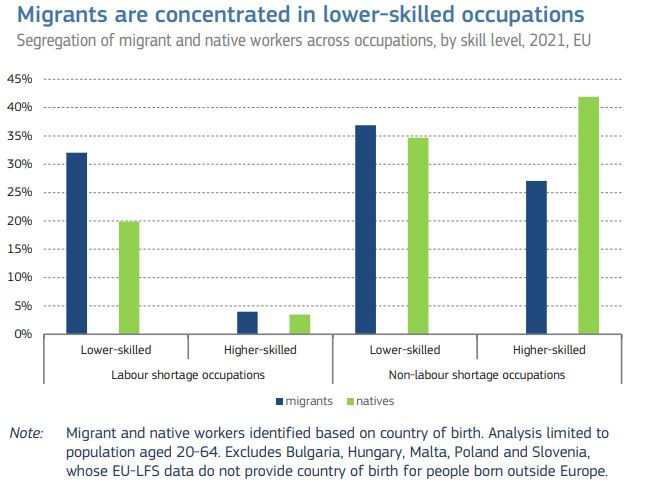
Migrant workers born outside the EU are more often employed in occupations facing persistent labour shortages. Compared to native workers with the same characteristics, being a migrant is associated with a higher probability (8.7 pp) of working in shortage occupations, especially in lower-skilled ones.
However, their lower participation rate in the labour market – particularly among migrant women – results in some untapped potential in tackling labour shortages.
Among people born outside the EU and working in occupations experiencing shortages, 9 out of 10 are employed in low-skilled occupations.
Migrant workers born outside the EU are 3.1 pp more likely to have difficulties in finding permanent or full-time employment, despite indicating their willingness to work more hours, especially in occupations with persistent labour shortages.
The high share of migrants reporting discrimination when in employment (8.6%, compared to 5.4% for the native population) also suggests inefficiencies in matching labour supply with relevant job opportunities. Further obstacles to migrants getting a (suitable) job are the lack of skills in the host country language(s), difficulties in recognising their formal qualifications obtained abroad, and care responsibilities. These factors may hinder the potential of migrants to mitigate future labour shortages.
Cover photo: Getty Images





