For the first time ever, more new EVs than diesel cars sold in Europe


European car industry building up muscle
In June 2023, the EU car market grew by 17.8% to 1 million registered units.
This growth can be attributed to the region’s rebound from a low comparison base last year, primarily driven by vehicle component shortages,
the ACEA said.
As we reported at the time, the unfavourable macro environment led several carmakers to change their strategy and focus on revenue and margins rather than volume, which is partly why car sales fell.
However, the European car industry, which has been ailing for many reasons,
seems to have recovered this year,
although it is important to point out that the statistics just published are a far cry from the "peacetime" of 2019, before the war and the coronavirus pandemic. In any case, in June most EU markets, including the four largest, were able to grow significantly, with Germany selling 24.8% more vehicles than in June last year, Spain's sales up 13.3% and France's by 11.5%.

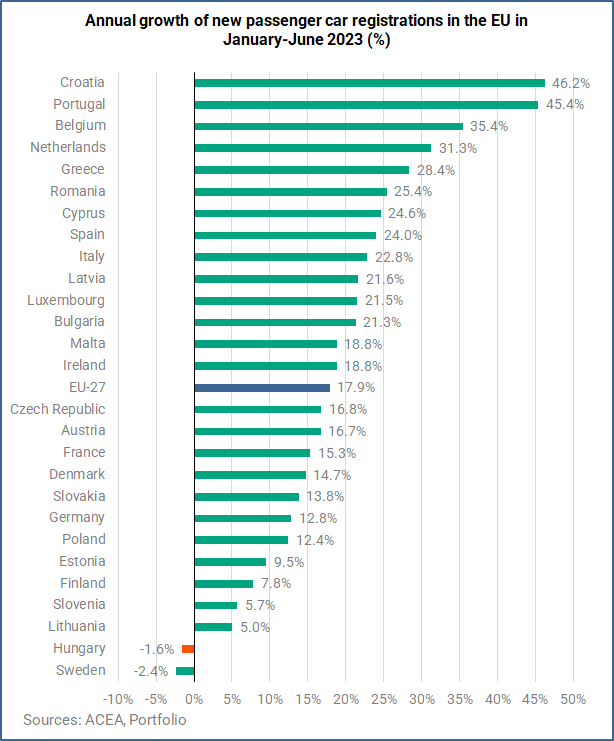
Not only June, but also the first half of 2023 turned out well, with new EU car registrations up significantly (+17.9%), reaching 5.4 million units.
The recent months’ improvements indicate that the European automotive industry is recovering from supply disruptions caused by the pandemic,
the ACEA said.
However, cumulative volumes are 21% lower compared to 2019. Most of the region’s markets grew significantly in the first six months of 2023, including the four largest ones: Spain (+24.0%), Italy (+22.8%), France (+15.3%), and Germany (+12.8%).
Electrification in focus
In June, new registrations of battery-electric cars in the EU increased by a significant 66.2%, reaching 158,252 units. This resulted in a market share of 15.1% (up from 10.7% in June 2022) and positioned battery-electric cars as the third most popular choice among new car buyers,
overtaking diesel for the first time
Most EU markets recorded impressive double- and triple-digit percentage gains, including the largest, such as the Netherlands (+90.1%), Germany (+64.4%), and France (+52.0%).


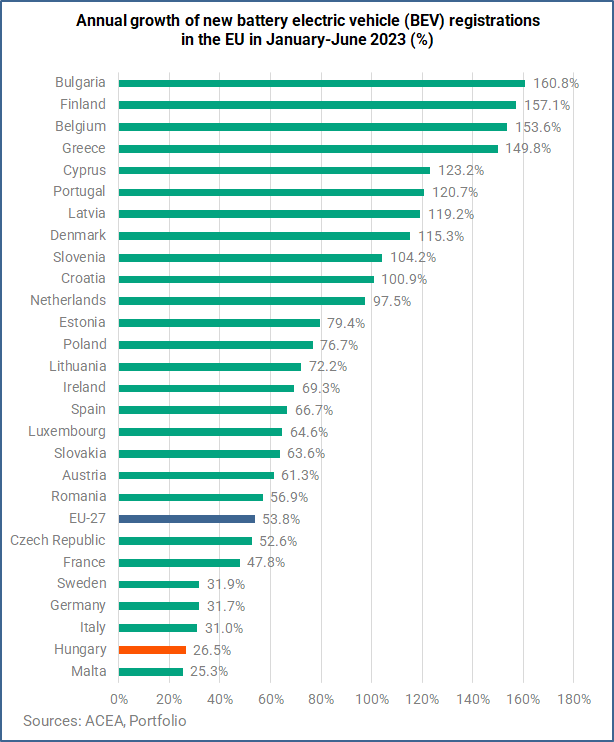
This contributed to a year-to-date growth of 53.8%, with 703,586 units sold between January and June. Contrasting the double- and triple-digit growth rates in BEV sales in several EU countries in the first six months is Hungary's mere 26% growth, which
landed the country on the penultimate place in the EU ranking
New hybrid-electric car registrations surged by 32.4% in June, reaching 254,100 units. This growth was primarily driven by substantial gains in the bloc’s largest markets: Germany (+59.1%), Italy (+29.9%), France (+27.9%), and Spain (+22.7%). Cumulatively, hybrid-electric car sales recorded a remarkable 27.9% increase from January to June, reaching nearly 1.4 million units and capturing 25% of the market.
How's the situation in Hungary?
Although the car market in the European Union has generally performed well, this is not the case in every Member State - ACEA reported single-digit growth in several countries, but apart from Sweden,
new car sales in Hungary also fell
in the first half of this year compared to the first half of 2022. In June, Hungary was the only other country to see a decline in new sales.
As for the distribution by fuel type seen in the domestic market, it is worth highlighting that in the first half of 2023, pure petrol vehicles were no longer the first choice of consumers (38.2%), but hybrid electric vehicles (HEV) were the most sold (39.1%) in Hungary. The total share of petrol and diesel cars, however, remains way higher at 50.2%.
Meanwhile, bucking the European trend somewhat, the share of battery electric vehicles (BEV) purchased by Hungarians remains extremely low, although the share of BEVs was slightly higher in the first half of 2023 (5.1%) than in the base period (3.9%).


Cover photo: Shutterstock





