Economy
Hungary FinMin says budget to be reviewed in Sept, central bank law to be amended


The Finance Minister touched on a number of topics in Wednesday's interview, published by Reuters on Thursday, and we summarise them them thematically with our own comments:
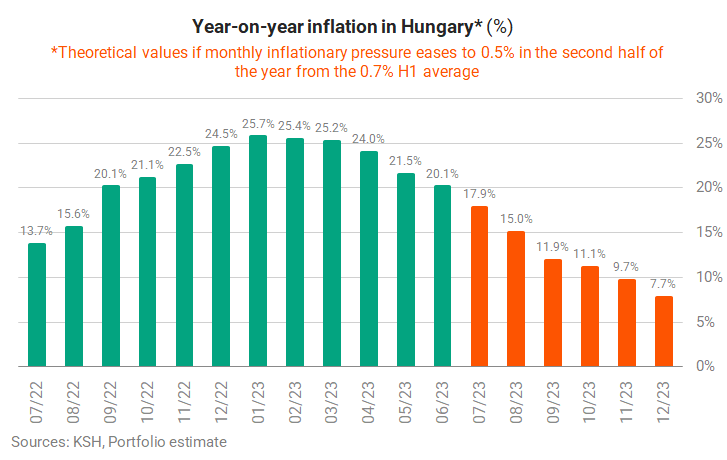
- Inflation. "By December for sure, but if we are lucky, inflation will be below 10% already in November. I can say that inflation will be around 7-8% by December," Varga said. This confirms Portfolio's scenario analysis on Monday, in which we also outlined that, with a monthly inflation rate of 0.5% (which is the market consensus and realistic assumption today), the year-on-year inflation rate could fall to 7.7% by December, and enter the sub-10% range already in November.
- Budget. According to Varga, no fiscal intervention is warranted for the time being, despite the fact that the first six-month deficit reached 85% of the annual target and, as we have pointed out in several articles, without measures the deficit target could be well above 3.9% of GDP. For example, OTP recently outlined a deficit of around 6% in its baseline scenario. "For the time being, I see no reason for such measures... in September we will have a review and if needed, the government will take measures. I'd like to leave the (3.9%) deficit target intact," the minister said, adding the government was also sticking with its 2.9% deficit goal for 2024.

- Central Bank Act. In order to meet next year's 2.9% of GDP deficit target, said the government would amend the central bank law effective January 2024 to avoid having to cover the bank's losses from the budget. The government will discuss the planned changes with the European Central Bank soon, said Varga. "We have agreed with the National Bank of Hungary that we propose a solution to the ECB that ... would allow the NBH to correct its losses over the medium term, that means about 3-5 years," he added. "Having a negative equity poses no threat to the operation of the central bank." This is the scenario Portfolio found the most likely to materialise.
- Forint exchange rate. Varga said a stable forint was crucial for economic players to be able to plan ahead and the concept that a weak currency was needed to boost exports "was a notion of the past," chiming in with the key messages of a recent taboo-breaking MNB study. In that they stressed that economic correlations have changed and a weak forint is not good for the economy (weaker pass-through to exports; greater boost to inflation, which leads to a bigger drop in real wages that results in a greater decline in consumption; more expensive imports, which has an adverse impact on investment activity).
- The minister spoke with rare candor about this matter. "Our problem is when the forint weakens 20 forints in a week, by 4%, then nobody can plan," he said. "If interest rates come down theoretically it is conceivable that the exchange rate would weaken ... but if the other segments of the economy improve ....then the MNB's monetary policy strategy that it reduces rates in 100 bps steps by the year-end, taking the base rate to 10% -- it could work without the exchange rate producing swings, remaining stable." Over the past two days, the forint eased almost 10 units against the euro and more than 10 versus the US dollar, creating a precedent for the predictability issue mentioned by Varga. The central bank is scheduled to hold its monthly rate-setting meeting next Tuesday, and the market expects the one-day deposit (i.e. benchmark) rate to be lowered by another 100 basis points to 15% (the following day). It can also be expected that, despite the intensive decline in the annual inflation rate expected in the coming months, the MNB will not step up the pace of the 100bp monthly rate cuts, as Deputy Governor Barnabás Virág has recently announced, saying they want to prevent the forint from falling sharply, as Varga also hinted at the possibility of that.

- EU funds, FX bond issue. When asked how Hungary would cope if the EU -- which has a rule-of-law dispute with Prime Minister Viktor Orbán -- does not disburse suspended EU funds this year, Varga said he expected both recovery funds and cohesion funds to start flowing. "I trust that we will not have to prepare an fx bond issue, so talks on EU funds will accelerate," he said.
- Regional growth. "I'm optimistic that this region has enough potential that if it can overcome the energy situation and inflation then [...] the CEE (Central European) countries can again be the fastest growing economies in the European Union."
Cover photo: Ákos Stiller / Portfolio





