Some great news on Hungarian inflation, we may start to breathe a sigh of relief


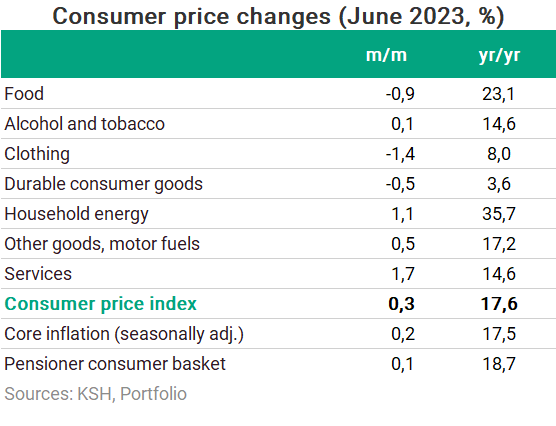
Portfolio's analyst consensus nailed the July annual inflation figure (17.6%) published by the Hungarian Central Statistical Office (KSH) this morning, which was accompanied by a 17.5% annual core inflation figure. The latter also shows a brisk slowdown, as the core inflation figure for June was still 20.8%.

In short, this means that the slowdown in the pace of inflation is indeed becoming more noticeable and
it seems increasingly certain that inflation will fall below the 10% level set as the government's target by the late autumn. In a statement issued in parallel with today's data release, Minister of Economic Development Márton Nagy predicted that this would happen in October.

Among the detailed data published by the KSH for July, these are the main points of interest:
- Over a month, consumer prices rose by 0.3% on average, but there were two main opposite effects. The average price index was dragged down by a 1.4% fall in the price of clothing, a 0.9% fall in the price of food and a 0.5% fall in the price of consumer durables. On the other hand, the average price index was pulled up by a significant increase of 1.7% for services, 1.1% for fuels and a 1.1% jump for household energy, including a 2.9% increase for piped gas. The latter is due to statistical effects, which means that under the new system of overheads cuts that started in August last year, there may have been a number of households in July that exceeded their annual consumption allowance and were billed at a higher price by their energy supplier, pushing up the average price of gas and electricity sold.
- Looking at the details, over a month, foodstuffs have become on average 0.9% cheaper, including eggs 5.0%, milk 4.4%, bread 3.9%, butter and butter cream 3.8%, dairy products 3.4%, seasonal foodstuffs (potatoes, fresh vegetables, fresh domestic and tropical fruit) 2.8%, poultry 2.6%, cheese 2.5%, dry pasta 2.0%, while cold cuts and sausages 1.0% and chocolate and cocoa 0.9% more. Services were 1.7% more expensive on a monthly basis, including 9.6% more for holiday services, 8.5% more for postal services, and 1.4% more for rent.
- Over 12 months, food prices rose by 23.1%, with the most significant increases for eggs (30.7%), dairy products (29.5%), coffee (28.8%), bread (26.7%), pastry products (25.4%) and butter and butter cream (24.2%). Within the product group, the smallest increases were for flour (2.4%) and edible oils (1.5%). Household energy rose by 35.7%, including 47.2% for piped gas, 41.6% for cylinder gas and 26.0% for electricity. Vehicle fuel prices rose by 21.5%. Prices of spirits and tobacco increased on average by 14.6%, including spirits by 19.6%. Services rose by 14.6%, including motorway use, car rental and parking by 25.3%, sports and museum admissions by 21.7%, vehicle repair and maintenance by 21.2%, holiday services by 20.2%, home repair and maintenance by 17.5% and taxis by 16.6%. Durable consumer goods were 3.6% more expensive, of which kitchen and other furniture 12.7%, new cars 9.5%, heating and cooking equipment 11.2%, and room furniture 7.4%. Pet food was 39.7% higher, washing and cleaning products 32.6%, personal care 21.7% and home repair and maintenance 10.2%.
In addition to the above, there is one more piece of good news from the detailed inflation data: the quarterly annualised core inflation indicator has slowed to just 4.4% year-on-year, meaning that the short-base indicator, which tries to capture core exchange rates, is now only showing a more subdued pace of price increases than has been seen since May 2021. The graph below also shows that the headline inflation indicator is starting to slow down, still some way behind, but looking ahead, it also points to the fact that disinflation is only now really starting to pick up in Hungary.

From a Hungarian monetary policy perspective, the above implies that the National Bank of Hungary (MNB) may continue to move ahead with the 100 basis points per month pace of interest rate cuts in the coming months.
In principle, the central bank might even consider accelerating this, as the annual inflation rate could fall below 10% by autumn, while the overnight deposit rate could still be "only" around 13%. Indeed, in its latest interest rate decision, the central bank's leadership sent a message that it would not accelerate the pace of interest rate cuts even as disinflation accelerates, so that higher real interest rates would emerge to support the forint in uncertain times. The recent fall in the forint in recent weeks (and the inflationary impact of the sharp rise in fuel prices) may also remind the central bank that it is worth keeping this vow, so the MNB is expected to remain cautious and stick to its 100 basis points per month rate cut pace.
Cover photo: Shutterstock





