Gaping hole on the Hungarian budget, public debt rising too


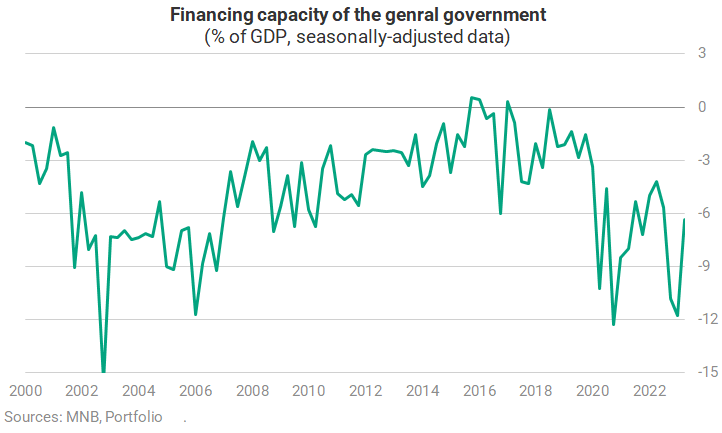
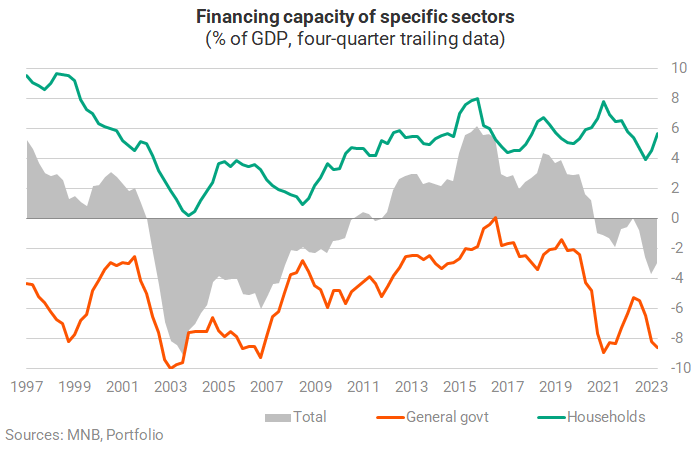
The central bank (MNB) has on Friday released its second quarter financial accounts statistics, confirming what we see in the month-on-month fiscal reports: a huge overspending of public finances. General government net lending was equal to -8.6% (HUF -6032 billion) of Hungary’s GDP in the four quarters leading up to 2023 Q2, one of the largest imbalances historically in the period 2021-2023.

It is cold comfort that seasonally adjusted financing need in the second quarter of this year was "only" 6.4% of GDP. However, the adjective "good" applies only when compared this figure to the crazy spending spree of 11-12% of the previous two quarters. The figure is very high any other way we look at it.
Although the need for accrual-based financing and the cash-flow logic of debt financing are not closely linked in the short term, it is not surprising that, with such a large fiscal imbalance, the decline in public debt has stopped. At the end of 2022, the debt-to-GDP ratio was 73.3%, and at the halfway point of 2023 it was 75%. So even high inflation has not helped enough to reduce the debt ratio.
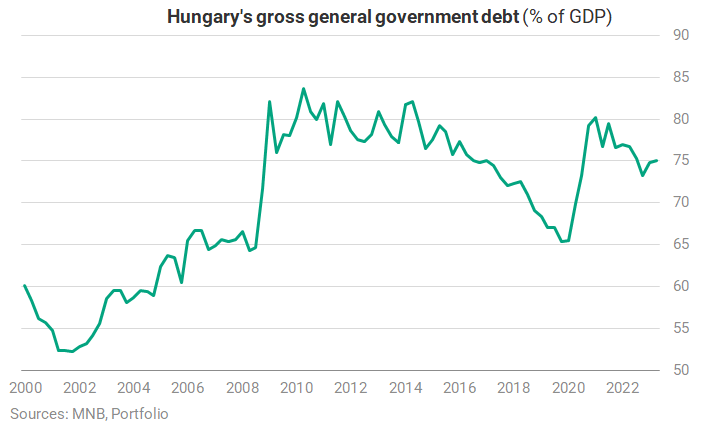
What is encouraging is that the budget deficit figures for the last two months have not been abnormally high. If this turns into an improving trend in the second half of the year, the debt curve could turn downwards again. In any case, it would be a strange "feat" if the declining debt trajectory could not be brought to the end of the year even with an average annual inflation rate of 17-18%.
Household financial accounts also produced extreme figures, but with the opposite sign. Net lending of households was equivalent to 11.2% (HUF 2,034 billion) of quarterly GDP in Q2, and in the four quarters to end-June it amounted to 5.6% of GDP. The main reason is not a sudden surge in savings, but a sharp fall in borrowing. (We will look at the second quarter household characteristics in a separate article later today.)
The combined financing position of the two sectors (general government and households) has thus improved, which can be broadly described as the fact that the financing-increasing impact of the extreme fiscal expansion was fully offset by the collapse in household lending.
This is leading to an improvement in the external balance, as the external financing need of the economy has declined. This effect may have been further reinforced by the third large sector of the economy in recession, the corporate sector, but we will only see this in the detailed statistics in a few weeks' time.
Cover photo: Getty Images





