Gaping hole in Hungarian budget, gov't running short of time to act


Serious slippage in this year's budget
Two weeks ago, we reported that the budget closed with a small deficit in July, but this did not change the overall picture of the 2023 public finances. And the detailed budget figures just published by the Finance Ministry also confirm this.
Looking at the month of July alone, there was no change in the biggest risks:
- VAT receipts fell (to HUF 710 billion from HUF 723 bn last year), the third time this year after February and May,
- excise duty receipts fell by 24% year-on-year for the seventh month this year,
- the state spent HUF 109 billion on the system of overheads reductions in July,
- interest expenditure increased by 15% to HUF 156 billion, while
- without the newly introduced special taxes and the increase in the old ones, there would have been a huge hole in the budget in the previous month.
Based on the detailed data, we can therefore say that our view of this year's budget has not changed in the past 1.5 months, when our analysis concluded that it was only a matter of time before the government revised its 3.9% of GDP deficit target for this year.
If we want to determine whether the data we have received over the past few months have changed the expected state of the budget this year, it is worth taking a schematic approach. We have looked at how the budget has performed in the January-July period for the most important items and how this compares with last year's performance. And any revenue shortfalls or expenditure overshoots have been prorated for the full year if they are determined by the macroeconomic path and are difficult for the government to affect by intervention.
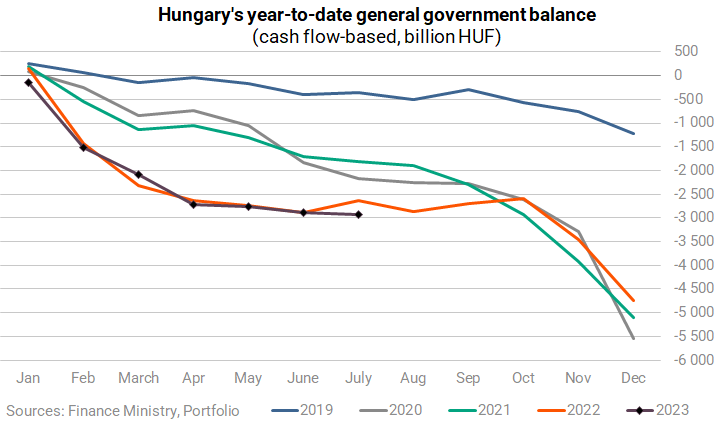
The graph clearly attests that this year, after the first seven months, the budget is in worse overall shape than in years of shocks (Covid, war, energy crisis).
A puzzle of nine pieces
In the framework of this simplified modelling exercise, we have identified nine main factors that will have a significant impact on the performance of the budget this year, and most of them not in a good way:
- VAT receipts,
- excise duties,
- payments from economic actors,
- personal income tax receipts,
- the balance of expenditure related EU programmes,
- the finances of budgetary bodies,
- contributions
- interest expenditure, and
- public asset management.
We estimate that
there could be an annual slippage of around HUF 1,400-1,500 billion in the 2023 budget,
which (assuming a GDP of HUF 80 trillion) would lead to an overshoot of the 3.9% deficit target by 1.8-1.9 percentage points, which would result in a shortfall of 5.7-5.8% this year.
Let's see the details!
Of the nine factors listed, the development of value-added tax receipts remains the most important. In seven months, VAT receipts amounted to HUF 4,038 billion, which is only 1.5% higher than the cumulative VAT receipts for the first seven months of 2022, while the cumulative inflation for the first seven months of this year was 22.8%. Something is therefore very wrong here, which is worrying because almost one in three forints of the central budget comes from VAT receipts. Even analysts are often baffled by what is happening, but basically three possible explanations (and a combination of them) seem plausible:
- Inflation has been so high in recent months that it has eaten into earnings growth, with household spending falling sharply.
- In such a recessionary environment, the rate and likelihood of income concealment in certain services increases, meaning that the successful economic whitening that has been going on for many years may not only have stalled, but may have reversed (a macro assumption confirmed by some micro news, such as tax authority raids of catering units at Lake Balaton and Lake Velence).
- An unusually large amount of money has been paid out of the budget in VAT refunds, with the amount transferred exceeding the January-July print of 2022 by 30%, or HUF 783 billion in nominal terms. The Ministry of Finance did not provide any details on this, stating only that "higher payments from intermediate sectors contributed to the increase in transfers". We contacted the ministry three weeks ago about the reasons behind the increase in allocations, but have not yet received a reply to our questions.
The impact of lower consumption is also being felt in excise tax revenues, where we estimate that a shortfall of over HUF 100 billion has already been recorded in the first seven months of this year, so it is possible that if trends continue at this rate, this revenue slippage will amount to HUF 180 billion.
A negative trend is starting to prevail also in terms of contribution receipts, as we estimate that there could be an annual shortfall of close to HUF 200 billion in this line.
It is also a disappointing development that the government cannot expect personal income tax revenues to save the budget either, as they are performing similarly to how they fared last year.
In the case of interest expenditure, we are already talking about a HUF 420 billion surge in the first seven months, and if this continues, the annual expenditure growth could be over HUF 700 billion.
But equally damaging for this year's budget is the fact that revenues for public assets are below target, while expenditure is significantly overrun. Therefore, we calculate that this item could worsen this year's balance by up to HUF 350 billion (we have assumed that this will not deteriorate further over the rest of the year on a time-proportional basis, which is a reasonable assumption).
And if we net out the revenues and expenditures of the budget agencies this year, we also find that there is a slippage of HUF 200 billion in the budget. We have assumed that there will be no further deterioration in public finances in this area, which raises questions about how sustainable it is.
There are two items, however, that somewhat offset the fiscal slippage, but we need to stress that this works only on a cash-flow basis. First, the balance of expenditure and revenue related to EU programmes. For EU spending, the government has already achieved savings of HUF 956 billion on a pro-rata basis in seven months, while revenues are moderately worse than they should be, so overall we can assume a balance improvement of around HUF 800 billion.
In addition, contributions from economic operators will also make a significant contribution to this year's budget, which is not surprising in the light of tax hikes, the raise to sectoral and windfall taxes. On this line, we could see an outperformance of some HUF 250 billion.
Overall, the government is not in an easy position. The latest worse-than-expected GDP growth data indicate a protracted recession, which would make a government intervention and stimulus logical, but the above budgetary determinants show that the cabinet has no room for manoeuvre, as the government's fiscal performance is much worse than expected.
This is partly due to the fact that the revised budget for 2023 still projected GPD growth of 1.5%, but in our latest analysis we pointed out that this is out of the question and that a mild recession could well occur this year.
There are, of course, external reasons for the worse-than-expected Q2 GDP print, as well as explanations relating to Hungary's exposure to imported energy, but there are also domestic factors, such as the persistence of inflation which remains the highest in the EU, the fiscal tightening stance (special taxes, spending cuts, investment deferrals, other tax hikes), and the complete disappearance of fiscal elbowroom, which in turn raises the responsibility of economic policy.
Such a situation can best be described as a vicious trap, because a series of fiscal adjustments and cuts hurt growth, and worse growth affects the fiscal position and the process starts all over again.
Cover photo: Getty Images





