Solving the inflation mystery: are prices not rising so much in Hungary anymore?


Who remembers how much this or that cost this time last year? We're not taking a big risk if we say that off the top of our heads, almost nobody. The most people remember is how much they spent on utilities in recent months, how much they left in the cash register during their last grocery shopping trip, or how much they paid at the hairdresser's last time. So many prices are not easy to remember, so even answering these questions can certainly be a problem. And it is virtually impossible to work out how much a product or service has gone up in price compared to the same period last year.
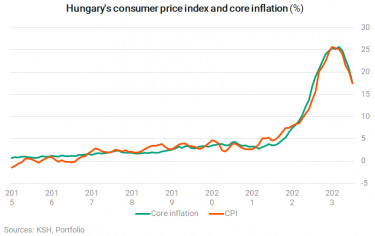
However, the inflation (headline) figure is always about how much prices have risen in a year. Public sentiment is also determined by whether inflation is 25%, 20% or even 17.6% (which is the latest figure for July). Much of the fall in inflation we have seen in recent months has been because by the second half of last year, a very significant rise in prices had already occurred.
Price increases in Hungary last year were driven by a surge in global inflation (recovery from Covid) and other factors. For example, the electoral distributions in the first few months of the year (e.g. gun money, 13th month pension, refund of personal income tax for those raising children) generated significant demand from the population. This was followed by fiscal measures, sectoral special taxes that further increased inflation: the biggest price-raising impact was the taxation of the Fast-Moving Consumer Goods (FMCG) sector. In addition, the forint depreciated sharply, making imports more expensive. In Hungary, the items that have become more expensive globally (e.g. food and energy) account for a larger share of the consumer basket than in developed countries.

The above shocks really began to have an impact in the second half of 2022, when prices started to rise significantly. In some months, monthly price rises were in the range of 2-4%, so the period of strong demand was when inflationary pressures were very strong, and when most of the high prices we still see today were formed. It is no longer easy to carry out further significant repricing relative to the prices then, especially in a period of falling real wages and declining retail sales.
The graph below illustrates the evolution of domestic inflation and price levels through a simple example. If we assume that last January we were living on HUF 100,000 - and buying from the KSH consumer basket - our expenditure increased by more than HUF 25,000 in a year. By the end of the first half of this year, however, we only had to increase our budget by less than HUF 4000 compared to the end of last year. And yet the horrendous inflation figures (between 20% and 25%) came at the beginning of this year, and the average inflation rate for the first half of this year (22.8%) was much higher than the average for the same period last year (14.5%). Yet the price level has barely risen month on month.
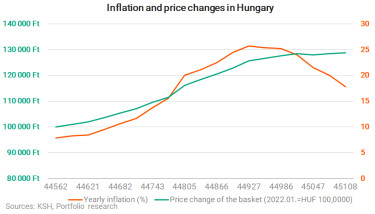
This is because, after rapid price increases in the second half of last year, inflation in January this year shows a significant jump from a very low base (at the start of the inflation explosion). This year's March inflation, on the other hand, compares to a higher price level, while June inflation compares to a very high price level. Thus, as we move forward in time, the year-on-year price increase is not so bad compared to the higher base (price level), or rather it is steadily decreasing. After all, it is no surprise that since March this year (while annual inflation has now fallen from 25% to below 18%), the amount we have to spend on the basket of products that cost HUF 100,000 at the beginning of 2022 is practically between HUF 128,000 and HUF 129,000.
So while inflation has come down by 7% points in six months, the nominal (i.e. in HUF) amount has barely changed since March, as monthly repricing has been tamed.
In 2022, the month-to-month repricing was much more significant than this year. In fact, there have already been months this year when prices have fallen.
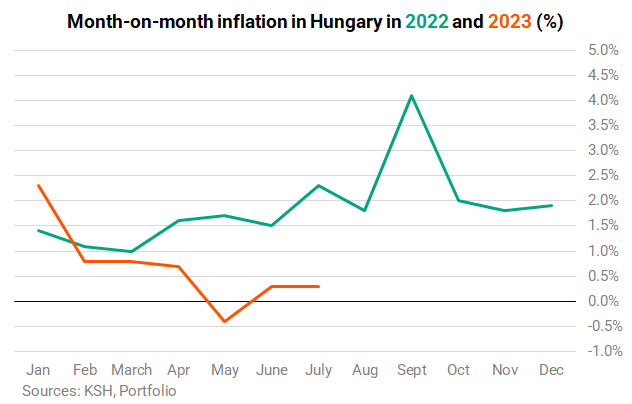
It is important to note that all this will only slow down the rise in price levels. As long as monthly inflation is positive, the average price level will rise, but nowhere near as much as last year. (Behind the average, there will of course be price falls and price rises for individual products.) Although May was a lucky month (when prices fell on a monthly basis), no one should expect prices to return to pre-2022 levels, as prices are inelastic on the downside (as are wages). There may still be lucky months like May, of course, but this is the exception rather than the trend. The optimistic scenario is that current prices will continue to rise only slightly, at a slightly lower rate than wages, i.e. real wage growth will turn positive again towards the end of the year after a long period of falling months.
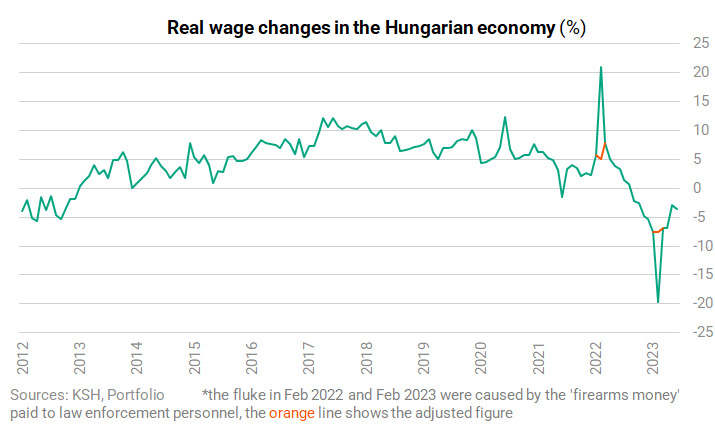
To summarise the above: the annual index is somewhat misleading for ordinary people, and it can also be said to track inflation with a slight lag. The annual index is high as long as the low prices of early last year are the base. However, the moment the period of price shocks (rapid and significant price increases) becomes the basis for comparison, the annual index also declines. We have seen this process in recent months.
To get a sense of current price pressures, however, we start with monthly inflation; and since this is already much lower than last year, we can be confident that the annual index will soon be in the single digits. One might ask why we do not expect price pressures to pick up in the second half of this year. It is because the price shocks seen in the second half of last year are not present. Consumption is down sharply on an annual basis, energy prices have collapsed, the forint is still strengthening somewhat compared to last year, global inflationary pressures have eased, and fiscal and monetary policy is tight. If an unforeseen shock does occur (which is now very unlikely), it is likely to feed through to prices over several months, with only four and a half months left of this year. So that would presumably only pull up next year's inflation figures. One such risk is the rise in fuel prices, but here again it should be seen that a significant jump in prices does not happen overnight.
Finally, let's look at a cautious estimate of what price levels we might see in a period of single-digit inflation (at the end of the year). For now, we present only the most realistic scenario, where average monthly price pressures in the second half of the year are 0.5% (a slowdown from the 0.7% average of the previous half-year), of which the July figure is already known, 0.3%, below our estimate; however, monthly price pressures are typically lower in summer, so the 0.5% average for the second half of the year cannot be discounted yet, but it is no longer an optimistic scenario either.
If average monthly inflation averages 0.5% in the second half of the year, annual inflation will be 7.7% by December, which is how much more we would pay for our consumer basket in December this year than at the end of 2022. This would mean that
a basket of products that cost HUF 100,000 in January last year and HUF 128,000 in the middle of this year would cost HUF 132,000 in December.
The graph below shows that the repricing is no longer as significant. We would like to stress again that this is not the optimistic scenario, some analysts and the government expect a slightly weaker price pressure in the second half of the year, and if this is the case, the basket of goods will continue to increase at a lower rate. But the difference will only be a few thousand forints at most compared to today's level, not tens of thousands of forints as we saw at the end of last year compared to the middle of this year.
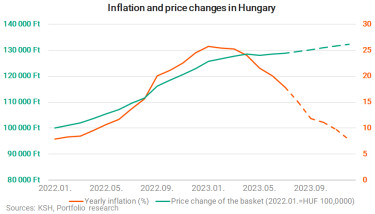
Overall, inflation was below 15% on average last year, and the bulk of the HUF 100,000 increase in our initial costs, around HUF 25,000, was left behind by the end of last year. Although average annual inflation is expected to be between 17-19% this year, our further cost increase in HUF (compared to the end of 2022) will be only around HUF 7,000 by the end of 2023 as a whole.
This also means that this Christmas will not be as difficult as last year's, given that wages are also rising by double digits. While last December we had to pay almost 25% more than a year earlier, this Christmas we can expect to see only a modest increase in the cost of living, after two years of a total increase of around 32% in the price index. In other words, inflation will collapse on its own because of the high price level last year, the result of the base effect, and our cost increases this year will be a fraction of last year's.
Cover photo: Brand New Images via Getty Images





