Hungarian passenger car market under pressure


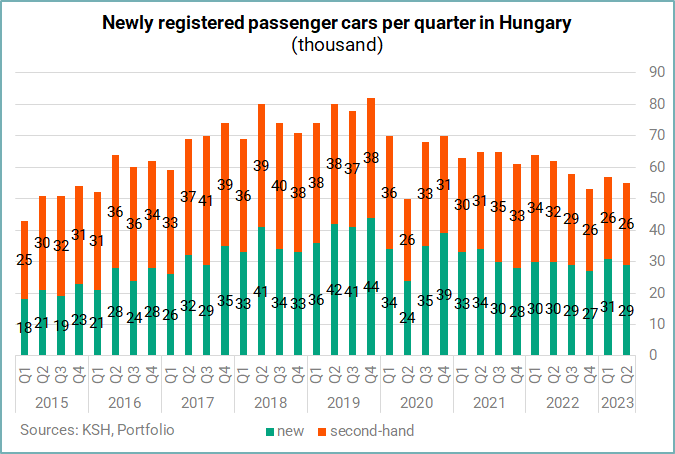
The number of passenger cars registered for the first time in Hungary totalled 55,000 in the second quarter, which
marks a 12% decline in annual terms.
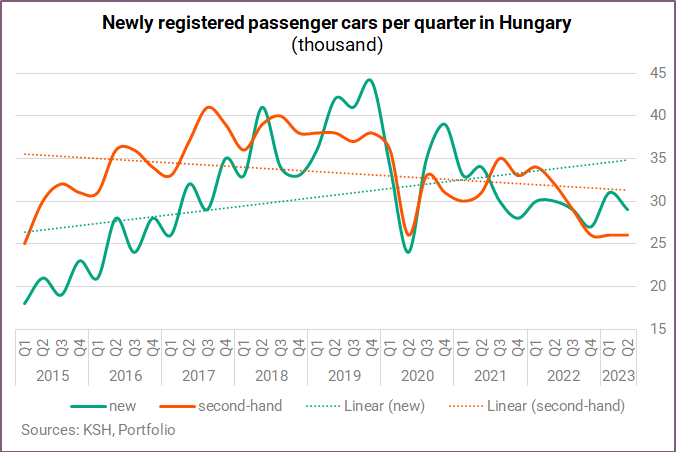
This is the continuation of a downward trend that has been in place for several years. The current decline can be explained by tightening demand caused by a steep rise in consumer prices which dampens demand and consumption and by higher credit costs.
the number of new passenger cars put into circulation for the first time dropped 2.0% yr/yr, while the decline at second-hand vehicles was 21.0%.
The number of electric cars placed on the market (2,700) was 7.8% lower than a year earlier (7 thousands of the 2022 year-end stock).
On 30 June 2023, 5.0 million motor vehicles were in circulation in Hungary, of which 4.1 million were passenger cars. The average age of vehicles continued to rise, by 0.2 years to 15.5 years.
Meanwhile, it is also worth noting that just today ACEA released its European car market statistics, which show that the number of new passenger cars registered in July jumped by 15.2% year-on-year to 851,156, after an annual increase of 17.8% in June. The number of new cars registered in the European Union rose for the twelfth month in a row.
According to ACEA data, 64,907 new cars were registered in Hungary in the first seven months of this year, 2.2% fewer than the 66,361 registered a year earlier. Of these, 3,274 battery electric vehicles (BEVs) were registered, up 25.3%, 3,298 plug-in hybrids (PHEV), up 18.3%, 25,298 hybrid electric vehicles (HEVs), up 2.5%, 24,562 petrol cars, down 9.2% and 8,065 diesel cars, down 6.3%.
Cover photo: Shutterstock





