Hungarian household loans cross a 'magic line', banks leak funds


According to the latest credit market statistics, 4,497 Hungarian households signed housing loan contracts worth HUF 50 billion in July 2023. The amount is down 45% and the number of loans 41% compared to July 2022. The other types of credit performed better, with personal loans, for example, up 5% in terms of amount and 14% in terms of number of contracts signed compared to a year earlier. However, the market for baby loans fell by roughly a third.
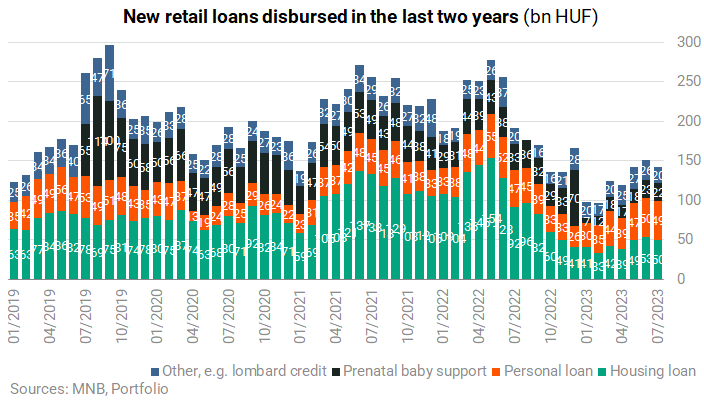
Pressure on the retail lending market appears to have eased. At least the yr/yr decline in July was smaller than the year-to-date drop, and personal loans even show a steady increase. At the same time, lending was already in decline in the second half of last year, meaning that we are increasingly comparing the recent figures with a lower base last year.
| Change in new retail lending compared to the same period of the previous year | |||||
| Housing loan | Personal loan | Baby Loan | Other | Total | |
| 2023 YTD (cumulated) | -64,6% | -7,0% | -54,4% | -7,8% | -45,7% |
| July 2023 | -45,2% | 5,0% | -32,5% | 0,6% | -26,0% |
| Sources: MNB, Portfolio | |||||
It would be premature to say that the fall in lending rates has brought a boom to the retail credit market. For example, average contracted interest rates for market-rate housing loans peaked in April (8.84%), and were only slightly lower in July (8.61%).
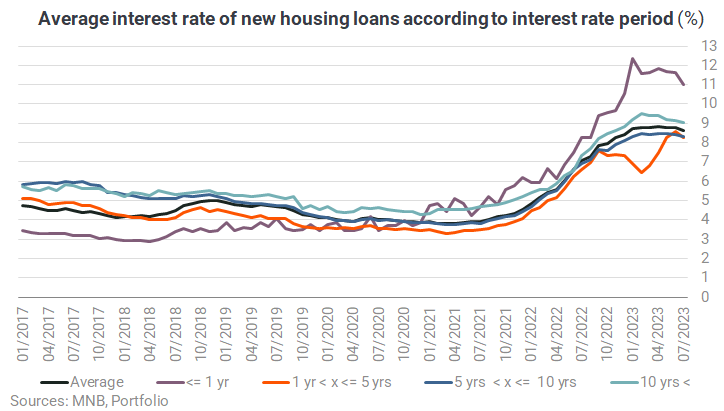
In the second half of the year, the fall in interest rates is unlikely to provide a strong boost to housing lending, as banks have recently been offering housing loans at an inherently low spread compared to benchmarks.
It is possible that a correction in mark-ups will come first, and only later will there be a reduction in interest rates on loans that will already be more noticeable for borrowers. That said, the phasing out of the "urban" CSOK (family housing support programme) on 31 December could bring forward demand and some recovery in the housing loan market in the autumn. We do not see a sharp fall in interest rates even at personal loans: their APR remains at a peak of 19.5%.

Overall, household bank debt is increasing despite the fall in lending. Net borrowing (i.e. borrowing minus repayments) was negative only in January and February. This is the first time that banks' household loan portfolio has exceeded HUF 10,000 billion, but this represents an increase of only 4.3% over a year. Housing loans grew by only 2.3%.

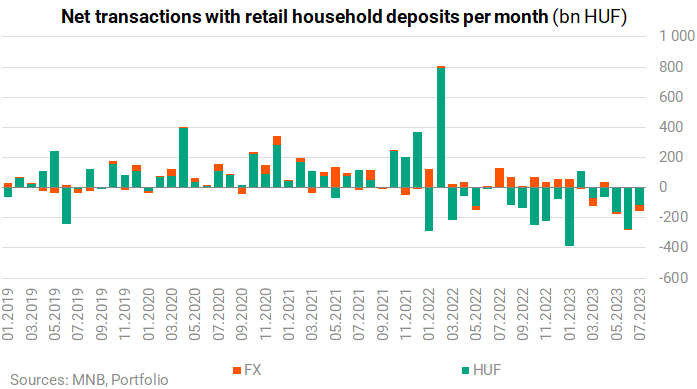
Meanwhile, deposits have been in decline for a long time, and savings have been shifting towards government securities and investment funds. We wrote about this in detail here. In July, for example, the value of net transactions was HUF -154 billion, which is how much more households withdrew from deposits (including both demand and time deposits) than they placed.
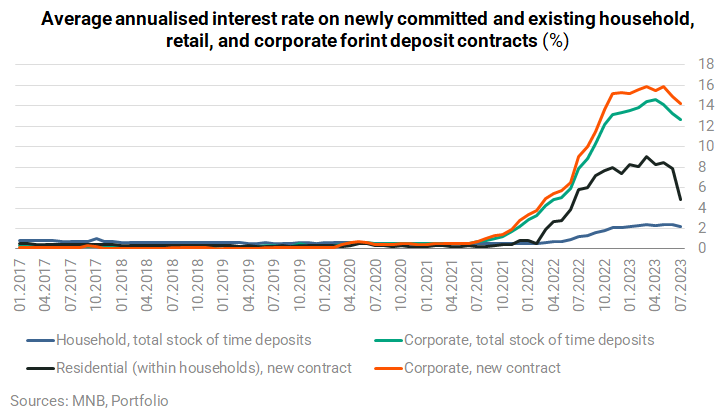
Banks now pay an annualised interest rate of just 2.23% on an average retail time deposit, and 4.87% on new contracts. Both show a downward trend: banks have immediately started to apply the lower interest rate environment to deposits.
The stock of household deposits shrank 12.4% in annual terms, with 80% of the HUF 11,777 bn stock being demand deposits.
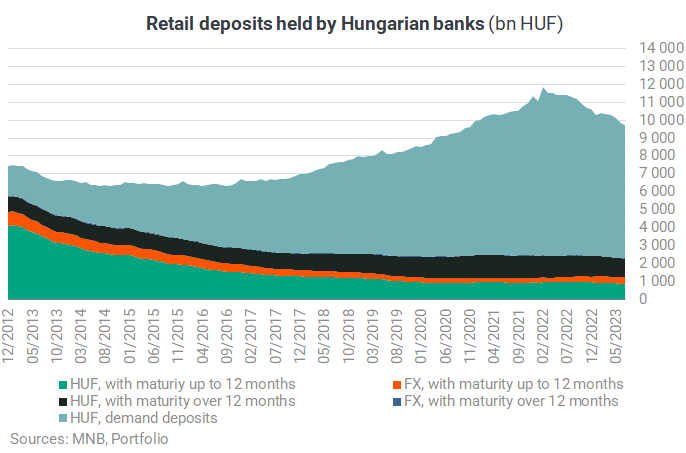
Meanwhile, corporates' deposits are also falling, but by a much smaller amount: by 0.3% over the past year. In the chart below, we have summarised the stocks of loans and deposits for households and corporates. Lending is slowing down and deposits are falling in both banking businesses.
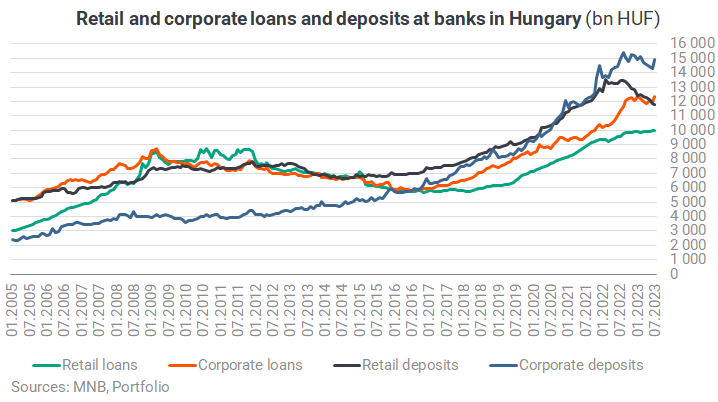
Although the Baross Gábor Loan Programme and the Széchenyi Card are providing support for corporate lending, net transactions are not as strong as before due to the high market interest rate environment and the decline in investment.
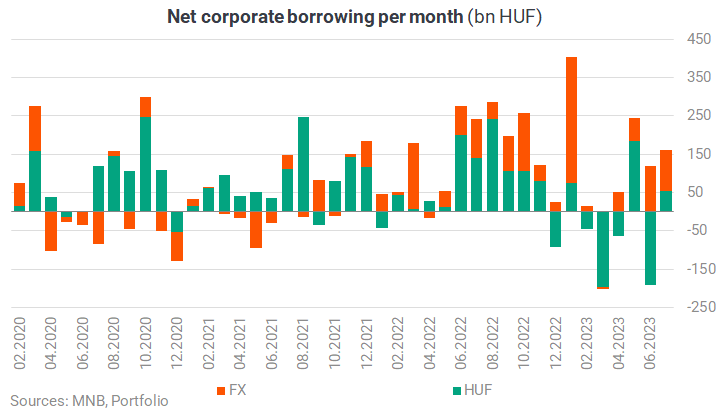
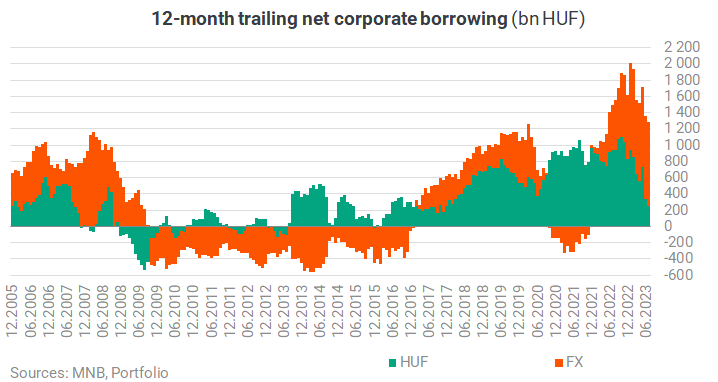
Even so, in the past year, companies borrowed HUF 1,282 billion more than they repaid, and their overall loan portfolio grew by 9.0%. Since December, the growth rate has been only 2.5%, so a significant slowdown is also visible this year.
Cover photo: Daniel Kadar via Getty Images





