Hungarians can expect driving to be a costlier endeavour from January 2024

Inflation in Hungary fell further to 16.4% yr/yr in August from 17.6% in July, the KSH reported today. The last time we saw a lower headline figure was in June last year. However, analysts were expecting a slightly bigger drop, with a median forecast of 16.2% and the highest estimate at 16.5%, i.e.
THE ACTUAL DATA WAS VERY CLOSE TO THE TOP OF THE FORECAST RANGE.
While the moderation is good news, it is not so peachy that under current regulations the price of e-vignettes will be raised by the rate of the August CPI. The differentiated price hike in 2023 might be repeated, though.
The government is exceptionally well when it comes to e-vignette revenues, as we have just reported:
Here's how e-vignette prices changed this year.

In June this year, the government announced that it would introduce the one-day motorway sticker by 25 March 2024. The Ministry of Construction and Transport said the deadline was set by the Eurovignette Directive of the European Parliament and the Council, but "at the moment, no decision has been taken on the price of the one-day travel pass or the exact date of its introduction in Hungary."
"If user charges are applied in respect of passenger cars, the use of the infrastructure shall be made available at least for the following periods: a day, a week or 10 days or both, a month or two months or both, and a year. The two-monthly rate shall not exceed 30% of the annual rate, the monthly rate shall not exceed 19% of the annual rate, the 10-day rate shall not exceed 12% of the annual rate, the weekly rate shall not exceed 11 % of the annual rate and the daily rate shall not exceed 9% of the annual rate," the Eurovignette Directive stipulates.
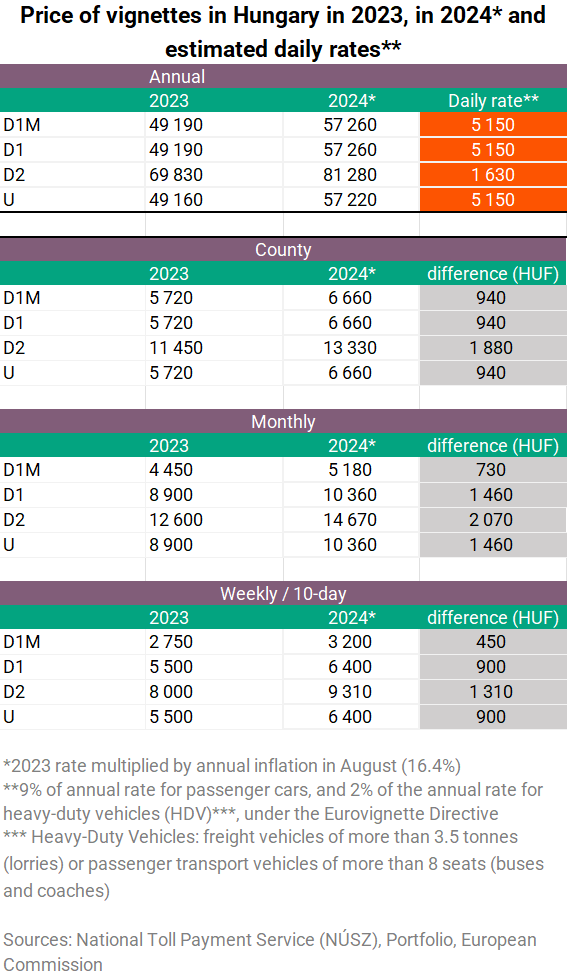
Calculating with the 16.4% yr/yr inflation in August, the annual rate in Hungary could be HUF 57,260 in 2024, which would put a HUF 5,150 price tag on the one-day sticker, but of course this is not set in stone.
From 1 February, buses will no longer be able to buy motorway stickers. They will be subject to the kilometre-based, pay-per-use toll rules for lorries, in line with an EU directive. They will have to pay more for using motorways, and have to pay for roads (e.g. expressways, trunk roads) in proportion to the distance travelled. If you thought sending your kid to a camp or an excursion with their school was expensive, think again!
At the end of August, autopalyamatrica.hu has made a couple of calculations to see how the cost of bus rides would change. The examples used were the Budapest-Miskolc (187 km) and the Budapest-Siófok (109 km) routes. On this basis, if someone was to travel by bus to Miskolc 10 times (both ways), they are paying
- HUF 17,730 (10-day sticker) this year but
- HUF 292,935 in 2024.
In the same way, if we consider Siófok, it costs
- HUF 17,730 this year and it will cost
- HUF 170,485 in 2024.
If we look at the same routes for 30 days and 30 round trips to Miskolc will cost HUF 878,806 instead of HUF 25,150 (monthly sticker), a 3500% increase, and to Siófok HUF 512,245 instead of 25.150, a 2000% increase.
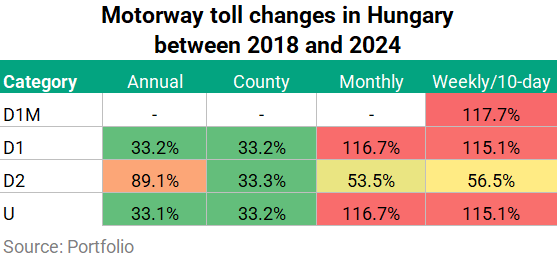
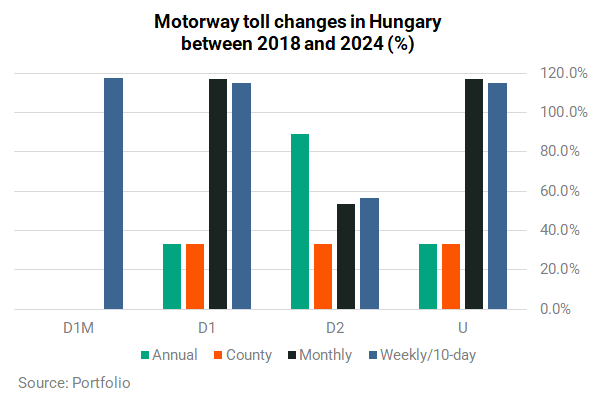
The price of the annual e-vignette for buses was raised 14.4% between 2018 and 2023, while the price went up 14.5% for the county, 14.4% for the monthly and 32.5% for the weekly/10-day passes.
Should the rates be raised by exactly the Aug CPI, and the price of the one-day sticker was to be set to the maximum allowed by EU rules, we'll find the following e-vignette prices in Hungary next year:
It is also clear from the table below which category of vehicles and passes the government favours when it comes to raising toll revenues.
Painful fuel prices
And that's only one of the headaches for motorists in Hungary. The other one is an upcoming excise tax hike on fuel.
The government's decision to raise the excise duty on fuel will lead to a total gross increase of HUF 41 per litre from 1 January, which - if current forecasts are correct - could push the price of a litre above the unprecedented HUF 700 mark for private consumers.
We have explained why this excise tax hike is so peculiar here.
In Hungary, the price of petrol has never been above HUF 700, and a litre of diesel was only this expensive for a month at the beginning of 2023, when the price cap was abolished. On a market basis, the price of fuel could have been much higher, but then the price freeze was implemented. The graph below shows the price evolution without the price freeze:

Even if we assume the unlikely event that fuel prices will not change at all until next year, the price of 95-octane petrol will jump from HUF 643 currently to HUF 684 and a litre of diesel will cost HUF 692 instead of the current HUF 651 as of 1 January 2024.
That alone corresponds to a 6.3% hike, but the picture is a lot worse when we compare the hypothetical new fuel prices to prices on two key dates, 12 May (the lowest point this year), and 30 June, after which prices started to climb.
ASSUMING A 50-LITRE TOP-UP MOTORISTS HAVE TO PAY HUF 5,600 AND HUF 6,400 MORE FOR PETROL AT THE PUMPS THAN ON 30 JUNE AND 12 MAY, RESPECTIVELY, WHILE THEIR DIESEL BILLS will be HUF 6,550 AND HUF 7,500 higher.

We have also drawn up a couple of scenarios depending on the type of fuel used, the consumption of the vehicle and the length of driving per month, and compared current prices with those on the key dates mentioned above. The top table is for petrol-fuelled cars and the bottom is for diesel-fuelled cars and the prices are in forints.

Cover photo: Getty Images





