How close was Hungary to sovereign default last year?


How close was Hungary to default last year?
It was a year ago, at the end of September, when the Monetary Council of the National Bank of Hungary (MNB) announced the end of its rate hike cycle at a 13% base rate. However, the international environment was not supportive, and the forint reacted to the move by weakening sharply in the following weeks, with the euro rising to 435 by mid-October. Then the central bank had to intervene, with Deputy Governor Barnabás Virág announcing an extraordinary 500-basis-point rate hike in a video, after the International Monetary Fund (IMF) general meeting in Washington.
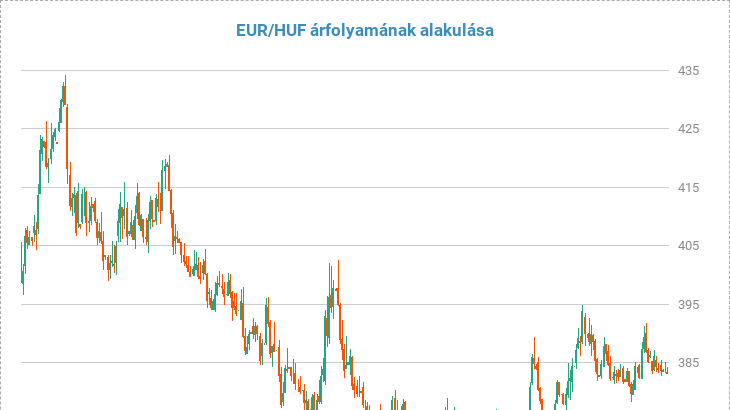
Although the base rate remained unchanged, it lost its practical relevance, as the daily deposit rate became the benchmark at 18.0%. The MNB then started to gradually reduce the one-day depo rate in May this year, and it is expected to merge with the base rate again next Tuesday at 13.0%.

Since then, few people have put the spotlight on the events of last autumn, and now, with the passage of time, it is perhaps possible to look back more boldly on the period when the collapse of world gas prices and the uncontrolled depreciation of the forint pushed Hungary to the brink of the abyss.
But how deep was the abyss into which we almost fell? This question was also discussed in a panel discussion on the occasion of the 61st Itinerant Conference of Economists, published today on the MKT's Youtube channel.
Quite frankly, objectively speaking, we were close to an exchange rate crisis in the autumn of 2022, the indicators monitored at times like that have deteriorated,
underlined in the panel discussion Zsolt Kuti, Executive Director for Monetary Policy, Financial Analysis and Statistics in the central bank (MNB). He added that such a situation could spill over into the government bond market, meaning that we were not in the immediate vicinity of a sovereign default, but one can wonder what would have happened if the central bank had not raised interest rates by 500 basis points.
The topic came up in the discussion because Csaba Lentner recently told Válasz Online that "at the end of last year, at the beginning of this year, we managed to avoid sovereign default."
The economist argued at the time that, in addition to the lack of EU cohesion and recovery funds, resources were scarce to cover maturing public debt and deficit financing, and our friends in the Far East and Arab countries came to our rescue. In this context, the participants of the panel discussion painted a much brighter picture, saying that by then the financing environment had improved due to the fall in energy prices and that the state's liquid reserves were always sufficient.
According to Viktor Zsiday, it is primarily a matter of credibility, and the exchange rate crisis and sovereign debt are also matters of such trust. According to the portfolio manager at Citadella Fund, the Hungarian economy has suffered a deterioration in the terms of trade that would have been very difficult to manage from an exchange rate and debt stance if it had persisted for 2-3 years. In the meantime, concerns about the government's relationship with the EU have come to the fore, and the combination of the two were squeezing the economy.
In such a situation, the market can be calm for a long time and then suddenly lose confidence, and
I think investors were close to "losing it", which the central bank was able to handle in the first place.
The year 2022 was a difficult one for bond investors worldwide, as interest rate hikes caused significant losses for all bondholders. From a Hungarian perspective, this was compounded by the massive redemption of MÁP+ [Hungarian Government Security Plus] and a higher-than-planned budget deficit, but
there was never a situation in 2022 where the Hungarian government had liquidity problems,
added Zoltán Kurali, Chief Executive of the Government Debt Management Agency (ÁKK).
MNB vs. gov't bout did not help
After the emergency rate hike, the government and the central bank have repeatedly made rules in recent months with apparently contradictory objectives. While the MNB's aim was to ensure that monetary transmission was as strong as possible and that higher interest rates were applied to all sub-markets, the government seemed to be concerned about the negative impact of high rates on economic growth and sought to dampen this impact.
It did not help that monetary policy and regulatory policy were in battle with each other, the effectiveness of transmission was critical,
underlined Zsolt Kuti. According to him, the market has adapted quickly to these regulatory tightenings, so there was no point in regulatory efforts to weaken the guideline character of monetary policy.
However, in the swaps market, for example, yields have closed up much more slowly than would have been justified or desirable. It is now clear that growth has stalled because of a surge in inflation, so the key issue was not whether growth or inflation took priority. The central bank had previously said that inflation had to be brought down, and this became a key objective for the state at some point, the central bank economist stressed.
Is there a chance to completely wipe out foreign currency debt?
In addition to the assessment of the situation last autumn, the discussion focused on the current challenges of debt management. According to Zsolt Kuti, the long-term goal should be for Hungary to have no foreign currency debt at all, as the Czechs in the region have already achieved. In the current situation, the lack of EU funds and the rising cost of financing in forint mean that there's a diversification need, but eliminating the risks arising from foreign exchange [debt] would be ideal.

Viktor Zsiday agreed with this, saying that the aim is to "minimise stress", and that the best thing for the country is for the population to finance its debt in its own currency, with the longest possible maturity. The question is whether we can do this, which would require some kind of foreign currency inflow, such as EU funds.
If the budget deficit can be reduced to around 3% of GDP in the coming years, it can be financed from the forint market, based on past experience, Zoltán Kurali said. In the long run, he said, the government bond market can only attract a third of the 6% household savings rate, which means that the public can only be relied on below a 2% of GDP deficit.
Even then, it is important to maintain a market presence for a while because of currency fluctuations. For Hungarian debt to be financed entirely from the domestic market, the ÁKK CEO said, two things would be needed: a significantly lower debt ratio of around 50% and a lower budget deficit.
Serious changes could also come to retail instruments
High inflation and interest rates have also caused major changes in the retail government bond market, as investors have typically shifted from fixed-rate MÁP+ to inflation-tracking PMÁP (Premium Hungarian Government Security) and discount Treasury bills. This does not mean, of course, that the former bestseller will disappear from the market forever.
When we reprice the MÁP+ in the future, there will be very strong sales barriers to reduce the risks. This pricing can happen when the yield curve is no longer so inverted,
highlighted Zoltán Kurali.
We have some interesting data on the MÁP+, which shows that there was almost no reduction in the first nine wealth deciles last year, but a sharp reduction in the tenth decile. On the one hand, they are the most mobile, they were the most affected by the purchasing constraint, they started to re-weight towards treasury bills and then foreign assets, added Zsolt Kuti.
The Managing Director of the MNB admitted that the central bank had to act quickly in October because euroisation was also clearly visible in household savings, with the third quarter of 2022 being the only quarter in the past 30 years when there was no net increase in forint savings. This demanded an extremely rapid response, because the euro exchange rate above 430 made everyone think about looking abroad.
For us, the run-up in retail government bonds was like starting a 100-metre dash from 30 metres behind the start line, said Viktor Zsiday, pointing to the perspective of fund managers. This disadvantage, he believes, will probably persist, albeit to a lesser extent, in the coming years.
At the end of the discussion, Zoltán Kurali stressed that in the coming years we need to return to the path of reducing the debt ratio and the budget deficit, which will ensure that Hungarian debt is financed more and more domestically.
You must do your homework and bring back temperance in the coming years, without it you cannot pass the exam,
stated the CEO of the ÁKK.
Cover photo: Getty Images





