Hungary mulls bank tax hike, revision of interest-subsidised loans


Shocking news for the banks and the credit market
Although the government is reluctant to use such a tool, it may consider raising taxes on banks if they make significant profits (which could exceed HUF 1,000 billion this year - editor's note), in order to improve the situation of public finances, said Finance Minister Mihály Varga in his presentation at the annual meeting of the Hungarian Economic Association (HEA or MKT) in Eger, northern Hungary, on Thursday.
Last year, the deficit was around 6% of GDP. The government is sticking to the 2.9% deficit next year, so in addition to the changes mentioned above, the government may even stop ongoing investments if the fiscal situation so requires, Mihály Varga said.
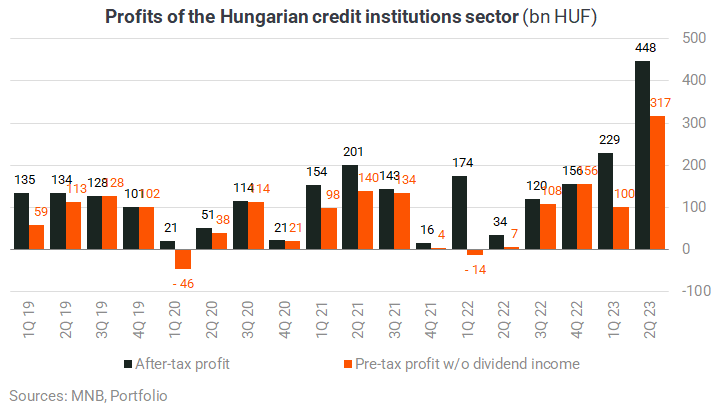
The Hungarian banking sector closed the first half of the year with a record combined after-tax profit of HUF 676 billion, and there is a good chance that the HUF 1,000 billion mark will be exceeded in 2023 as a whole, which means record profits and thus increased burden-bearing capacity.
However, two-thirds of the increase in profits is due to higher central bank interest rates, which have already started to fall, so the record profits are temporary.
The banking sector has already accounted for HUF 76.6 billion in "traditional" bank tax liabilities and HUF 208.4 billion in windfall tax ('extra profit tax') liabilities for the year as a whole, to which the HUF 58.1 billion burden of the extension of the interest rate freeze until the end of the year will contribute.
The government has so far promised to roughly halve the extra profit tax in 2024 if banks significantly increase their holdings of government bonds, which has been a real possibility so far. The question is to what extent this promise, already included in a regulation, would be overridden by the government's latest tax idea.
A further tax burden would certainly not help banks to increase their credit supply at a time when economic policy wants to see the credit market recover as quickly as possible.

In addition, Mihály Varga said that interest-subsidised loan schemes may also be reviewed, citing the significant gap between market and subsidised interest rates. It was not clear whether he was referring to the Széchenyi Card Programme, which currently runs at 5%, the 3% interest rate CSOK loan (family housing subsidy) or the 0% pre-natal Baby Loan. The HUF 1,000 billion budget of the Baross Gábor loan programme, which was also available in the spring and subsidised with interest rates, has been essentially exhausted by now.
A good part of the interest subsidies that the government is now paying are interest subsidies for loans granted in previous years or even decades, so they are unlikely to be reduced or abolished, as this would mean overwriting loan contracts and radically increasing the repayment burden for the retail and SME customers concerned.
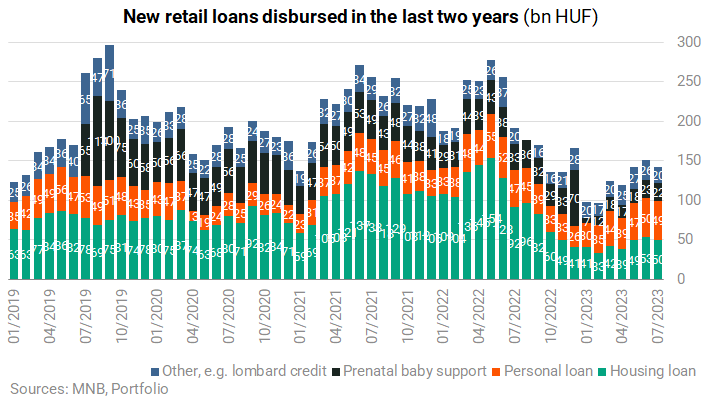
Instead, the decision would probably affect subsidised loans that will be granted in the future, which would be negative news for the credit market, both on the corporate and retail side. Indeed, on the corporate side, almost half (two thirds for SMEs) of all lending in recent times has been subsidised loans, and on the retail side roughly one fifth to one quarter.
Fiscal considerations
We have been writing for months that this year's budget is not sustainable. In our latest calculations, we showed that the slippage could be as much as HUF 1600-1800 billion, even compared to the amendments passed in March.
That is why we also anticipated months ago that the government would have to act, with adjustment measures and/or a revision of the deficit target. We also said at the time that, as the government was running out of time, the most it could do was to resort to raising special taxes and implement one-off spending cuts, in addition to raising the deficit target for 2023.
Based on Mihály Varga's statement, we can say that the scenario predicted by Portfolio earlier may materialise: the government may further tighten the special tax squeeze and implement one-off spending cuts. We are curious to see whether the government will raise this year's deficit target of 3.9%.
It is also worth pointing out that the government resorting to special taxes is a step backwards from the process of removing this type of extra burden. It is perhaps less of a surprise that Mihály Varga has committed to a deficit target of 2.9% next year, even though there are also tensions in the 2024 budget.
This will pose challenges, as constantly putting off spending does not represent a lasting deficit reduction, so it will not help the bottom line of next year's budget. We are therefore curious to see how today's announcement on the 2023 budget will affect next year and, within that, what the government plans to do with extra profit taxes for next year, as it is known that their phasing out or reduction will only start in 2024. The last time the government promised a full phasing out of extra profit taxes was from 2025. It could well be that this phasing-out or reduction plan will now be overruled if the government's intention to raise taxes is maintained in the current fiscal emergency.
Cover photo: Ministry of Finance





